

Quick Facts
→ Agentic AI is transforming supply chain and logistics by enabling autonomous, multi-step operational intelligence across freight, customs, transport, warehousing, ESG compliance, and customer data.
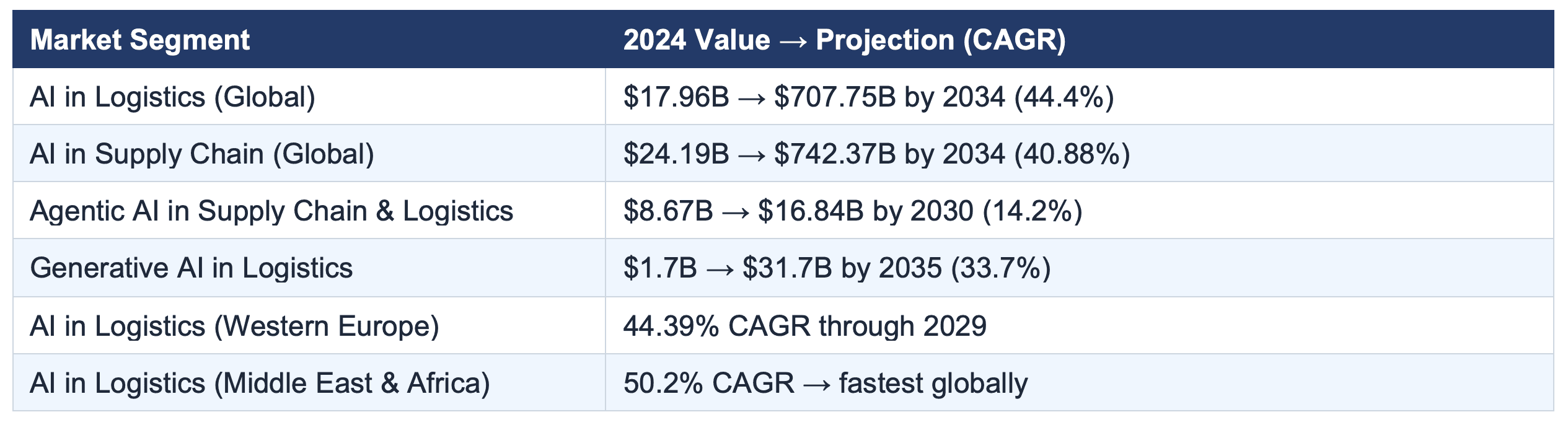
→ The global AI-in-logistics market is growing from $17.96 billion in 2024 to $707.75 billion by 2034 (CAGR 44.4%).
→ Five macro forces (volatility, regulation, labour, customer demands, and data overload) are creating an adoption forcing function.
→ Companies deploying AI across supply chains are already reporting 12.7% reductions in logistics costs and 20.3% reductions in inventory levels (McKinsey, 2024).
→ Logistics companies that embed Agentic AI into core operations over the next 24 months will structurally outperform those that treat AI as a peripheral initiative. The window for differentiation is open but it will not remain so.
→ Middle East & Africa AI logistics market is growing fastest globally at 50.2% CAGR.
Section I:
The AI-in-Logistics Market: Size, Growth, and Drivers
How large is the AI-in-logistics market and how fast is it growing?
The global AI-in-logistics market was valued at $17.96 billion in 2024 and is projected to reach $707.75 billion by 2034 at a CAGR of 44.4% (Precedence Research).
Western Europe is the fastest-growing region after Asia Pacific, while Middle East and Africa is growing at 50.2% CAGR, the fastest rate of any region globally.
What is Agentic AI and how is it different from previous supply chain AI?
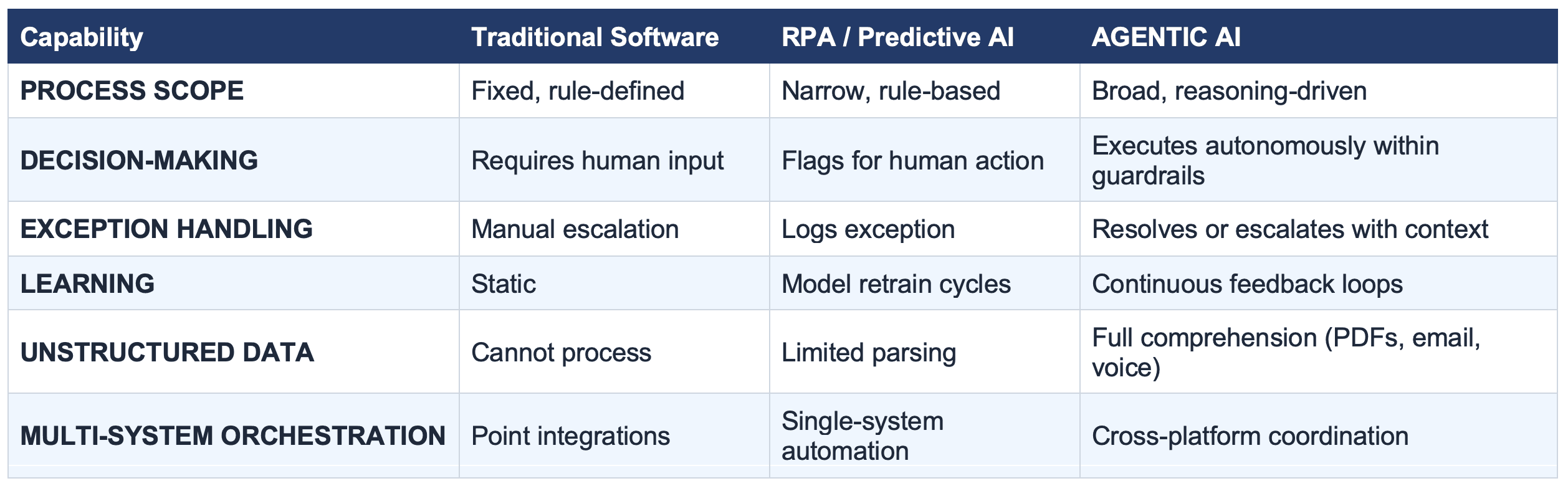
Agentic AI is qualitatively different from previous generations of supply chain technology. ERP and TMS systems digitalised processes. RPA automated narrow rules. Predictive analytics surfaced insights but left humans to act.
Agentic AI reasons across complex data, executes multi-step workflows autonomously, handles exceptions without human prompting, and learns continuously from outcomes.
What macro factors are accelerating AI adoption in logistics?
Five converging forces are accelerating Agentic AI adoption in logistics beyond the technology push: freight-rate volatility (spot rates swung up to 40% during 2024), regulatory pressure (EU CSRD mandatory 2026, CBAM full rollout 2027), labour cost escalation (8–12% annual increases in Europe 2022–2024), customer expectations for real-time visibility, and unprocessed unstructured data (less than 20% of logistics data is ever analysed).
What is driving Agentic AI adoption in European logistics?
Five converging forces are driving AI adoption in European logistics:
(1) CSRD and CBAM regulatory deadlines creating a hard forcing function for AI-powered ESG compliance;
(2) EU AI Act implementation creating demand for explainable, auditable AI;
(3) labour market tightness in Germany, Netherlands, Belgium, and France;
(4) The Netherlands processing 500 million tonnes of freight annually through Rotterdam and Schiphol with active government AI investment; and
(5) Onshoring and nearshoring of manufacturing supply chains creating new AI-optimised routing requirements.
What is driving Agentic AI adoption in the Middle East?
The Middle East and Africa is the fastest-growing AI logistics market globally at 50.2% CAGR.
Dubai has committed to becoming the world's top logistics hub by 2030 under UAE Vision 2031.
Saudi Arabia's Vision 2030 explicitly targets logistics as a strategic economic pillar.
GCC governments spend over $100 billion annually on defence procurement, creating a high-value AI logistics opportunity.
Section II:
Eleven Domains and Use Cases of Agentic AI Transformation
This section draws on Agentics' recent solutions delivered for its enterprise clients in Supply Chain, Shipping and Logistics industry across Europe and Middle East. It showcases 11 use cases across various operating domains in which Agentic AI is already delivering measurable transformation: e.g. from freight and customs automation to next-generation warehousing, from unified customer intelligence to ESG compliance automation.
For each domain, we have presented a direct answer to the question executives are asking, the current-state challenge, the Agentic AI future state, evidence-based ROI benchmarks, and competitive context.
Domain 1: How is Agentic AI Transforming Freight and Customs Operations?
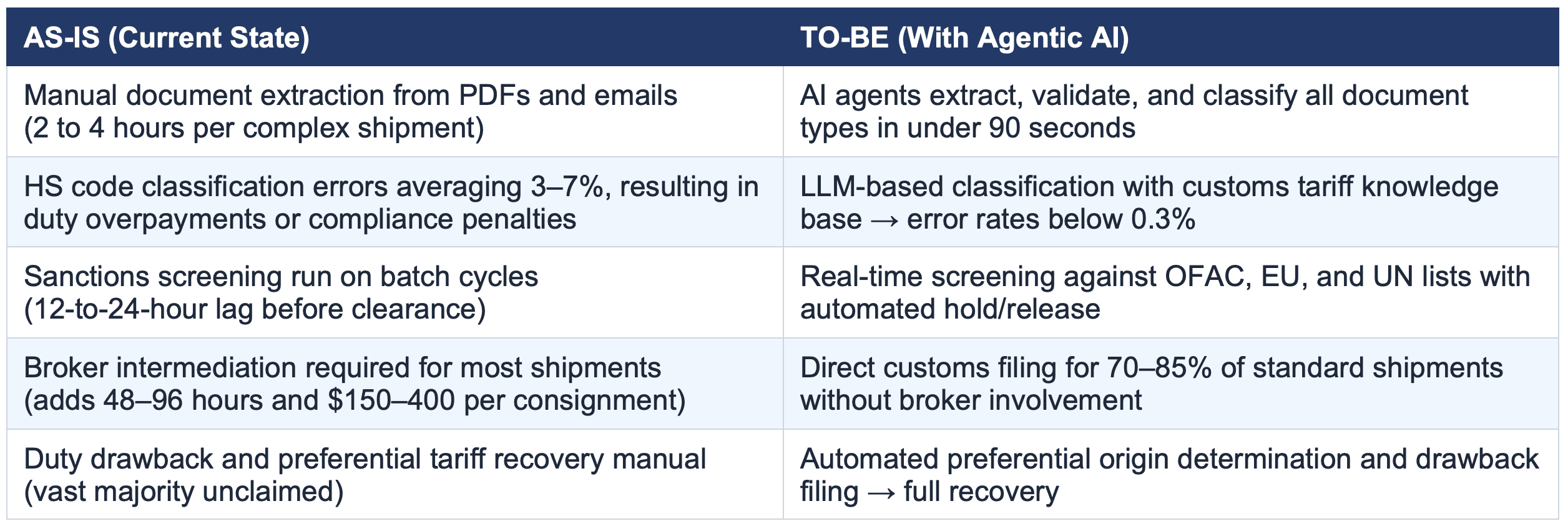
Agentic AI reduces customs processing time from 2–4 hours per complex shipment to under 90 seconds by autonomously extracting and validating documents, classifying HS codes with error rates below 0.3% (vs. 3–7% manually), and filing directly with customs authorities for 70–85% of standard shipments without broker involvement.
Cross-border freight operations remain among the most documentation-intensive processes in commerce. A single containerised shipment can generate 30 to 50 discrete documents i.e. commercial invoices, bills of lading, certificates of origin, packing lists, dangerous goods declarations, and customs entries; each subject to jurisdiction-specific rules that change with legislation, trade agreements, and sanctions regimes.
As-Is / To-Be: Freight and Customs

Domain 2: What Does Agentic AI Do for Transport Orchestration?
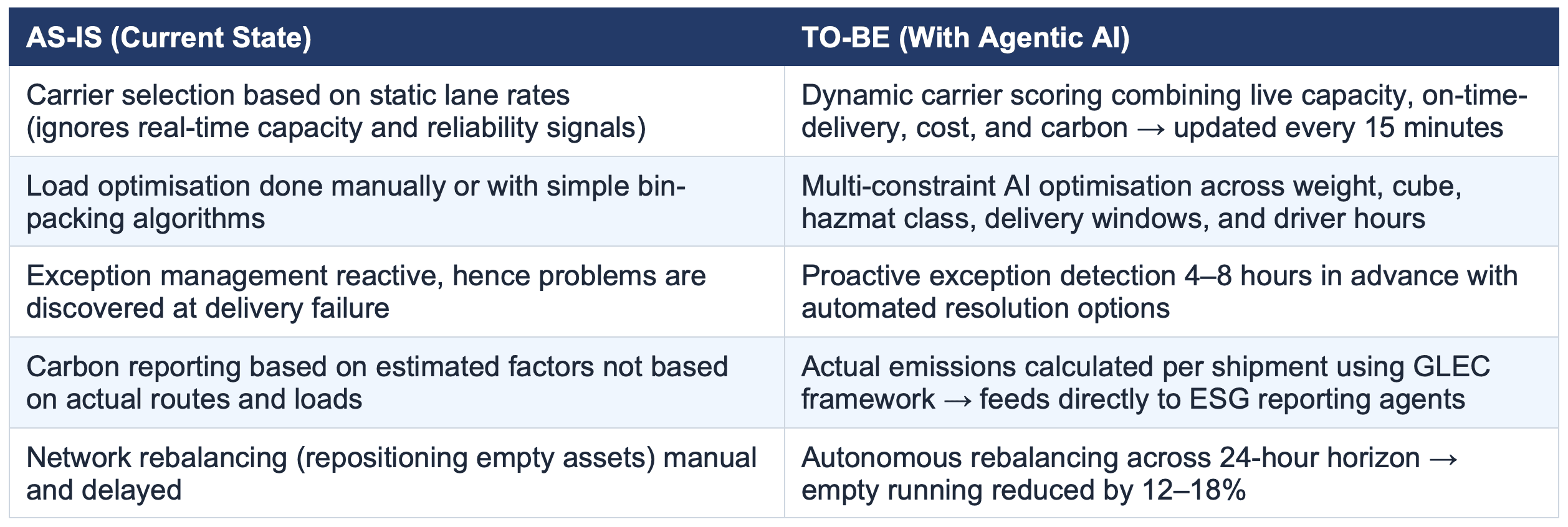
Agentic AI replaces reactive, rule-based transport planning with continuous autonomous optimisation → dynamically selecting carriers using live capacity and reliability data updated every 15 minutes, reducing transport costs by 8–15%, cutting empty running by 12–20%, and increasing planner productivity by 2.5x to 4x.
Transport orchestration i.e. the dynamic coordination of carriers, routes, loads, and exceptions across a shipper's network, has historically been constrained by the speed of human planners and the rigidity of rule-based TMS logic. Agentic AI replaces reactive planning with continuous autonomous optimisation.
As-Is / To-Be: Transport Orchestration

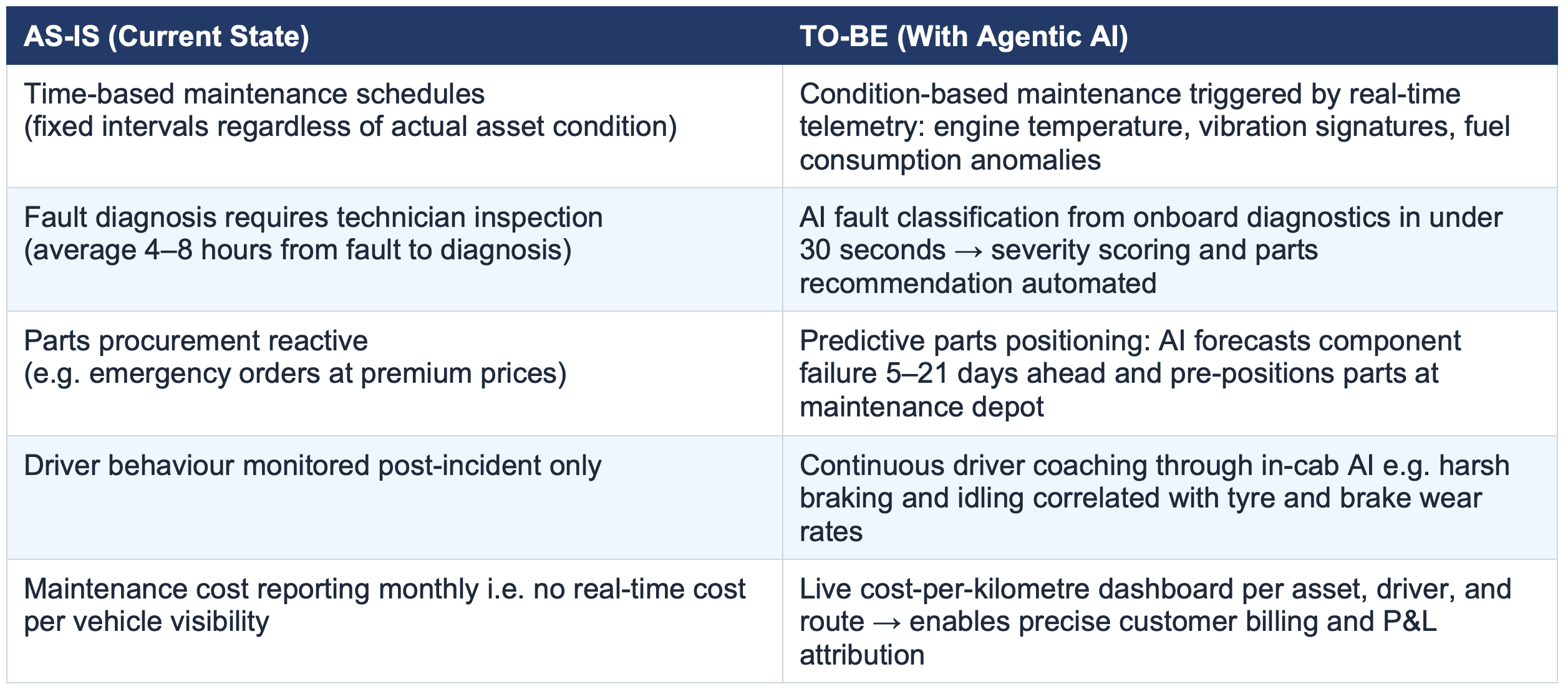
Domain 3: How Does Agentic AI Enable Predictive Fleet Maintenance?
Agentic AI replaces time-based maintenance schedules with condition-based intervention triggered by real-time vehicle telemetry. This reduces unplanned downtime by 25–40%, cuts maintenance costs by 15–22% and extends asset lifespan by 18–30%, converting a $1.2–6M annual unplanned downtime problem (for a 200-vehicle fleet) into a managed, predictable cost.
Unplanned vehicle downtime costs between $500 and $2,500 per hour depending on asset class. For a fleet of 200 vehicles averaging one unplanned breakdown per vehicle per month, that equates to $1.2 to $6 million in annual unplanned downtime costs, before accounting for missed SLAs, customer penalties, and recovery logistics.
As-Is / To-Be: Fleet Maintenance

Domain 4: Can Agentic AI Automate Freight Procurement and Spot Markets?
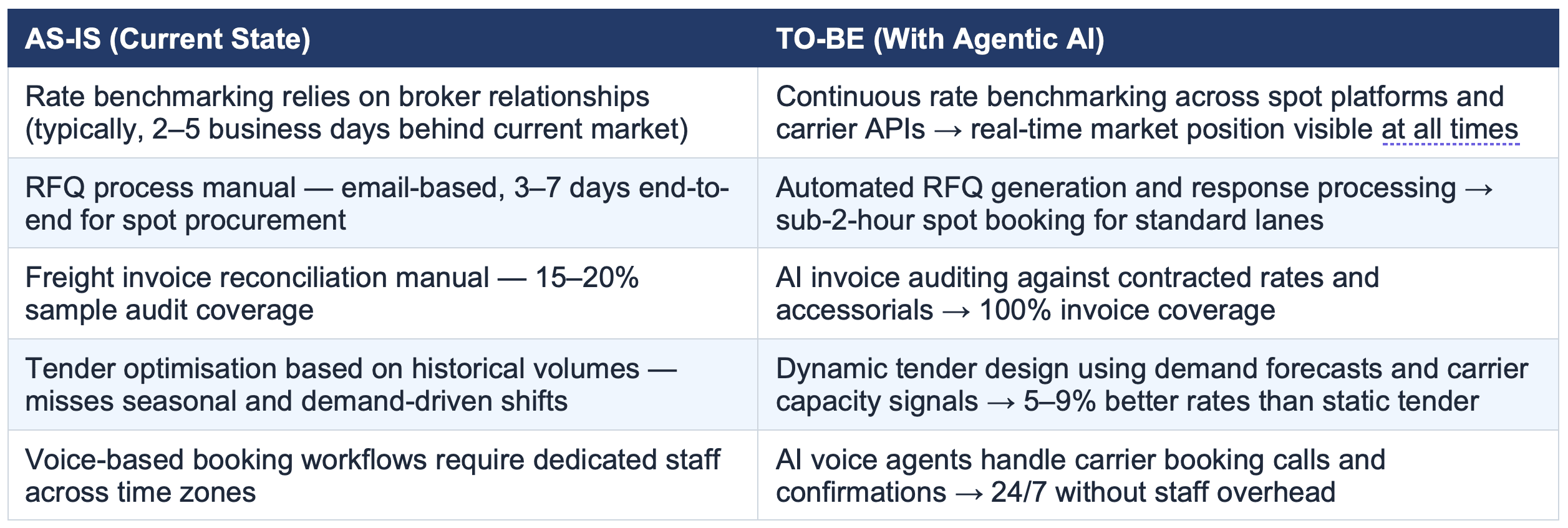
Yes, Agentic AI converts freight procurement from a labour-intensive, relationship-dependent process to an always-on autonomous operation. AI agents continuously benchmark rates across spot platforms and carrier APIs, generate and process RFQs in under 2 hours (vs. 3–7 business days manually), and audit 100% of invoices (vs. typical 15–20% sample audits)
→capturing 5–9% better rates than static tender cycles.
Freight procurement, particularly in the spot market, has historically demanded significant human effort for rate negotiation, capacity sourcing, and booking confirmation. With freight-rate swings of up to 40% observed during 2024 and the growing availability of digital freight marketplaces (Freightos, Transporeon, Uber Freight), companies that can arbitrage spot markets continuously capture material cost advantages.
As-Is / To-Be: Freight Operations and Spot Markets
Domain 5: How Does Agentic AI Transform Warehousing and 3PL Operations?
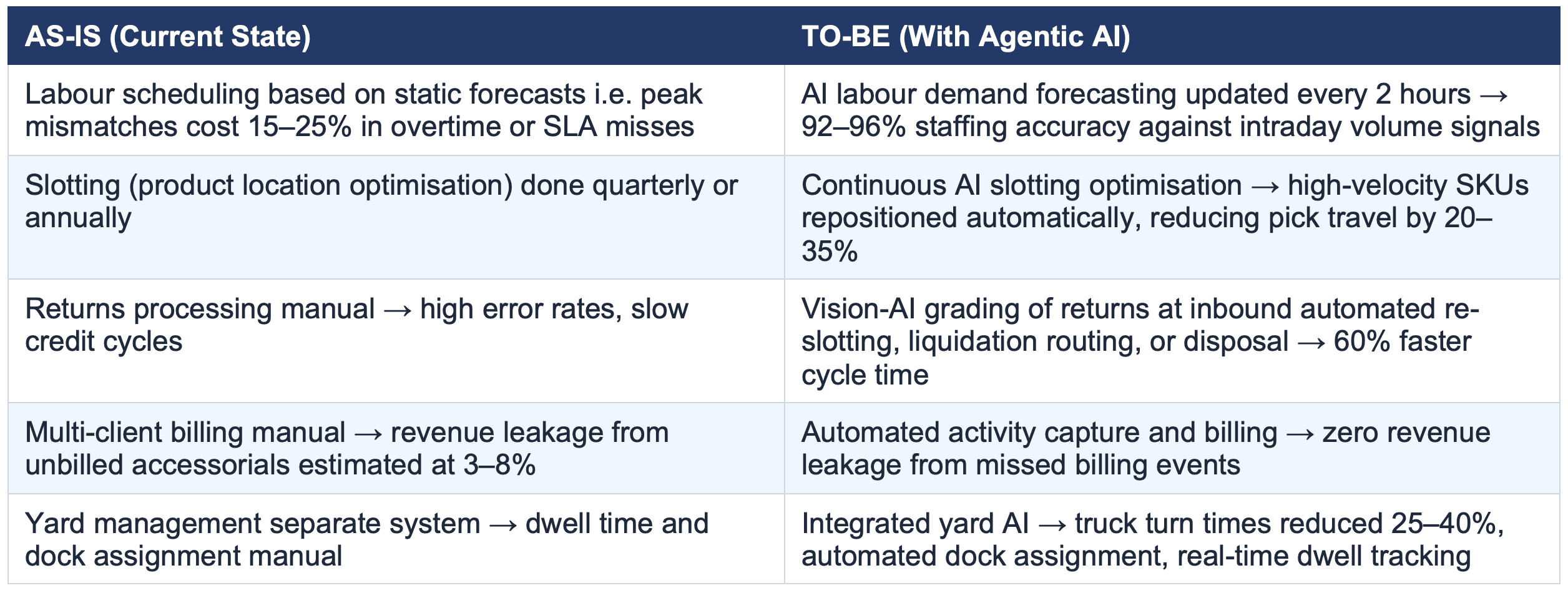
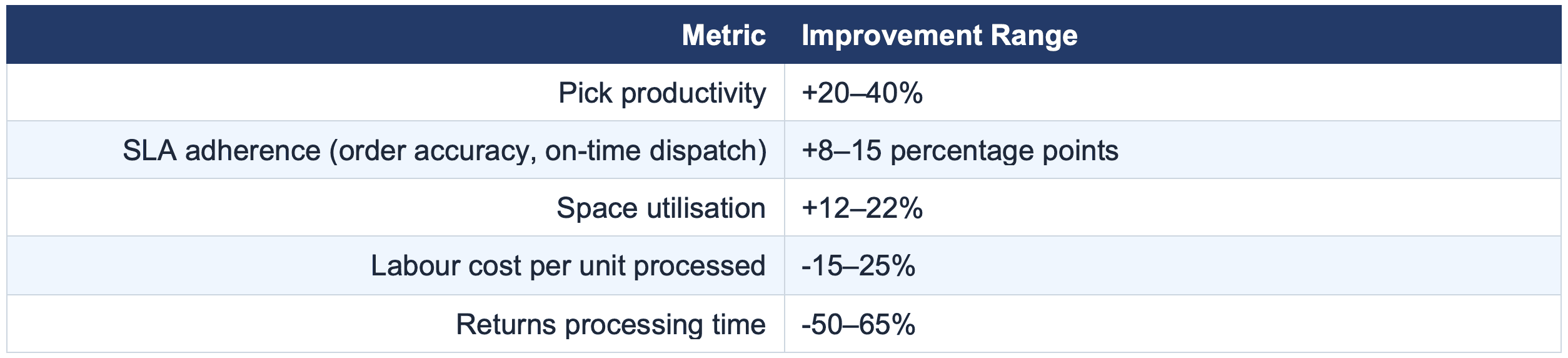
Agentic AI improves warehouse pick productivity by 20–40%, reduces SLA adherence gaps by 8–15 percentage points, cuts labour cost per unit by 15–25%, and reduces returns processing time by 50–65%, all without new physical infrastructure investment. The ProConnect case (165 warehouses, 6 million sq ft across India) demonstrates SLA improvement and space optimisation achieved through real-time AI visibility alone.
The ProConnect Supply Chain Solutions Case
ProConnect, a Redington company operating 165 warehouses covering 6 million square feet across India — faced deteriorating SLA performance despite physical infrastructure being in place. Root cause: lack of real-time operational visibility meant exceptions were discovered at the point of customer complaint rather than the point of occurrence.
Real-time mobile warehouse visibility applications, internal and customer-facing shipment monitoring, and AI KPI analytics were delivered, achieving optimised space utilisation, improved SLA adherence, and enhanced customer satisfaction with no new physical infrastructure investment.
As-Is / To-Be: Warehousing and 3PL
Domain 6: How Secure is Agentic AI for Defense and Project Cargo?
Secure Agentic AI for defence and project cargo operates within a private cloud or on-premises architecture where data never leaves the client's environment. It automates export control screening (ITAR, EAR, EU Dual-Use), maintains tamper-evident chain-of-custody across handoff points, and generates audit-ready compliance documentation → all within defined authorisation hierarchies and with no third-party model training on sensitive freight data.
Defence logistics and project cargo operate under constraints that standard commercial AI platforms cannot meet. Route security, export control compliance, chain-of-custody integrity, and data sovereignty requirements create a fundamentally different risk profile. The architecture deployed for one of our clients in Netherlands has private cloud deployment with GDPR compliance across France, Germany, and the Netherlands provides the direct precedent for defence-grade deployment.
Key Capability Requirements
→ Private cloud or on-premises deployment: data never leaves the client's environment → no third-party model training on sensitive freight data.
→ Export control screening: automated end-to-end partner screening against denied party lists, commodity classification against CCL and EU Dual-Use schedules, and country-of-destination risk scoring.
→ Chain-of-custody AI: multi-agent tracking across all handoff points with tamper-evident logging and automated deviation detection.
→ Mission-critical exception handling: agentic rerouting incorporating classified route risk intelligence and alternative mode selection within defined authorisation hierarchies.
→ Audit trail and reporting: automated audit-ready documentation for ITAR/EAR license compliance in the required regulatory format.
Domain 7: How Does Agentic AI Handle Specialised Logistics for Critical Assets?
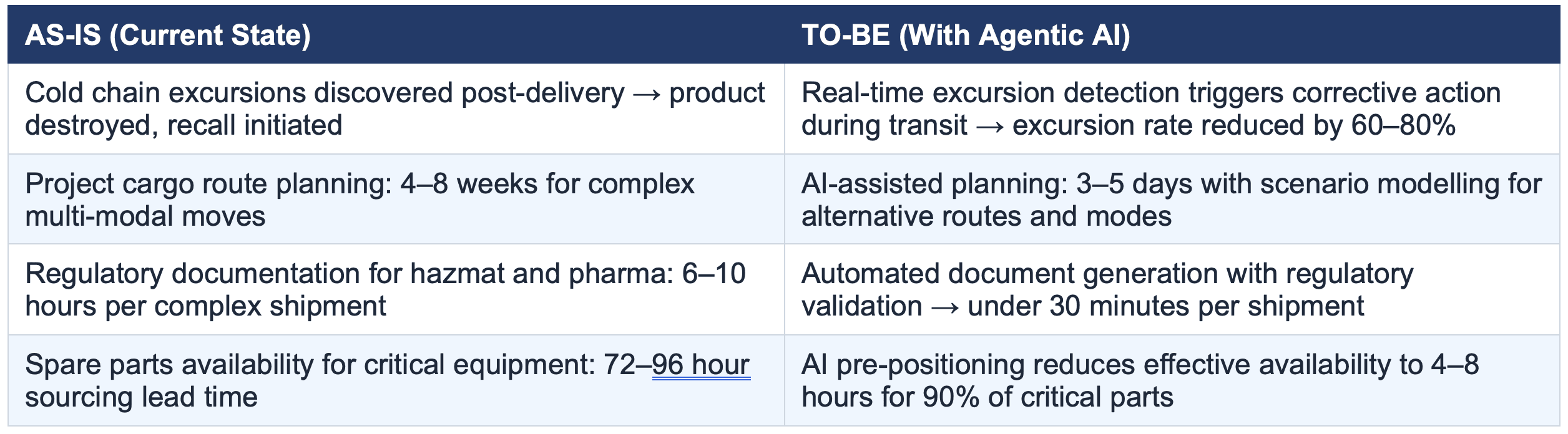
Agentic AI reduces cold chain excursion rates by 60–80% through real-time IoT monitoring and automated rerouting during transit. It cuts project cargo planning cycles from 4–8 weeks to 3–5 days, reduces hazmat and pharmaceutical regulatory documentation from 6–10 hours per shipment to under 30 minutes, and reduces effective spare parts availability for critical equipment from 72–96 hours to 4–8 hours.
As-Is / To-Be: Critical Asset Logistics
→ Cold chain integrity: IoT sensor streams fed to AI agents detecting excursions in real time → automatic rerouting before regulatory breach.
→ EU FMD and US DSCSA serialisation: real-time verification at each custody transfer point → automated compliance with pharmaceutical track-and-trace mandates.
→ Heavy lift and project cargo: AI-assisted route survey analysis, over-dimensional load planning, and permit application automation across jurisdictions.
Domain 8: How Does Agentic AI Enable Legacy Modernisation Without Operational Disruption?
Agentic AI enables legacy modernisation without disruption by using AI agents to extract and document all business rules from legacy systems before any cutover, reducing data migration timelines by 40–60% through intelligent data mapping, and monitoring production systems post-transition with zero operational impact.
The DP World engagement, transitioning end-of-support terminal and rail applications across a $10.7B, 40-country operation, delivered a seamless handover with zero operational disruption.
The DP World Case
DP World with $10.7 billion in revenue and operations across 40 countries faced an existential legacy risk: OEM support had ended for its terminal and rail management applications. Our Validation-First approach delivered a de-risked transition through systematic feature mapping, functional equivalence testing, and parallel running before cutover followed by a phased modernisation programme that delivered real-time customer visibility capabilities the legacy system could not provide.
Why AI-First Legacy Modernisation Outperforms Big-Bang Replacement
→ Knowledge extraction: AI agents analyse legacy codebases, extract business rules, and document system behaviour at a depth human analysts cannot match economically → creating a living knowledge base.
→ Intelligent data migration: LLM-based data mapping and transformation agents handle complex, exception-rich migration from legacy data models to modern schemas → reducing project timelines by 40–60%.
→ Change management: AI-powered user acceptance testing, documentation generation, and training content creation reduce organisational change management effort by 30–50%.
→ Continuous monitoring: post-transition AI agents detect functional regressions and integration failures before they affect operations → replacing manual hypercare teams.

Domain 9: How Does Agentic AI Optimise Inventory and Integrate Supply Chain Data?
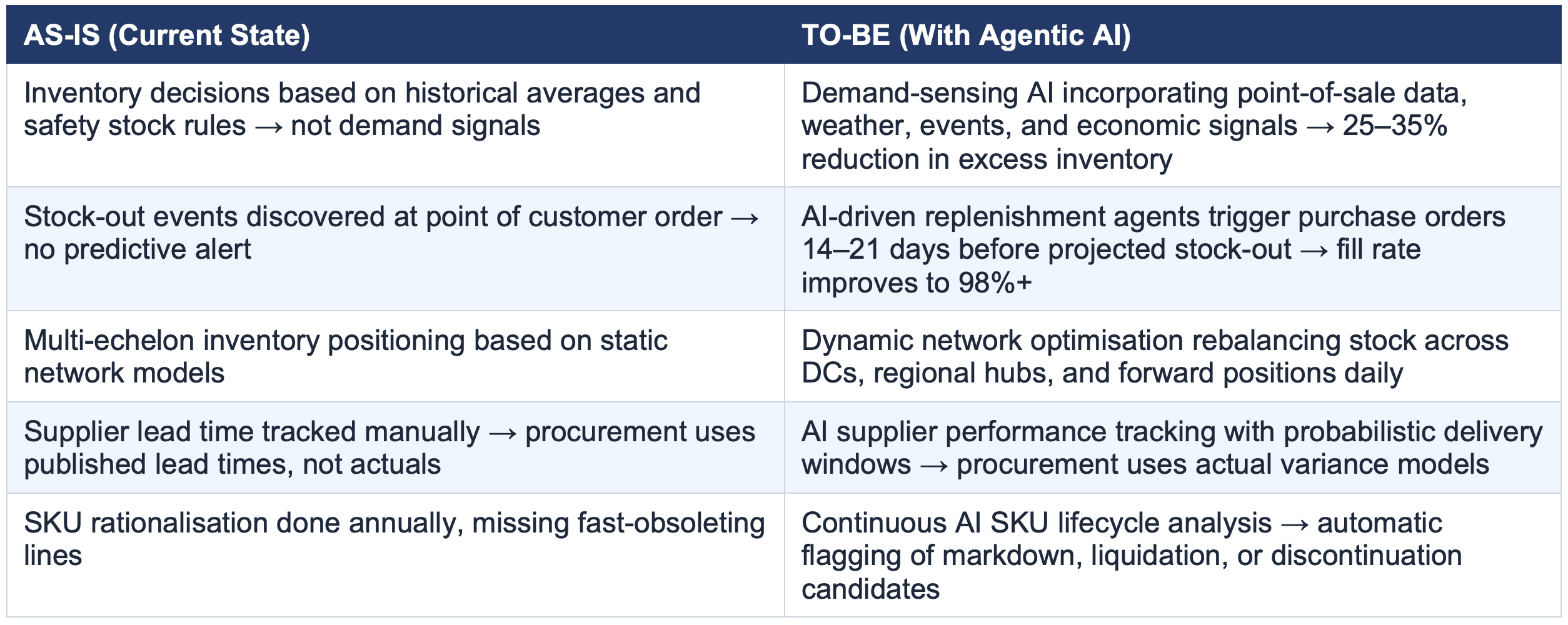
Agentic AI reduces excess inventory by 25–35% and improves order fill rates to 98%+ by replacing historical-average safety stock rules with demand-sensing AI that incorporates point-of-sale data, weather, events, and economic signals. The TVS Supply Chain Solutions deployment integrating ERP, WMS, TMS, and CRM across a $1.1B, 20-country operation eliminated manual interventions, centralised data, and measurably improved customer visibility.
The TVS Supply Chain Solutions Case
TVS Supply Chain Solutions serving Automotive, Aerospace & Defence, Retail, and Healthcare clients across more than 20 countries had invested in IoT, GPS, and RFID infrastructure, but this data was not integrated into the analytics layer. Inventory decisions relied on manual Excel-based processes. We delivered a unified data fabric connecting ERP, WMS, TMS, and CRM systems, enabling an AI-powered control tower with real-time cross-system visibility and automated inventory optimisation.
Key Facts: Demand forecasting represents the largest single segment of the Agentic AI supply chain market → 32.1% of the total in 2024 (Mordor Intelligence).
McKinsey finds AI-driven inventory management achieves 20.3% average inventory reduction while simultaneously improving service levels.
As-Is / To-Be: Data Integration and Inventory Optimisation
Domain 10: How Does Agentic AI Derive Intelligence from Unstructured Customer Data?
Agentic AI unlocks the 'hidden 60%' of unstructured logistics data i.e. in emails, PDFs, call transcripts, maintenance logs, and carrier communications, by extracting and integrating this intelligence into operational workflows.
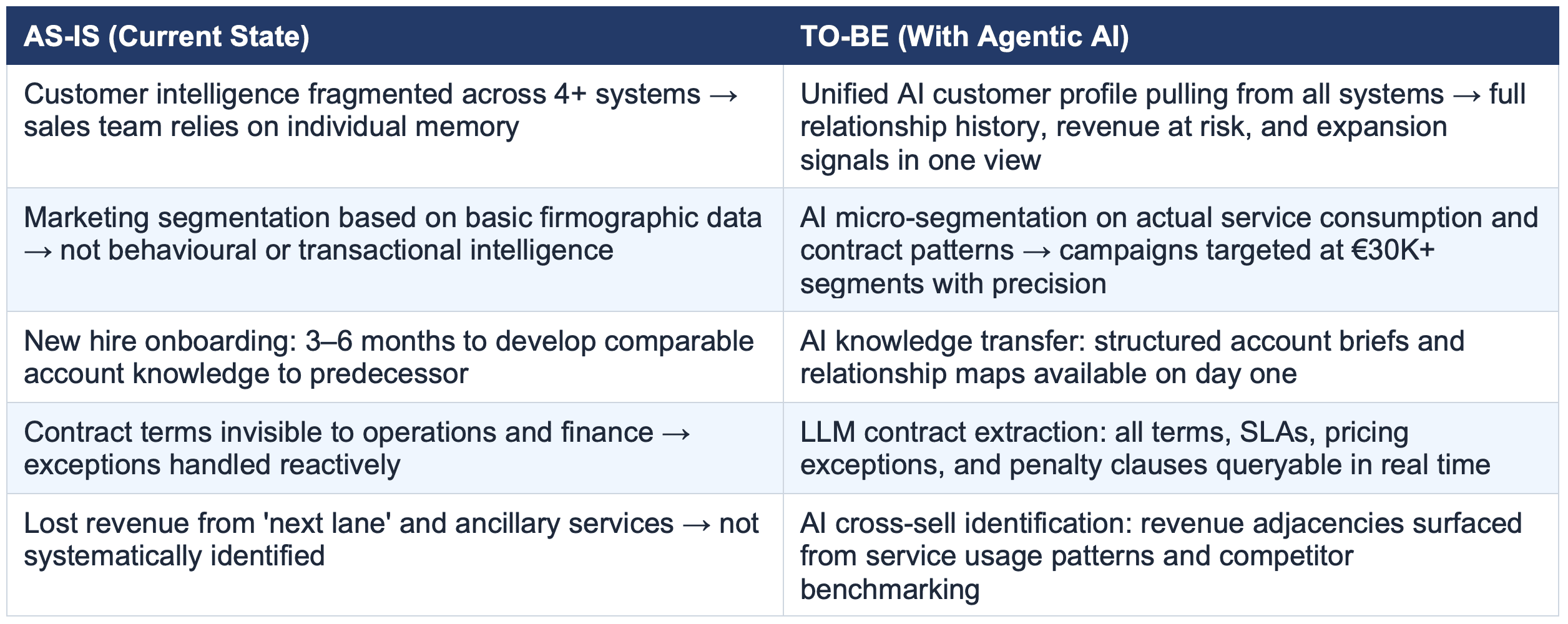
Agentics has created a unified AI customer intelligence layer that integrates across client’s IT systems such as ERP, CRM, Finance, Billing, Customer Support etc., enabling natural-language querying of the full customer data estate and AI-driven identification of revenue adjacencies in the existing customer base.
Client: Europe’s leading trailer and equipment leasing and services business
Faced a universal enterprise challenge: four systems (Salesforce, ALS, Matrix, Dynamics) holding different fragments of customer reality with no unified view. Workshop revenue flows were invisible in Salesforce. Customer knowledge lived in Outlook as shadow notes. Signed contracts existed as inert PDFs. New hires faced a blank page.
Our solution was not a system replacement but an intelligence wrapper → an enrichment layer that connected all systems, automated LLM extraction of PDF and contract data, and delivered an AI Assistant enabling any team member to query the full customer data estate in natural language. Architecture: private cloud deployment with GDPR compliance across France, Germany, and the Netherlands → data never leaving client's environment.
The Hidden 60% Problem of Unstructured Data
Research across enterprise logistics operations consistently finds that 60–80% of operationally relevant data exists in unstructured form: emails, PDFs, call transcripts, maintenance logs, customs declarations, and carrier communications. This data is generated continuously, is often business-critical, and is almost entirely invisible to analytics and AI systems operating only on structured database records. The Agentics Co.'s Unstructured Data Engine, a Multi-Agent Intelligence System with six specialised agents coordinated via a Meta-Engine, processes this data at scale and integrates extracted intelligence into operational workflows.
As-Is / To-Be: Unified Customer Intelligence
Domain 11: What is the Business Use Case for AI-Powered Logistics ESG Compliance?
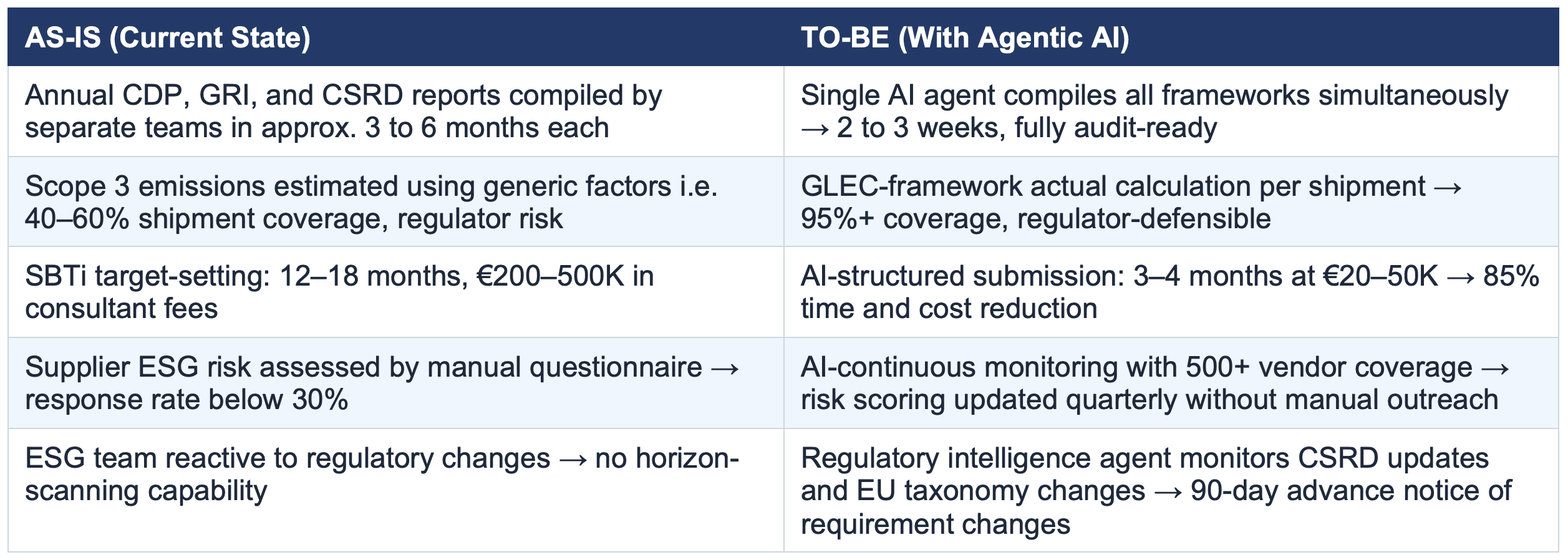
The Agentics’ Ai-ESG platform reduces ESG consulting and reporting costs by 90%, from €150,000–€500,000 per year to €15,000–€50,000, with payback achieved by Month 6–8. It simultaneously fulfils CSRD, CDP, GRI, and EcoVadis reporting from a single data input, calculates Scope 3 emissions with 95%+ shipment coverage using the GLEC framework, and monitors ESG credentials across 500+ suppliers continuously.
Why ESG Compliance Has Become a Logistics Revenue Issue
The EU Corporate Sustainability Reporting Directive (CSRD) becomes mandatory for large companies from financial year 2024 (reporting in 2025–2026). The EU Carbon Border Adjustment Mechanism reaches full implementation in 2027. SBTi validation is increasingly a prerequisite for major shipper tender inclusion, with ESG weighting in RFQ processes now ranging from 10% to 30% of total evaluation score.
Key Fact: DHL: CDP A-List, EcoVadis 76 Gold, SBTi validated. Kuehne+Nagel: CDP B, EcoVadis Gold, net-zero 2030. DB Schenker: CDP A-, EcoVadis Platinum 78, net-zero 2040. Logistics operators without validated SBTi targets and CSRD-ready reporting face growing commercial disadvantage in enterprise RFQs.
The Five Agentic AI Modules of Agentics Ai-ESG | EcoRatings OS
→ Multi-Framework AI Reporting Agent: simultaneously compiles CDP, GRI, CSRD, and EcoVadis reporting from a single data input → eliminating the double and triple entry consuming 60–80% of ESG team effort.
→ Scope 3 AI Agent: calculates Scope 3 emissions using the GLEC (Global Logistics Emissions Council) framework with 95%+ shipment coverage → replacing estimated factors that expose companies to audit risk.
→ SBTi Preparation Agent: structures the data submission and target-setting process for Science-Based Targets validation → reducing a 12–18 month, €200–500K consultant process to 3–4 months at €20–50K.
→ CSRD Compliance Agent: automates data collection and gap analysis across ESRS E1–E4 (environmental), S1–S4 (social), and G1 (governance) topics → with audit-ready documentation output.
→ Supplier ESG Intelligence Agent: continuous monitoring across 500+ vendors → risk scoring updated quarterly without manual outreach.
ESG Compliance Cost Comparison
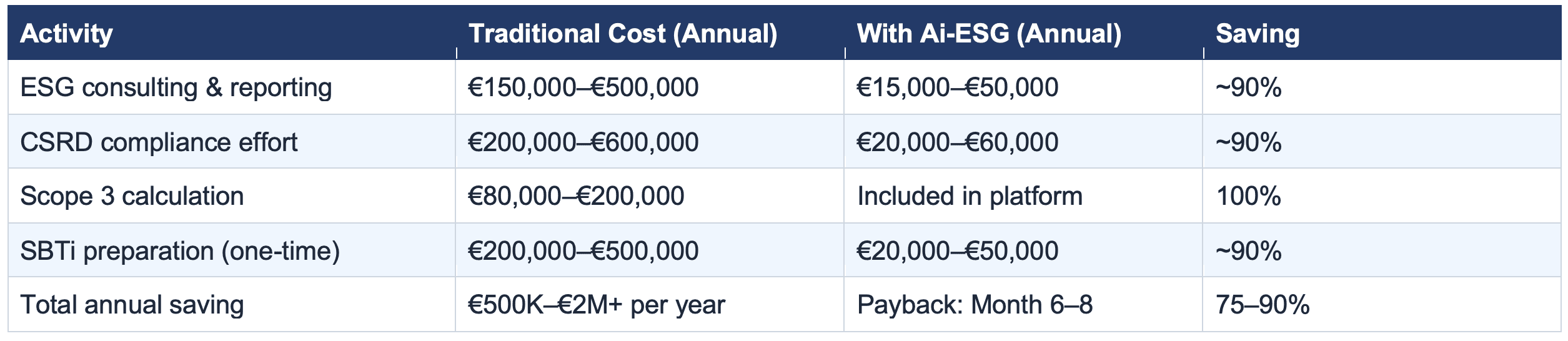
As-Is / To-Be: Ai-ESG Operations
Section III:
Implementation Framework: Agentic AI in Supply Chain, Shipping & Logistics
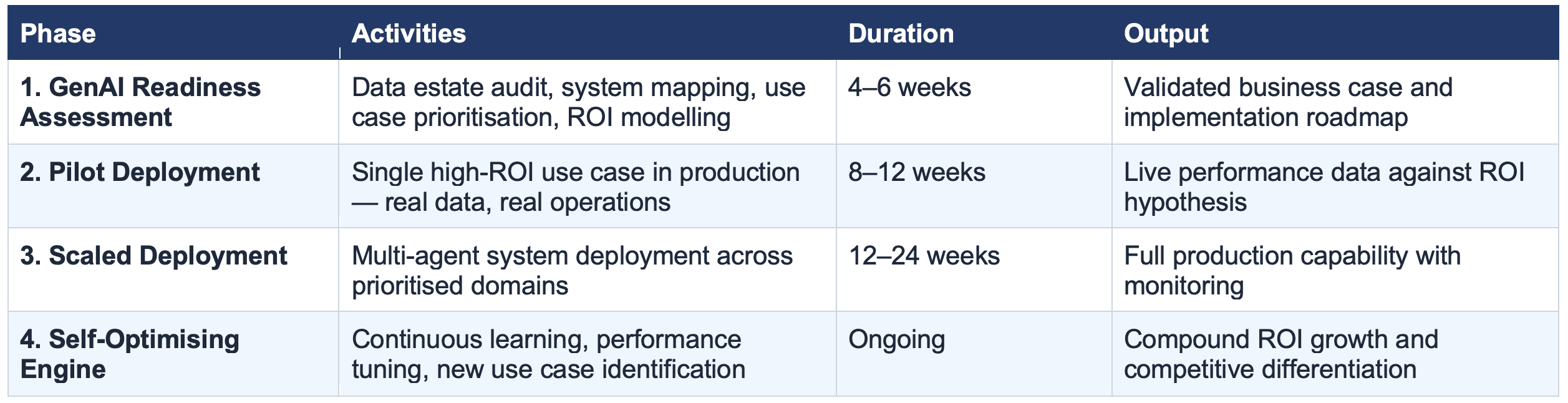
The Validation-First Framework
Starts with a 4–6 week GenAI Readiness Assessment that maps data estates, validates the business case, and commits to a 6–12 month ROI target before full deployment.
This is followed by an 8–12 week pilot on a single high-ROI use case in production before scaling.
The 72% of high-performing operators that successfully scaled AI all began with a single, well-defined use case.
Most important risk mitigation principles
→ Start with unstructured data: unlocking the hidden 60% of operational data delivers immediate intelligence value with minimal integration risk.
→ Prioritise high-frequency, rule-bound processes first: customs classification, invoice reconciliation, and demand replenishment have clear success criteria and generate rapid, measurable ROI.
→ Maintain human oversight by design: initial deployment incorporates human-in-the-loop checkpoints at exception thresholds, autonomy expands as confidence accumulates.
→ Instrument everything: every agent action is logged, attributed, and reviewable which is essential for regulatory compliance and performance management.
→ 72% of high-performing operators that successfully scaled AI began with a single, well-defined, high-ROI use case before expanding.
Conclusion: The Intelligence Imperative
Logistics companies that embed Agentic AI into core operations over the next 24 months will structurally outperform those that treat AI as a peripheral initiative. The evidence is clear: 44.4% market CAGR, 20-30% cost reductions confirmed by McKinsey, 90% ESG compliance cost reductions, and live enterprise deployments demonstrating real, measurable outcomes.
The supply chain and logistics industry is at an inflection point. The companies that will define the competitive landscape in 2030 are making decisions today → about where to invest in AI, how to sequence capability development, and what partner ecosystem to build around their transformation.
The ROI case is not speculative. McKinsey documents 5-15% logistics cost reductions and 20-30% inventory reductions. The Agentics Co.'s client engagements demonstrate SLA improvements, seamless legacy transitions, and ESG compliance cost reductions of 75–90%. The technology is production proven. The implementation methodology is validated. The market is growing at 44% compounding annually.
The question is not whether to deploy Agentic AI. It is how quickly to do so, and with whom.

The Agentics
Agentics is a boutique Enterprise AI transformation firm headquartered in the Netherlands, specialising in Agentic AI and Multi-Agent Systems. We combine deep logistics domain expertise with genuine Agentic AI engineering capability. Unlike platform vendors (constrained to their own software stack) and large consulting firms (high day-rates, methodology-first, no committed ROI), Agentics commits to a 6–12 month ROI target, deploys end-to-end from assessment through validated production, and applies its Validation-First Framework to de-risk every engagement. We serve enterprise clients across CPG, retail, manufacturing, healthcare, logistics, and BFSI verticals in Europe, the Middle East and Africa, APAC/ANZ, and LATAM.
Let's talk:
Email: Hello@TheAgentics.co
Web: https://TheAgentics.Co
ESG Platform: https://theagentics.co/ai-innovation-store/genai-for-esg-sustainability