
Enterprise AI Adoption: The AI Governance Playbook
Enterprise AI is no longer an experiment; it is a strategic imperative. Across CPG, manufacturing, financial services, healthcare, and logistics, organisations are deploying AI agents to automate decisions, process unstructured data, and orchestrate multi-step workflows at a scale no human team could match. Yet for every enterprise accelerating deployment, another is stalled; not by a lack of capable technology, but by a lack of governance infrastructure to support it safely. This playbook addresses that gap head-on. Drawing on our work with enterprise clients across Europe, the Middle East, LATAM, and APAC, and grounded in the governance frameworks regulators and boards actually require, we present a structured, actionable approach to AI governance; one that enables scale rather than inhibiting it.

Posted by
The Agentics
Posted at
AI Transformation
Posted on

1. Why Governance Is the #1 Enterprise AI Blocker
The Governance Gap
Most enterprise AI conversations begin with capability: what can the model do, how fast, at what cost? The conversation almost always ends with governance: who is accountable when it goes wrong, how do we prove compliance to an auditor, and how do we explain an AI decision to a regulator or a customer?
This mismatch between the pace of capability development and the maturity of governance infrastructure is the single greatest bottleneck in enterprise AI adoption today. Forrester's research confirms that 73% of enterprise leaders cite governance (not cost, not talent, not technology) as their primary barrier to scaling AI.
Three Categories of Governance Risk
Governance gaps create risk across three dimensions, each with real financial and reputational consequences:
⚠ Operational Risk |
Agents make decisions without human-readable justification trails. When something goes wrong and in complex, multi-step autonomous workflows, edge cases are inevitable; teams cannot diagnose root causes, cannot demonstrate due diligence, and cannot prevent recurrence. The financial cost of a single AI-driven compliance failure in a regulated industry averages $4.2M (McKinsey). Operational risk is not theoretical. |
⚠ Compliance Risk |
89% of regulated industries require complete audit trails for automated decisions. Without comprehensive logging of who triggered the agent, what data it accessed, what decision it made, why; organisations cannot demonstrate regulatory compliance during examinations. Compliance risk is an existential concern in HIPAA, SOX, GDPR, and FedRAMP environments. |
⚠ Reputational Risk |
When AI systems fail publicly due to biased decisions, data leaks, unauthorised actions etc.; the inability to explain and account for agent behaviour amplifies the damage. Trust, once eroded, is expensive to rebuild. Proactive governance is reputational insurance. |
Agentics' Perspective: In our client engagements, we consistently find that the enterprises making the fastest progress on AI adoption are not the ones with the most advanced models; they are the ones that invested earliest in governance infrastructure. Governance is a force multiplier, not a speed bump.
2. The Five Pillars of AI Agent Governance
Effective AI governance is not a monolithic policy document; it is a set of five interlocking control mechanisms, each addressing a distinct risk dimension. Together, they form a governance stack that operates at the speed of the agents themselves.
01 Permission Boundaries
Define granular permissions specifying exactly what each agent can and cannot do — from API access and data scope to action triggers and time windows. Permission boundaries are the first line of defence against scope creep and privilege escalation. Every agent should operate under the principle of least privilege: access only what is necessary, nothing more.
02 Audit Trails
Every agent decision, data access, and action must be logged with full context: who initiated the workflow, what data was accessed, what decision was made, what changed, and when. Audit trails are not just a compliance requirement, they are the foundation for debugging, continuous improvement, and stakeholder trust. Logs must be immutable, queryable, and compliance ready.
03 Data Access Controls
Agents operate under strict data access controls aligned to the principle of least privilege. Role-based access control (RBAC), data masking for sensitive fields, and dynamic permission scoping ensure agents only see the data required to complete their assigned task and nothing else. This is especially critical in multi-tenant and cross-departmental deployments.
04 Human Escalation Protocols
Not every agent decision should be fully autonomous. Define the conditions e.g. high-dollar transactions, novel decision patterns, sensitive data access, anomaly detection thresholds etc., under which an agent must pause and escalate to a human reviewer before proceeding. Escalation protocols are the safety valve that preserves human oversight where it matters most.
05 Compliance Mapping
Link agent behaviours and technical controls to specific regulatory requirements, industry standards, and internal policies. Compliance mapping closes the loop between what your governance framework says and what your agents actually do, enabling automated compliance reporting, gap analysis, and audit-ready documentation.
How the Five Pillars Interact
The five pillars are not independent checkboxes; they are a system. Permission boundaries define what agents are allowed to do. Audit trails record everything they actually do. Data access controls constrain what they can see. Human escalation catches the decisions too consequential for full automation. Compliance mapping ties the entire stack to the regulatory obligations your organisation is held to.
A governance framework with four of the five pillars has significant gaps. An agent with strong audit trails but no permission boundaries is uncontrolled. An agent with permission boundaries but no compliance mapping cannot demonstrate regulatory adherence. All five pillars must be implemented and integrated.
The Four-Layer Governance and Control Architecture
At The Agentics, we operationalise the five pillars through a four-layer control architecture that maps each governance requirement to a distinct organisational function and technical artefact:
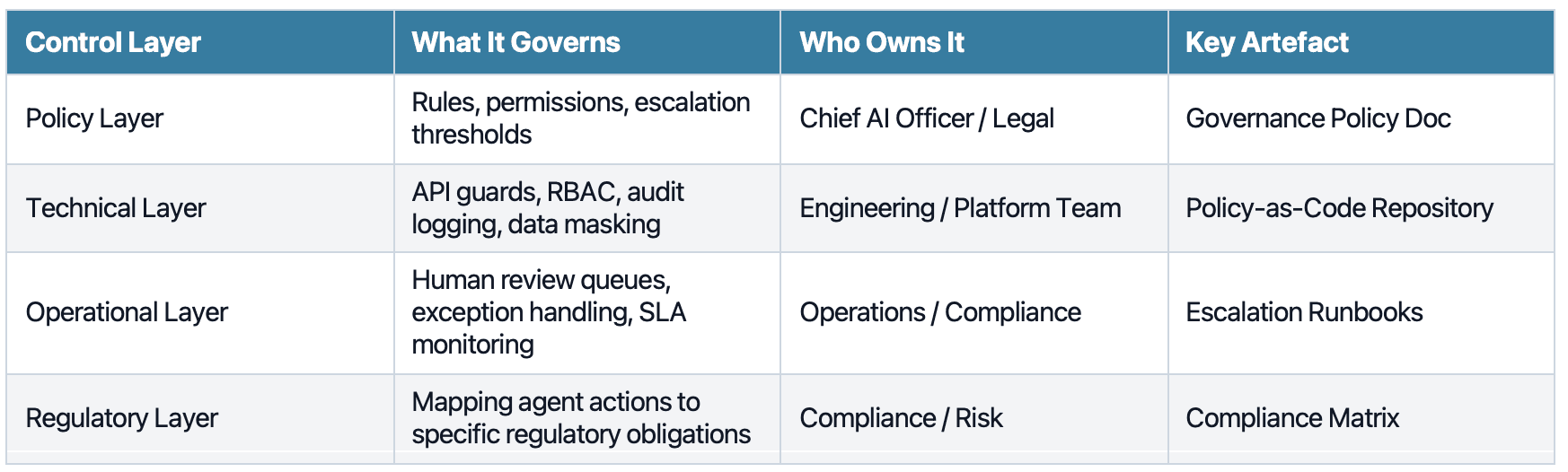
Key Insight: Governance must be owned across multiple functions; it cannot live exclusively in IT, Compliance, or Legal. The most effective governance programmes we have seen embed ownership at all four layers, with clear accountability, escalation paths, and tooling at each level.
3. Regulatory Mapping: Governance by Industry
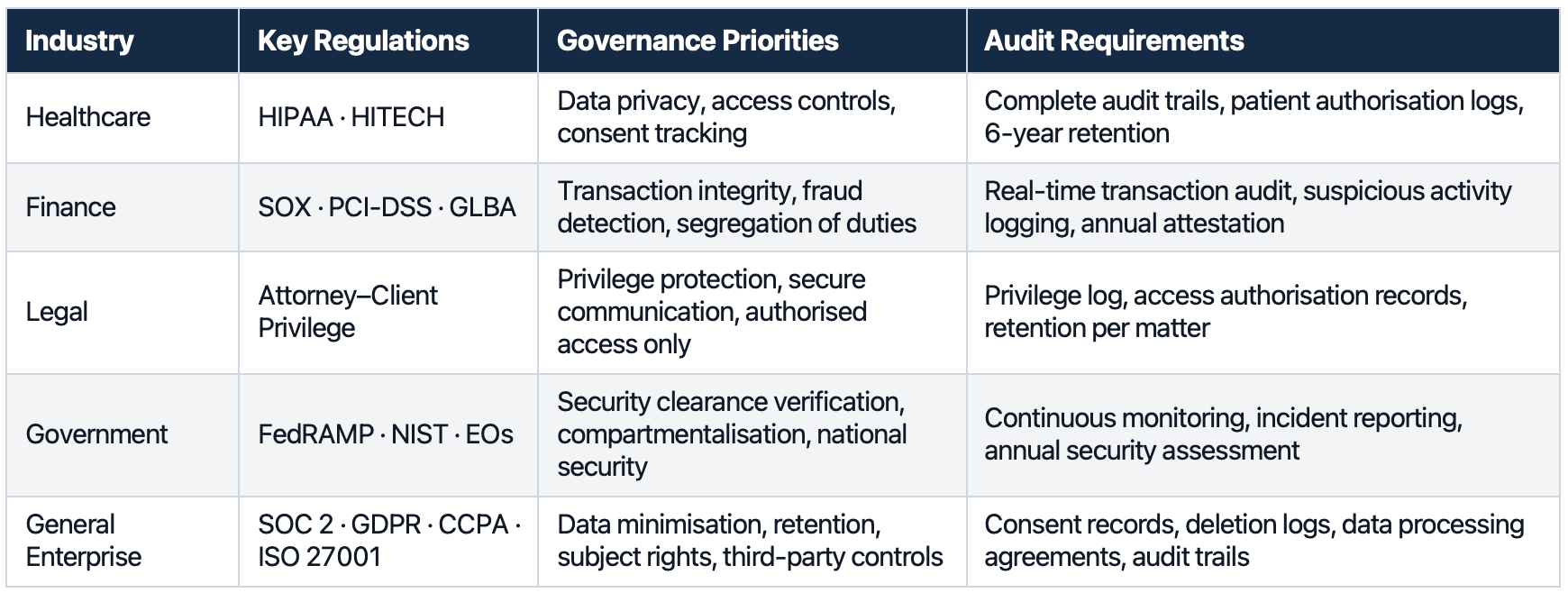
Governance requirements are not generic; they are shaped by the regulatory environment your organisation operates in. The table below maps the five highest-impact regulated sectors to their primary compliance obligations, governance priorities, and audit requirements for AI agent deployments.
Critical recommendation: Map your agents to this matrix before deployment begins. If your agents handle healthcare data, implement HIPAA-grade controls from day one. If you are in financial services, SOX and PCI-DSS compliance must be designed into your audit logging and transaction integrity controls at the architecture stage. Retrofitting governance after deployment is exponentially more expensive and creates compliance gaps that are extremely difficult to close.
📋 Governance Beyond These Five Sectors |
For organisations in sectors not listed above besides retail, CPG, logistics, manufacturing, ESG, the baseline standard is SOC 2 Type II compliance combined with GDPR (for European operations) or relevant regional data protection frameworks. The 5 pillars apply universally; the specific controls and audit requirements vary by jurisdiction & data type. |
4. The Governance Implementation Roadmap
Governance is not a one-time project, it is a continuous capability that evolves alongside your AI deployments. The roadmap below provides a phased approach to building a governance stack from the ground up, grounded in what we have seen work in real enterprise deployments.
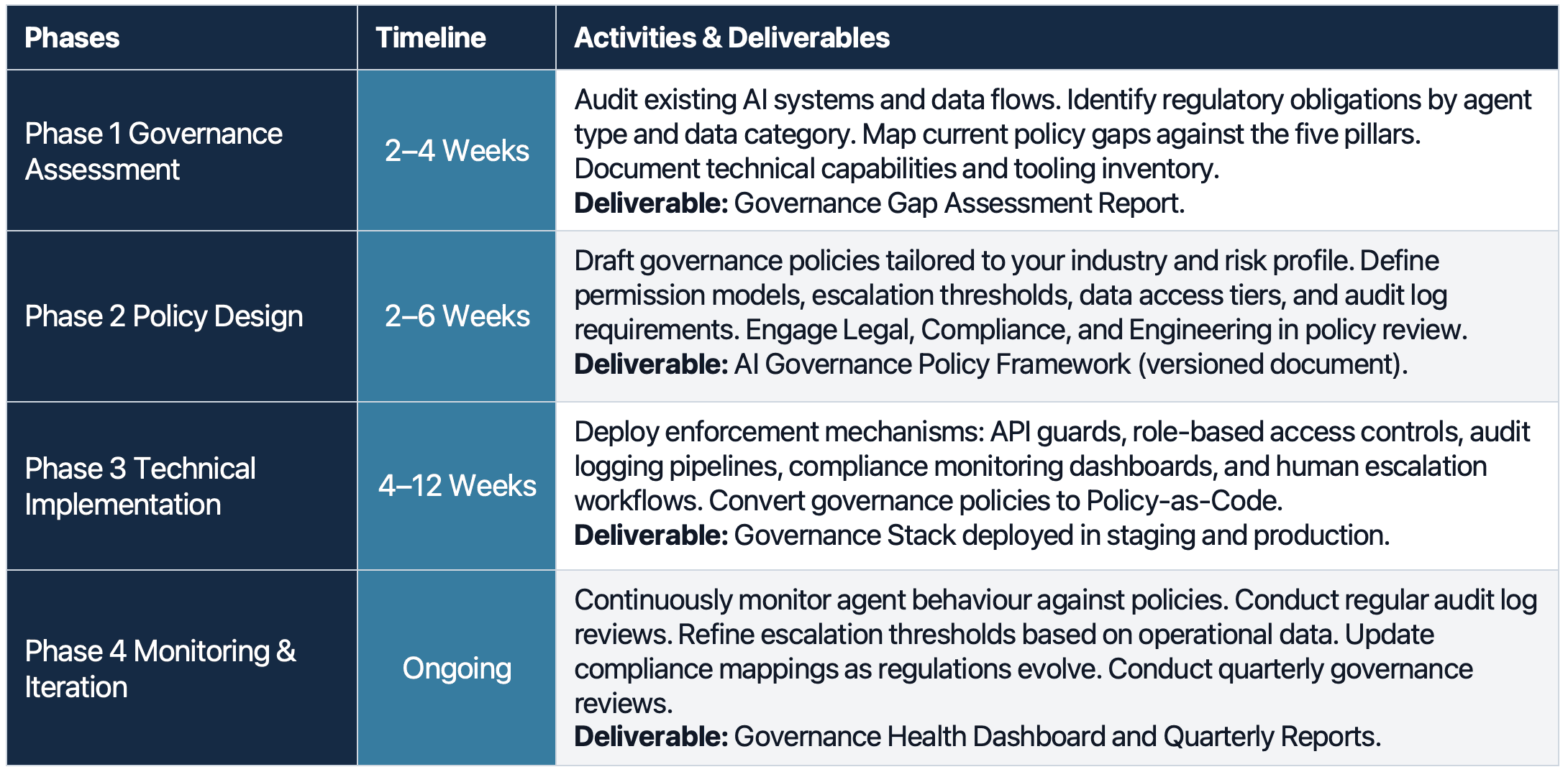
Timeline realism: The timelines above reflect our experience with mid-to-large enterprise deployments. Organisations with mature data governance programmes and well-documented compliance frameworks can move faster. Organisations starting from scratch in regulated sectors should allow additional time for legal review and regulatory consultation in Phase 2.
5. Common Governance Anti-Patterns to Avoid
Learning from failures accelerates success. Across our client engagements, three governance anti-patterns appear consistently and consistently cause the most damage. Understanding them is as important as understanding the five pillars.
01 Over-Permissive Agents
Granting agents broad access to reduce implementation friction is the most common and most dangerous anti-pattern. When a single agent has access to multiple data systems, a wide range of action triggers, and minimal escalation constraints, a single failure cascades across the entire system.
One compromised or mis-behaving agent can exfiltrate data, trigger unauthorised transactions, or corrupt downstream workflows at scale.
Risk: Regulatory violation · Data breach · Cascading operational failure
02 Governance as Afterthought
Building and deploying agents first, then retrofitting controls, is the enterprise equivalent of building a highway and then trying to add traffic laws. The result is invariably blind spots in audit coverage, inconsistent policy application across agent types, undocumented decision pathways, and audit nightmares that surface only when a regulator or auditor asks a question the organisation cannot answer.
Risk: Untrackable decisions · Compliance gaps · Costly remediation · Audit failure
03 Manual-Only Audit
Relying on human reviewers to manually audit agent decisions does not scale beyond a small pilot. At enterprise scale dozens of agents making hundreds of decisions per hour, hence manual audit is not a governance strategy; it is a theatre of governance. The result is missed violations, excessive operational overhead, and an audit process so slow it creates regulatory latency.
Risk: Missed violations · Operational overhead · Regulatory latency
The Underlying Principle: DESIGN GOVERNANCE IN, NOT ON
All three anti-patterns share a root cause: governance treated as an add-on rather than an architectural principle. The most effective governance frameworks we have seen are those where permission models, audit logging, and compliance mapping are designed into agent architecture from the first sprint; NOT retrofitted after the first incident.
This is the 'Validation-First' principle we apply at The Agentics: Every agent deployment begins with governance architecture, not with capability development.
6. Policy-as-Code: The Governance Model That Scales
One of the most significant advances in enterprise AI governance in recent years is the shift from governance-as-documentation to Policy-as-Code. Rather than governing agents through policy documents, spreadsheets, and manual review processes, organisations are encoding governance rules directly into their technical infrastructure, making governance executable, testable, and continuously enforced.
What Policy-as-Code Means in Practice
• Governance policies are written as code artefacts (YAML, JSON, or domain-specific policy languages) and stored in version-controlled repositories.
• Policy changes go through the same peer review and deployment pipeline as application code, ensuring policies are tested before they reach production.
• Enforcement is automated: agents cannot perform actions not explicitly permitted by the current version of the policy, enforced in real time by a rules engine.
• Compliance reporting is generated directly from policy-to-action mappings, eliminating the manual effort of constructing audit evidence after the fact.
• Policy drift: The gradual divergence between written policy and operational reality is eliminated because the policy is the operational reality.
The Policy-as-Code approach directly addresses the two most expensive governance failure modes: governance as afterthought (policies exist but are not enforced) and manual-only audit (governance exists on paper but not in practice).
7. The Agentics Approach: Validation-First Governance
At The Agentics, governance is not a feature we add to AI deployments; it is the foundation on which every deployment is built. Our Validation-First methodology means every agent architecture begins with a governance design session, and no agent reaches production without passing governance validation across all five pillars.
The Semantic Governor
At the centre of our governance architecture is the Semantic Governor: a rules engine that sits between every agent and every action it could take. Before an agent accesses data, triggers a workflow, or escalates a decision, the Semantic Governor validates the action against the current policy set. Non-compliant actions are blocked, logged, and escalated for review in real time, without human intervention required in the enforcement path.
What This Means for Enterprise Clients
• Agents deployed by The Agentics operate within defined permission boundaries from the first deployment, not after the first incident.
• Every agent action is logged with full context i.e. who triggered it, what data was accessed, what decision was made, what the outcome was; in an immutable, queryable audit trail.
• Compliance mapping links every agent behaviour to specific regulatory obligations, enabling automated compliance reporting that satisfies auditors without manual evidence construction.
• Human escalation workflows are configured at design time, ensuring high-stakes decisions always involve the right human reviewer before execution.
• Governance policies are managed as code, versioned, peer-reviewed, and continuously enforced; not buried in a compliance folder and reviewed annually.
Agentics' 6–12 Month ROI Commitment
Our governance-first approach is not just about risk management → it is a commercial proposition. Organisations that invest in governance infrastructure upfront spend less time in compliance remediation, less time in audit preparation, and less time managing agent failures. The operational savings alone typically deliver positive ROI within 6–12 months of deployment.
More importantly, governance-enabled organisations can deploy at scale. Without it, AI deployment is throttled by the bandwidth of human oversight. With it, you can safely run hundreds of agents in parallel and that is where the transformative value of enterprise AI is captured.
8. Key Takeaways
Five principles that should guide every enterprise AI governance programme:
01 Governance scales faster than agents.
Without governance, your team can only safely oversee a handful of agents. With governance infrastructure in place, you can deploy dozens or hundreds. Governance is the prerequisite for enterprise-scale AI; not a constraint on it.
02 Governance builds trust faster than assurance reviews.
When stakeholders, boards, and regulators can see audit trails, permission boundaries, and compliance mapping, confidence in AI systems increases tangibly. Governance evidence replaces the endless reassurance cycle that consumes leadership time in ungoverned AI programmes.
03 Governance is designed in, not bolted on.
Start with permission models, audit logging, and compliance mapping at the beginning of agent design. Every week of delay in governance implementation multiplies the cost and complexity of retrofitting. The Validation-First principle is not a methodology preference; it is a financial imperative.
04 Governance is continuous, not one-time.
Agent behaviour evolves. Regulations change. New edge cases emerge. Governance is an ongoing process of monitoring, auditing, and refining policies, not a project with a completion date. Build for continuous governance from the start.
05 Governance tooling is not optional at scale.
Manual audits and spreadsheet policies do not scale beyond a small number of agents. Enterprise-scale AI governance requires technical enforcement, automated compliance tooling, and operational discipline across all four control layers. Invest in tooling proportionally to the scale of your AI deployment.
Ready to build your AI governance framework? Contact us at Hello@TheAgentics.co
About The Agentics
A boutique Enterprise AI transformation firm specialising in Agentic AI and Multi-Agent Systems. We work with enterprise clients across CPG, retail, manufacturing, healthcare, logistics, BFSI, and ESG in Europe, the Middle East, LATAM, and APAC delivering governance-first AI deployments that are safe, auditable, compliant, and commercially transformative.
Related Post

Everything AI
Sep 3, 2026

Enterprise AI
Aug 19, 2026