
Agent-Ready Retail: Why the Protocol War Is the Wrong Thing to Prepare For?
AI-referred retail traffic grew 393% and now converts 42% better than non-AI traffic. But the flagship checkout was retired and standards have fragmented. Agent-readiness is a data and policy problem, not a protocol integration.
Posted by
The Agentics Co. | Research Desk
Posted at
Agentic Commerce
Posted on
THE SHORT ANSWER
The commercial signal is real. Adobe recorded AI-referred traffic to US retail sites growing 393% year on year in Q1 2026, and in March 2026 that traffic converted 42% better than non-AI traffic, a reversal from converting 38% worse a year earlier. Revenue per visit ran 37% higher.
The technical signal is a mess. OpenAI retired Instant Checkout in March 2026 after roughly a dozen Shopify merchants ever shipped against it. At least six overlapping standards are now in play. Stripe endorsed Google's UCP despite co-authoring ACP. Walmart joined both camps. Adyen shipped an adapter whose entire value proposition is not having to choose.
OUR POSITION: Agent-readiness is a data and policy problem that every protocol consumes, not an integration with any one of them. Feeds, inventory truth, machine-legible policy, price logic, agent identity and post-purchase service are required whoever wins. Build those; keep protocol adapters at the edge where they can be swapped.

In March 2026 two things happened to agentic commerce in the same month, and the retail industry paid attention to the wrong one. The first was that OpenAI switched off Instant Checkout, the flagship consumer agentic-purchase experience it had launched with Stripe six months earlier, after roughly a dozen Shopify merchants ever shipped against it. The second was that AI-referred traffic to US retail sites converted 42% better than everything else, a complete inversion of the position twelve months earlier, when the same traffic converted 38% worse.
Read together, those two facts are the whole strategic picture. The plumbing for agentic commerce is unsettled, contested and in at least one high-profile case already deprecated. The demand for agentic commerce is growing fast and arriving with unusually high intent. Most retail organisations have responded by asking which protocol to integrate, which is a question they cannot currently answer and which, in our view, they do not need to answer yet.
This paper is The Agentics Co.'s design position on what agent-ready retail actually requires. It covers the evidence on whether this channel deserves attention at all, the protocol fragmentation and why it favours a particular architecture, the data and policy substrate every standard depends on, a walkthrough of all eight layers of the commerce value chain against a modelled European fashion retailer, and the forward view on genuine agent-to-agent commerce. It closes with an invitation rather than a product.

01) THE EVIDENCE: A small channel that inverted in 12 months
Begin with the honest scale. AI referrals remain a minority of retail traffic: under 2% for leading retailers in early 2026, rising to roughly 5% by late 2026, with some merchants approaching 10%. Anyone describing agentic commerce as having already arrived is overstating it.
What changed is not the volume but the quality, and the swing is unusually sharp. In March 2025, AI-referred traffic converted 38% worse than non-AI traffic. In March 2026 it converted 42% better, i.e. roughly an eighty-point reversal inside a year. Adobe's data put revenue per visit 37% higher, time on page 48% higher and pages per visit 13% higher for AI-referred sessions. On Shopify, more than half of AI-referred sessions begin directly on a product detail page, against about a fifth for organic search.

Two caveats keep this honest. First, individual retailers report sharply divergent results: one jeweller describes AI arrivals converting above 13% against a 3% site baseline, while a gifting retailer reports AI traffic converting at roughly half its site average. Both are describing 2026, both are describing the same handful of assistants, and both are almost certainly accurate about their own data. Category, catalogue quality and assortment all move this number.
Second, and more consequentially for anyone trying to decide whether to act: you are probably reading an undercount. Industry analysis in 2026 estimated that around 70% of AI referral traffic is invisible in standard analytics configurations, misclassified as direct because many assistants do not pass referrer headers. Google Analytics added a native AI Assistant channel grouping only in May 2026. A retailer concluding that agentic traffic is immaterial may be looking at a third of it.
“The number that should concentrate the mind is not the growth rate. It is the inversion. The buyer on the other end stopped being a browser and became a procurement process.”
— Nishith Srivastava, Founder, The Agentics Co.
02) THE CORRECTION: The Protocols Fragmented
Most advice currently circulating tells retailers to get ACP-ready. That advice is roughly a year out of date, and it is worth understanding precisely why, because the detail changes the architecture.
OpenAI and Stripe published the Agentic Commerce Protocol on 29 September 2025 and launched Instant Checkout inside ChatGPT on the same day. Adoption was thin. On 24 March 2026 OpenAI retired Instant Checkout and repositioned ACP toward product discovery i.e. merchants push feeds and promotions into ChatGPT over the protocol, and checkout returns to the merchant side or to a ChatGPT app. OpenAI's own framing was that the original flow did not offer the flexibility it wanted. The protocol outlived its own product.
Meanwhile the field widened rather than consolidating. Google launched the Universal Commerce Protocol at NRF in January 2026 with Shopify and a retailer coalition, targeting the entire commerce lifecycle and deliberately payment-agnostic. Google's earlier Agent Payments Protocol was donated to the FIDO Alliance in April 2026, giving it neutral governance. Anthropic's Model Context Protocol went to the Linux Foundation in December 2025. Visa has the Trusted Agent Protocol, Mastercard has Agent Pay, and stablecoin settlement runs over x402 or Stripe's Machine Payments Protocol.

Three market signals tell you how the participants themselves read this. Stripe endorsed UCP despite having co-authored ACP, on the reasoning that commerce protocols and payment protocols do different jobs. Walmart integrated with ChatGPT and announced a Gemini partnership at NRF, joining both ecosystems rather than choosing. And in June 2026 Adyen shipped an agentic adapter whose stated proposition is to integrate once and support UCP, ACP, AP2 and Meta, a hedge, sold explicitly as a hedge.

03) THE THESIS: Every Protocol Consumes The Same Substrate
Here is the observation that resolves the paralysis. Strip the six standards down to what they actually ask of a merchant and they converge almost completely. They differ in transport, governance, settlement rail and commercial terms. They do not meaningfully differ in what they need to know about your products.
All of them require a complete and current product feed with real attribute depth. All of them need inventory that is true at the moment of the query, not true at last night's batch. All of them need your returns window, shipping promise, warranty terms and eligibility rules expressed in a form a machine can evaluate rather than a shopper can read. All of them need price and promotion logic that resolves to a specific, bindable number for a specific basket. The payment and identity standards additionally need a mandate; evidence that a human authorised this agent to spend this amount in this place.
That substrate is where the work is, and it is the part that does not become obsolete when a specification is deprecated. An adapter for a retired protocol is a week of wasted engineering. A catalogue with 40% attribute coverage is a structural disadvantage in every agent surface simultaneously, for as long as it persists.
"Protocol adapters belong at the edge of the architecture, where they are cheap to add and cheap to throw away. The expensive, durable work sits underneath: making the commerce estate truthful and legible. Build the substrate and you are ready for the standard that wins, including the one nobody has announced yet."
- Faizel Israel, Chief Growth Officer, The Agentics Co.
What this means for AEO and GEO
Agent optimisation is routinely discussed as search optimisation with new vocabulary. It is not, and the difference matters for where budget goes. An agent does not read a hero headline, a testimonial or an urgency banner. It parses structured attributes and compares them against a stated intent, and it discards candidates whose data is incomplete rather than ranking them lower. Persuasion stops working; completeness starts working.
It is also worth noting that OpenAI has stated explicitly that its ACP transaction fee does not influence ranking or recommendation within ChatGPT. Whether or not that holds indefinitely, the honest reading today is that the route into an agent's consideration set is the quality and completeness of your data rather than a commercial placement. For a mid-market retailer that is unusually good news: this is a channel where catalogue discipline beats media budget.
04) THE WALKTHROUGH: 8 Layers → What Breaks At Each One?
To make this concrete rather than architectural, we have modelled a reference retailer and walked the full commerce value chain against it. The eight layers below are the AUG11 model of the commerce estate; the failure modes are what we would expect to find at each layer in an organisation of this shape.

Fashion is a deliberately demanding test case. Variant depth is high, sizing is inconsistent between brands, return rates run far above general retail, and a meaningful share of the catalogue is supplied by third parties whose data quality the retailer does not control. If agent-readiness can be specified here, it can be specified anywhere.
Customer Journey → BROWSE
The entry point moves from the homepage to the product
More than half of AI-referred sessions land directly on a product detail page. The merchandising surface that took a decade to optimise (category pages, editorial, campaign landing) is largely bypassed. The product page is now the storefront, and it is being read by software before it is seen by a person.
What breaks → Investment concentrated in journey and campaign layers that agents never traverse, while product pages carry thin, marketing-led copy and incomplete structured data.
Merchandising & Catalog → SHELF
Attribute depth becomes the ranking mechanism
An agent matching "waterproof walking boot, size 43, under €180, delivered before Friday" needs material, membrane, fit, width, sizing standard, colour, price and delivery promise as discrete fields. In multi-brand fashion the same attribute is expressed differently by every supplier e.g. one brand's "EU 43" is another's "9.5 UK", and agents do not reconcile taxonomies on a retailer's behalf.
What breaks → Incomplete or inconsistent attributes remove the product from consideration entirely rather than ranking it lower. Invisibility, not demotion, is the failure mode.
Inventory & Procurement → STOCK
Inventory truth is the trust boundary
An agent that recommends and transacts against stale availability does not produce a disappointed customer; it produces a failed transaction at machine speed and scale, with an agent surface that learns from the failure. Nightly feed refresh is adequate for a shopper browsing a category and wholly inadequate for an agent committing a basket.
What breaks → Batch inventory synchronisation. Variant-level availability that is accurate in the ERP and stale in the feed is the single most damaging gap in this archetype.
Order & Fulfillment → ROUTE
Delivery promises must be committed values
"Usually 2–4 working days" is readable by a human and useless to an agent asked to deliver before an event. Agent-grade fulfilment data means a bindable promise per destination, per item, at the moment of the query — including the split-shipment case when a basket spans own-stock and drop-ship.
What breaks → Estimated ranges, and baskets that silently split across suppliers with different promises after the agent has already committed to one.
Supplier & Vendor Ops → VENDOR
In multi-brand, you are only as agent-ready as your worst supplier
A third-party-supplied line with sparse attributes and unreliable stock is not merely a weak product; it is a liability in every agent surface it appears in, and a failed agentic order is attributed to the retailer rather than the supplier. Supplier data quality moves from a merchandising annoyance to a commercial term.
What breaks → Onboarding agreements that specify commercial terms and imagery standards but say nothing about attribute completeness, update frequency or stock accuracy.
Finance & Compliance → LEDGER
Mandate, settlement and authorisation
Agent-initiated payment introduces a question card rails were not built for: did a human actually authorise this agent, for this amount, at this merchant? That is what AP2's signed mandates and Visa's agent attestation exist to answer. For an EU retailer it compounds with VAT treatment across borders, strong customer authentication, and the evidential question of what you retain to defend a disputed agentic order.
What breaks → Dispute and chargeback processes that assume a human at a browser, and no retained evidence of the mandate under which an agent acted.
Marketing & CRM → REACH
Promotions must resolve, not persuade
A promotion an agent cannot evaluate is a promotion that does not exist. "Up to 40% off selected lines" is a marketing construct; an agent needs to know whether this item, in this size, for this customer, at this moment, is €149 or €89 — and whether the discount survives in the basket. ACP's post-pivot discovery model is explicitly feed-and-promotion driven, which makes this a protocol-facing surface, not just an internal one.
What breaks → Promotional logic that lives in campaign tooling and resolves only at checkout, long after the agent has made its comparison.
Data & Analytics → SIGNAL
You cannot manage a channel you are measuring at a third of its size
With roughly 70% of AI referral traffic misclassified as direct, the first genuine deliverable in any agent-readiness programme is measurement: segmenting on known agent user-agent strings and referrer signals, establishing a pre-intervention baseline, and separating agent-referred from agent-transacted. Without it, every subsequent investment is unprovable.
What breaks → Default analytics configuration, and a board conversation in which agentic commerce looks immaterial because the instrumentation says so.

05) THE FORWARD VIEW: When the merchant side becomes an agent too
Everything above describes agent-to-endpoint commerce: a buyer-side agent reading a feed and calling an API. That is what exists today, and it is worth being precise that genuine agent-to-agent commerce i.e. two autonomous parties negotiating terms is not yet a live market mechanic. It is, however, the direction every protocol is pointed, and it changes the economics in ways worth preparing for rather than being surprised by.
Four shifts seem to us most likely, in rough order of how soon they bite.
→ Negotiation returns to retail. When both sides are software, price, bundle and delivery terms become negotiable per transaction at a cost that makes negotiation viable on a €120 basket, which it has never been in consumer commerce.
→ Eligibility becomes conversational. A buyer agent asks whether this customer qualifies for a price, and the merchant agent answers with reference to loyalty, history and inventory position in real time.
→ Disputes get handled machine to machine. Returns, partial refunds and delivery failures are exactly the high-volume, rule-bound work that resolves agent-to-agent, which is the natural adjacency for an autonomous service layer.
→ And the merchant agent becomes a durable asset; a persistent, governed representation of your commercial policy that every buyer-side agent interrogates, rather than a feed you publish and hope is read correctly.
That last point is the one with architectural consequences. A feed is something you emit. An agent is something you operate, which means it needs the controls, observability and oversight that any production agent requires, and the governance posture that an EU retailer will need to defend. The commerce question and the agent-governance question converge at precisely this point.
06) READINESS: 8 Questions before you integrate anything
If this is the right analysis, the sequence inverts. Protocol selection is the last decision, not the first. These are the questions we would ask before any integration work is scoped and, in our experience of adjacent programmes, the answers are rarely as good as the organisation expects.
Measurement. Can you separate agent-referred from human traffic today, and do you know your undercount?
Attribute coverage. What share of your catalogue carries complete, normalised attributes at variant level?
Inventory latency. How stale can published availability be at worst, and who would notice?
Delivery promise. Can you commit a bindable date per item and destination, including split baskets?
Policy legibility. Are returns, warranty and eligibility expressed as data, or only as pages?
Price resolution. Can a promotion resolve to a specific number for a specific basket before checkout?
Supplier terms. Do vendor agreements specify data completeness and refresh frequency as obligations?
Mandate evidence. What would you retain to defend a disputed agent-initiated order?
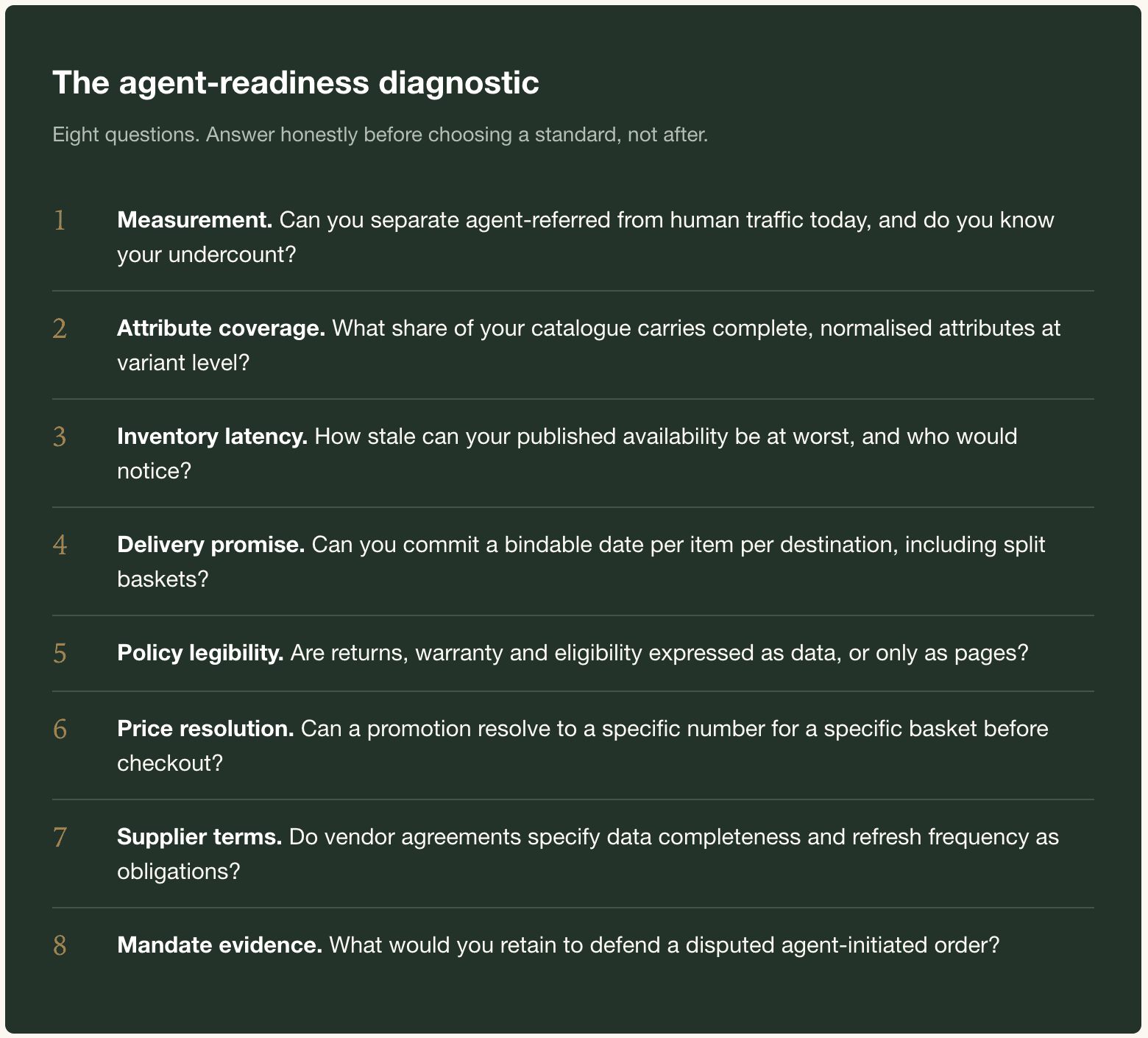
A retailer that can answer these well is ready for ACP, UCP and whatever supersedes them. The integration becomes a short piece of work at the edge of the estate. A retailer that cannot is not made ready by any integration, and will discover this only after the engineering is complete.

"We could have waited, built the module quietly, and announced it as finished. Publishing the design position first is the more useful thing to do; it is testable, someone can tell us we are wrong, and the retailer who disagrees most strongly is probably the one we should be building this with."
- Amjad Pendhari, Head - APAC & Middle East, The Agentics Co.
We are looking for one retailer to build this with
If the eight questions above made uncomfortable reading, that is the normal result and it is a solvable problem. We are seeking a single European design partner, preferably mid-market, multi-brand and genuinely exposed to agent-referred demand, to build the agent-readiness layer of AUG11 with us rather than for an imagined buyer.
A measured baseline of real agent traffic, including the undercount
A readiness assessment across all eight commerce layers
A protocol-agnostic remediation sequence, with adapters last
Shared design input into what gets built, and first access to it

About this research
This paper synthesises published 2026 data on agentic commerce adoption and performance — principally Adobe Analytics Digital Insights, Shopify and Salesforce commerce data, Similarweb referral analysis and IAB measurement research with the primary specifications and governance announcements of ACP, UCP, AP2, MCP and the card-network agent protocols, and with The Agentics Co.'s delivery experience architecting and governing multi-agent systems for commerce.
The eight-layer commerce model is AUG11's own and is published in full. The modelled European fashion retailer is a composite archetype constructed for this paper and is not based on any client engagement. The agent-readiness diagnostic is offered freely and is citable with attribution.
Citation: The Agentics Co. (2026). Agent-Ready Retail: Why the Protocol War Is the Wrong Thing to Prepare For. Retrieved from https://theagentics.co/insights/agent-ready-retail-why-the-protocol-war-is-the-wrong-thing-to-prepare-for
Figures cited are drawn from third-party research across differing samples and methodologies and are directional rather than guarantees; retailer-level results in this channel diverge widely by category and catalogue quality. Protocol status is current as at 6 October 2026 and is changing rapidly. This paper is analysis and general information, not legal, financial, tax or payments-compliance advice.
Selected sources and further reading
Salesforce — 2025 holiday season analysis of AI-influenced retail orders.
Similarweb — ChatGPT referral share by retailer; comparative referral conversion analysis.
Linux Foundation — Model Context Protocol governance transfer, December 2025.
Visa Trusted Agent Protocol; Mastercard Agent Pay; Adyen agentic adapter, June 2026.
Related Post

Agentic Commerce
Oct 6, 2026


Everything AI
Sep 3, 2026