

Continues from Part One. The first paper covered the shift to coordinated systems, why single agents break at scale, the five architecture patterns, infrastructure, self-replication and governance.
THE SHORT ANSWER
A multi-agent design that works in a pilot tells you almost nothing about how it behaves in production. Agentic workflows consume 5–30x more tokens per task than a standard chatbot, because one user request can trigger ten to twenty model calls. Around 40% of multi-agent pilots fail within six months of deployment, and Gartner expects over 40% of agentic projects to be cancelled by the end of 2027.
The failures are not prompt problems. Research across five frameworks and 150+ tasks found 14 distinct failure modes and concluded most are structural. This paper covers what changes between pilot and production i.e. economics, observability, identity and state, and sets out the five controls and the operating cadence that keep a fleet alive once it meets real traffic.
In December 2025, Uber's engineering organisation was at 32% adoption of an agentic coding tool. By March 2026 it was at 84%. By April, the company's entire annual AI budget was gone, and its CTO told the press he was back at the drawing board because the budget he thought he would need had already been blown away. Monthly API costs were running between five hundred and two thousand dollars per engineer.
That is not a story about a company with weak financial controls. It is a story about a cost curve almost nobody models correctly, because the thing that makes agentic systems valuable is the same thing that makes them expensive: they do not answer, they work. A chatbot query triggers one inference call. An agentic workflow plans, calls tools, checks its own output, notices a problem, and tries again (ten to twenty model calls for a single user-initiated task). Gartner's March 2026 analysis puts the multiplier at five to thirty times the tokens per task of a standard chatbot.

Part One of this series ended at the point most architecture papers end: a designed system, a chosen pattern, a governance model on paper. This paper is about the part that actually decides the outcome i.e. the eighteen months after go-live, when the design meets volume it was never tested against, a bill nobody forecast, and incidents that were theoretical until they weren't.
Deployment is not the last step of architecture. It is a distinct discipline with its own failure modes, and it is where the majority of multi-agent value is currently being lost.

01 - THE ECONOMICS: The Token Multiplier Nobody Modelled
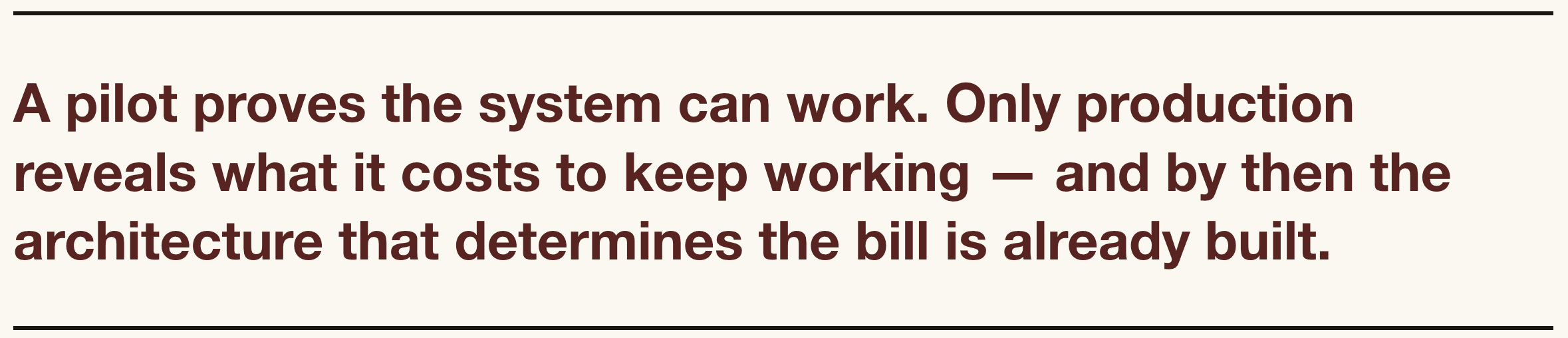
Start with the number that ends most programmes, because it arrives before any of the others. Pilot economics and production economics for the same multi-agent design are not on the same scale. A pilot runs perhaps fifty to five hundred controlled queries with predictable inputs. Production runs tens of thousands of requests daily, with edge cases, retries, concurrency and real business stakes. A three-agent workflow that costs tens of dollars across a demo cycle can generate five-figure monthly bills at production volume.
The multiplier compounds through three mechanisms, and understanding them is what makes the cost forecastable rather than surprising.
First, call multiplication: each step in an agent's loop i.e. plan, act, observe, verify, correct, is a separate inference.
Second, context carriage: in naive designs every agent receives the full accumulated context, so token consumption grows with the product of agent count and context length. Measurements on production five-agent code-review pipelines record 42,000 to 71,000 tokens per invocation, of which 29–38% is redundant context consumed by agents that never act on it.
Third, retry amplification: a failure at step nine of a twelve-step graph may re-run everything upstream of it.
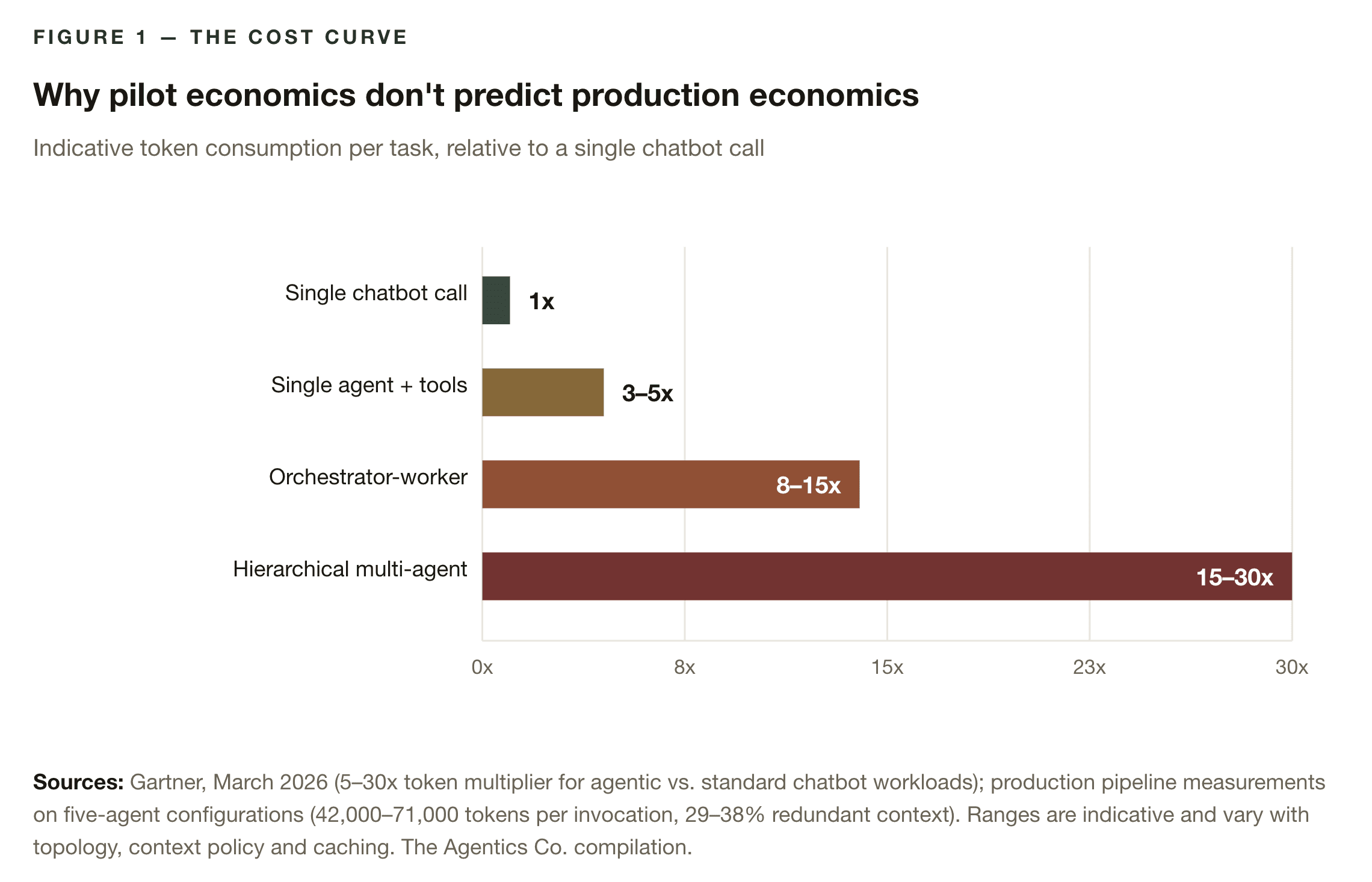
The practical response is not to abandon multi-agent designs; it is to treat cost as an architectural property rather than a billing surprise. That means budgeting for the multiplier before deployment, scoping context per agent instead of broadcasting it, caching intermediate reasoning, routing simple sub-tasks to cheaper models, and instrumenting token consumption per workflow step as a first-class metric alongside latency and accuracy. A fleet without a per-task spend cap and a circuit breaker is a fleet with an unbounded liability attached to it.
02 - THE FAILURE SURFACE: Most deployment failures are structural, not prompt-level
The most consequential research finding of the past year, for anyone operating these systems, is that the failures are architectural. An analysis of five popular multi-agent frameworks across more than 150 tasks identified 14 distinct failure modes grouped into three categories: specification and system design, inter-agent misalignment, and task verification and termination. The authors' conclusion was blunt i.e. many of these failures cannot be fixed with better prompting. On one benchmark, redesigning the topology lifted correctness from 25.0% to 40.6%: a substantial relative improvement that still sat well below what a production system would tolerate.
This matters because it redirects the response. When a multi-agent system misbehaves in production, the instinct is to tune the prompt, add an instruction, or swap the model. Those interventions treat a structural problem as a linguistic one. In our delivery experience the recurring production failures cluster into five patterns, each of which has a control rather than a prompt as its answer.

01) Runaway loops and non-termination
An agent fails a verification step, retries, fails again, and never reaches a terminating condition with burning tokens and wall-clock time on a task that will not complete. This is the single most expensive production failure because it is silent: the system is busy, so nothing looks broken.
THE CONTROL → An action budget capping tool calls and iterations per task, with a hard stop on exceed and an alert rather than a silent retry.
02) Cost overrun without a circuit breaker
Consumption scales with adoption, not with forecast. When usage grows faster than expected as it invariably does after a successful internal launch, a fleet with no spend ceiling converts enthusiasm directly into an unbudgeted bill, often before the next reporting cycle surfaces it.
THE CONTROL → Per-task and per-fleet spend caps with an automatic circuit breaker, plus real-time cost alerting tied to an owner, not a dashboard nobody opens.
03) Silent output corruption
A malformed or hallucinated output passes unvalidated into a downstream system, where it is treated as fact. Unlike a crash, this failure propagates: the error becomes a record, the record becomes an input, and the damage is discovered weeks later in a reconciliation.
THE CONTROL → Schema-validated outputs at every hand-off, so a malformed result triggers an automatic retry or escalation rather than silently corrupting state.
04) Over-permissioned agent identity
An agent holds a valid credential with no allow-list scoping what it may touch. As Part One noted, most enterprises do not yet treat agents as identity-bearing entities, which makes an over-permissioned agent a service account nobody is monitoring, operating at machine speed.
THE CONTROL → Tool allow-listing per agent role, explicitly audited and reviewed, with credentials scoped to the agent rather than inherited from the engineer who deployed it.
05) Unreconstructable incidents
Something went wrong in a twelve-step graph with three sub-agents and four tool calls, and the logs record only the final output. Without step-level traces the team cannot say which agent, which tool call, or which decision branch caused it; so the fix is a guess and the incident recurs.
THE CONTROL → End-to-end trace propagation with nested spans preserving parent-child relationships across hand-offs, plus checkpoint and rollback so failures are recoverable.
03 - THE OBSERVABILITY LAYER: Tracing a prompt is not tracing a system
The most expensive misconception in production agentics is treating an agent as a single model call with a wrapper around it. It isn't. A production agent is a distributed system that happens to reason in natural language, and it needs the observability posture of a distributed system rather than the logging posture of an application.
The distinction is precise. Conventional monitoring observes outputs. Agent observability explains the chain of decisions that produced the outcome: tool selection, tool arguments, model responses, memory reads and writes, state transitions and decision branches. One tells you the answer was wrong.
The other tells you that the retrieval step returned stale context at span seven, which caused the planner to select the wrong tool at span nine. Only the second is actionable, and only the second produces the evidence trail that governance and the EU AI Act's logging obligations require.
Four capabilities now constitute the working baseline for production multi-agent systems. They are worth stating plainly, because most enterprise stacks have one or two of them and assume that is sufficient.
CAPABILITY | WHAT IT MEANS IN PRACTICE | WHAT BREAKS WITHOUT IT |
|---|---|---|
SPAN-LEVEL TRACING | Every step emits a span; nested spans preserve parent-child relationships across multi-agent hand-offs. | Incidents can't be reconstructed or attributed |
STANDARDS-BASED SCHEMA | OpenTelemetry-based instrumentation, so traces are portable across backends without re-instrumenting. | Vendor lock-in; re-instrumentation on every tool change |
CONTINUOUS EVALUATION | Automated judges scoring sampled production traces against a golden dataset, on a schedule. | Semantic drift surfaces as customer complaints |
TRACE-TO-TEST LOOP | Risky production traces become evaluation cases; every incident yields a regression test. | The same failure recurs after every model update |
The fourth capability is the one most often missing and the one that compounds fastest. An observability stack that only shows you traces is a debugging tool. An observability stack that converts production failures into permanent regression coverage is an improvement engine; hence it means the system gets measurably harder to break with every incident, rather than accumulating fragility with every model update.
04 - THE CONTROLS: Five controls that belong on every production fleet
Part One set out four governance controls at the architecture layer. Deployment adds a further five, and their common property is that each one is a boundary, a limit the system cannot exceed without a human being informed. Autonomy without boundaries is not autonomy; it is an unmonitored process with a credential.
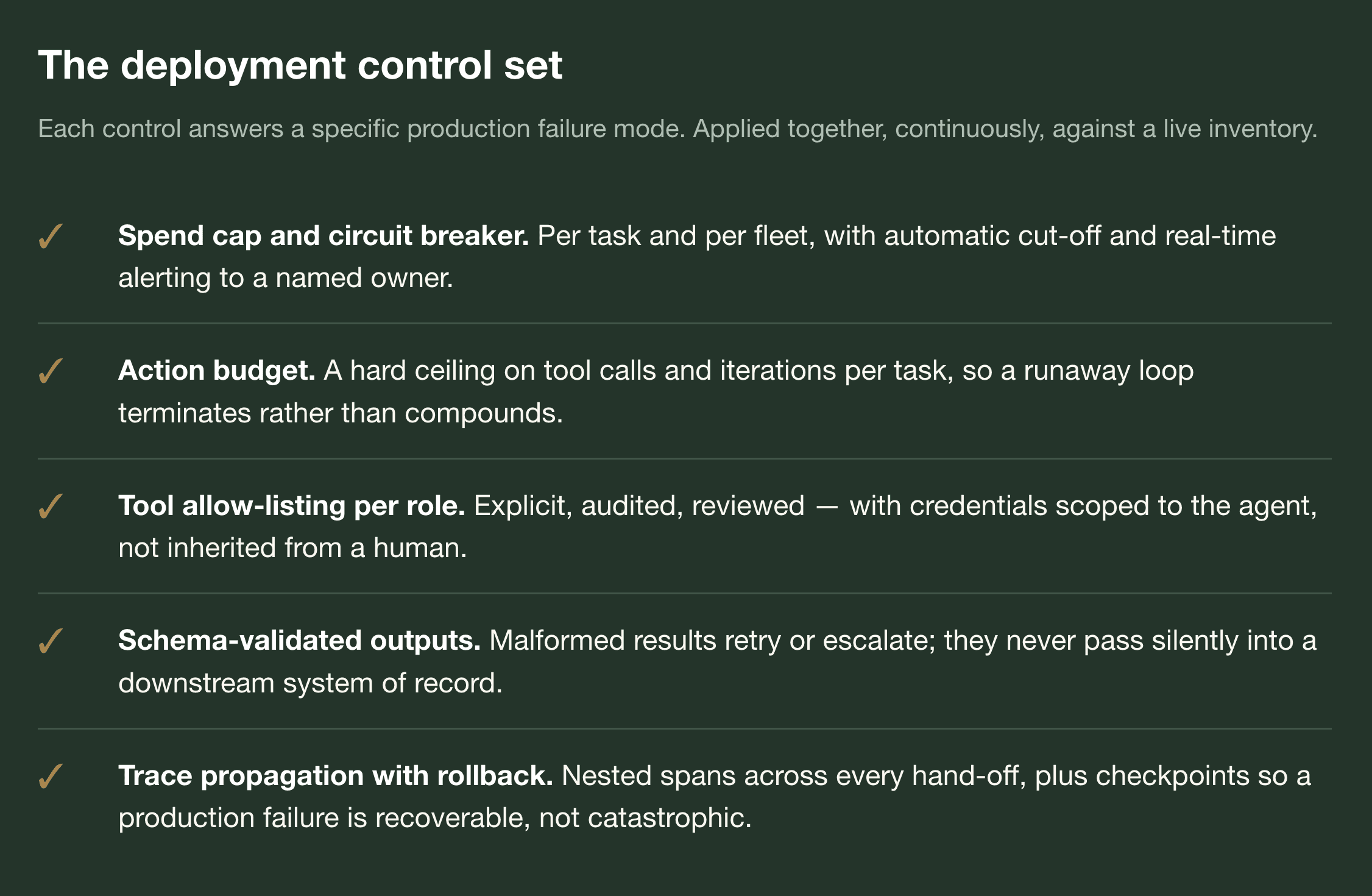
None of these is technically difficult. All five are routinely deferred, because at pilot scale none of them appears necessary as the volumes are small, the costs are trivial, and the engineer who built the system is watching it. Every one of them becomes necessary at exactly the moment it becomes expensive to add.
05 - THE OPERATING CADENCE: From launch to operating capability
The final piece is organisational rather than technical. Part One's framework described a loop (architecture, deployment, optimisation) that does not terminate. In practice, enterprises sit at one of four levels of deployment maturity, and the distance between them is measured in operating discipline rather than technology spend.
Level 1 · Launched
The system is live and largely unobserved. Logs capture outputs, not decision paths. Cost is discovered monthly, in arrears. Incidents are diagnosed by reading the final answer and guessing backwards. Most first deployments sit here, and most stay here until something expensive happens.
Level 2 · Instrumented
Traces exist and someone reads them. Span-level tracing is in place, cost is visible in near real time, and there is a named owner. The team can reconstruct what happened but improvement is still reactive, driven by incidents rather than by measurement.
Level 3 · Evaluated
Quality is measured continuously, not anecdotally. Sampled production traces are scored against a golden dataset on a schedule; drift is caught before users report it; every incident becomes a regression test. The system now gets harder to break over time.
Level 4 · Governed at fleet scale
The unit of management is the fleet, not the agent. A live inventory of every agent, owner, access scope, model version and review date. Controls applied uniformly. Retirement is a defined process. New use cases inherit the operating model instead of rebuilding it, which is the point at which multi-agent stops being a project and becomes a capability.
The gap between Level 1 and Level 4 is not eighteen months of engineering. It is a set of decisions about what to instrument, what to cap, and who is accountable; most of which cost far less to make before deployment than after. The organisations that reach Level 4 are rarely the ones that spent the most. They are the ones that treated deployment as a design problem rather than a launch event.
Autonomy without boundaries isn't autonomy. It's an unmonitored process holding a credential, operating at machine speed.
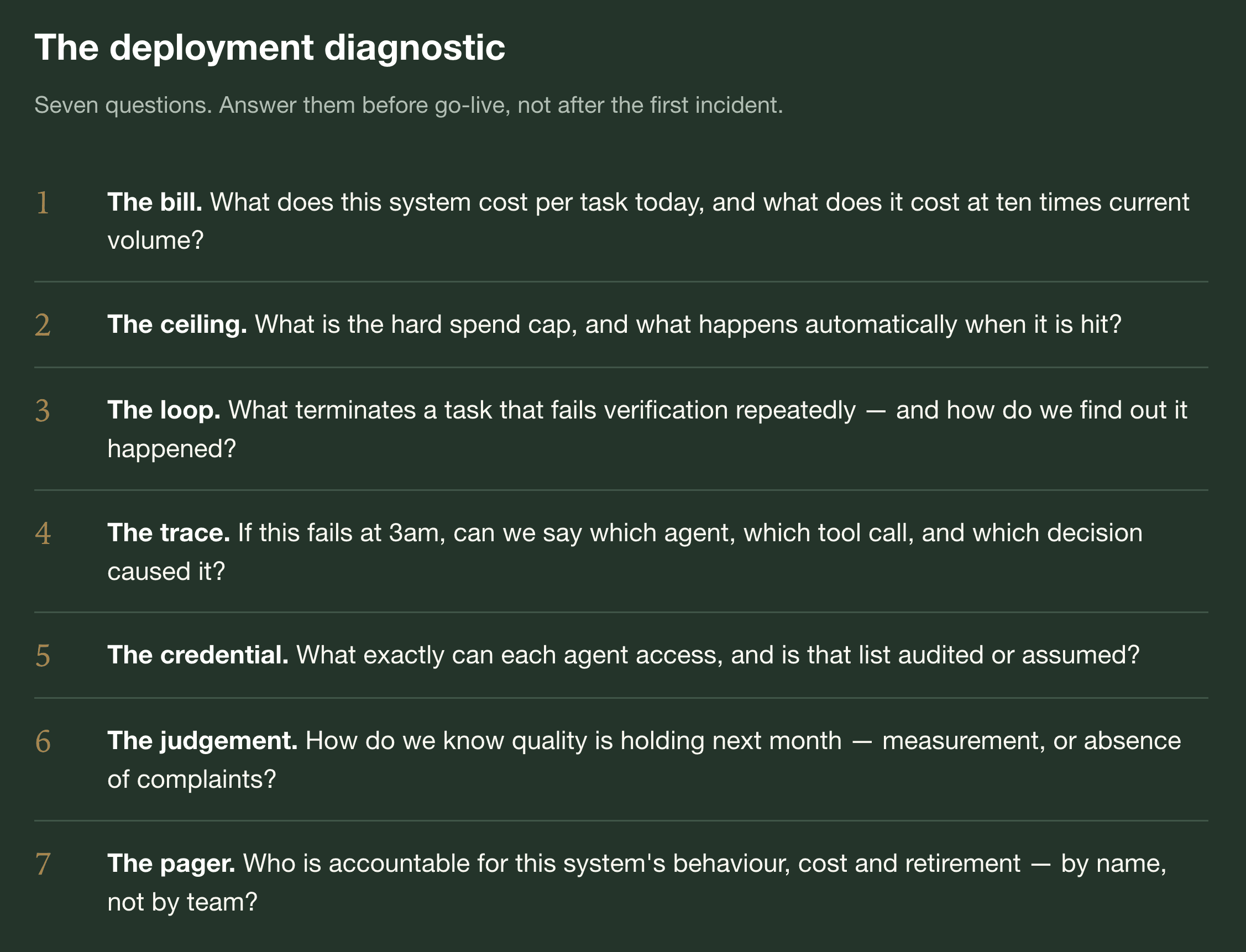
06 - THE DIAGNOSTIC: Seven questions before your next production release
Part One closed with nine questions for an architecture review. These seven are for the release review, the meeting immediately before a multi-agent system meets real traffic. As before: if the answers require jargon to sound convincing, the answer is no.
Architecture is a Decision. Deployment is a Discipline.
The enterprises that will be operating meaningful agent fleets in eighteen months are not the ones with the most sophisticated topologies. They are the ones whose systems survived the month the volume tripled, the quarter the bill arrived, and the night an agent did something nobody had designed for. None of those events are edge cases. They are the normal operating conditions of a production multi-agent system, and they are entirely foreseeable.
Part One argued that you should architect the system, not just the agent. Part Two's argument is narrower and, in our experience, more expensive to ignore: design the operating model before you need it. The controls, the traces, the caps and the named owners cost days to build before deployment and months to retrofit after an incident. The gap between a fleet that compounds value and one that quietly compounds liability is almost entirely decided in that window.
About this research
This paper is Part Two of The Agentics Multi-Agent Architecture Series. It synthesises 2026 industry research on agentic cost, observability and deployment failure with The Agentics Co.'s delivery experience architecting, deploying and governing multi-agent systems across BFSI, CPG, retail, manufacturing, healthcare, logistics and ESG in Europe, the Middle East, Africa, APAC and LATAM. The deployment control set, the four-level deployment maturity ladder and the seven-question release diagnostic are The Agentics Co.'s own analytical frameworks, offered here for the wider enterprise community and citable with attribution.
The Agentics Co. is a boutique Enterprise AI transformation firm specialising in Agentic AI and Multi-Agent Systems. Learn more at theagentics.co.
Citation: The Agentics Co. (2026). Agentic AI Multi-Agent Architecture Series — Part Two: Deployment at Scale. Retrieved from https://theagentics.co/insights/agentic-ai-multi-agent-architecture-series---part-two-deployment-at-scale.
Figures cited are drawn from third-party 2026 research across differing samples and methodologies and are directional rather than guarantees; cost multipliers in particular vary widely with topology, context policy, caching and model selection. This paper is analysis and general information, not financial, legal or security advice.
Selected sources & further reading
Goldman Sachs — projected growth in enterprise token consumption to 2030.
The Agentics Co. — Multi-Agent Architecture Series Part One, The Enterprise MCP Guide 2026, The Enterprise AI Value Realisation Engine, theagentics.co/insights.