

The Short Answer
“Bundling” is four different legal problems wearing the same word. In antitrust it is a pricing and market-power question. In healthcare billing it is a coding-accuracy question and the violation is unbundling. In campaign finance it is a disclosure question with a hard dollar threshold. In FDA submissions it is a filing-structure question under a user-fee regime.
The same commercial act → Selling or Filing things together, triggers four unrelated bodies of law, enforced by different agencies, tested by different standards. Most enterprises manage them in four separate silos, none of which sit where the transaction actually happens: the ERP.
This article maps the four regimes, walks nine industry verticals, and shows where a governed agentic layer changes a detective control into a preventive one while being explicit about the judgments an agent must never be permitted to make.
1 | The Landscape: Four Regimes, Seven Agencies, One Word
Bundling compliance is not one rule set. It is a cross-functional framework spanning antitrust, healthcare billing, political disclosure and FDA submission strategy; each with its own regulator, its own test, and its own evidentiary expectation.
The confusion is not academic. A pricing team running a portfolio discount, a revenue-cycle team coding a procedure, a government-affairs team tracking contributions, and a regulatory team packaging a device filing are all doing something called “bundling.” None of them are doing the same thing, and the controls that govern one are useless for the others.
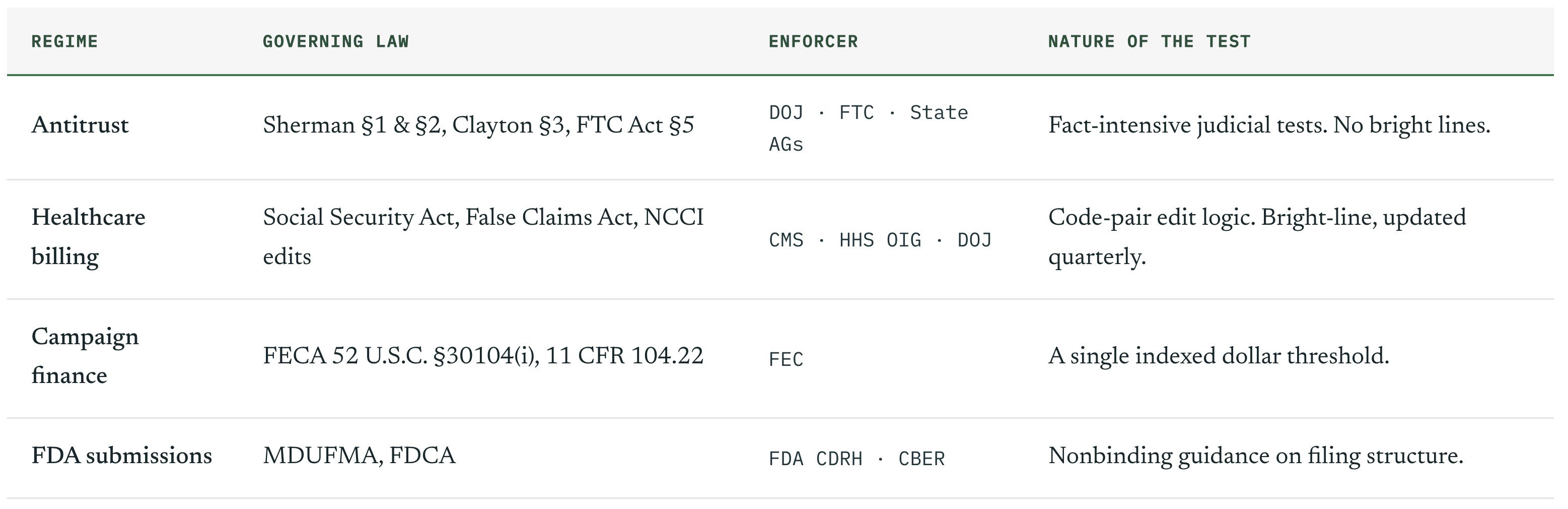
The Asymmetry That Drives Control Design: Three of these regimes give you numbers you can code against. Antitrust gives you fact-intensive judicial standards. That single difference determines what can be automated and what must always route to a human and it is the reason a uniform “bundling policy” rarely survives contact with operations.
2 | The Structural Problem: Why Bundling Resists Governance?
Every other compliance domain has a natural owner. Bundling does not. It is created by Sales, priced by Finance, delivered by Operations, billed by Revenue Cycle, and reviewed by Legal.
That diffusion is the root cause, and it produces four failure modes that appear in every sector we have examined:
Ownership is diffuse. The bundle is designed in a pricing meeting, approved in a CRM, executed in the ERP, and billed in a claims system. No single function sees the whole chain, so no single function is accountable for its legality.
Controls are detective, not preventive. NCCI edits fire at claim scrubbing. Contribution aggregation is checked at period close. Bundle pricing reaches counsel after the deal is structured. Every one of these fires after commitment.
The rules move underneath you. CMS updates NCCI Procedure-to-Procedure edit tables quarterly. The FEC threshold is indexed annually. A control hard-coded once is stale within a quarter and silently wrong thereafter.
Evidence is scattered. Proving a bundle was compliant means reconstructing pricing, contracts, clinical documentation and approvals from four systems, months later, under time pressure from a regulator.

3 | The Four Regimes
Regime One: Antitrust

Bundling becomes an antitrust problem when a firm with market power uses the bundle to coerce purchase of a product the customer does not want, or to foreclose rivals who cannot match the bundle. Both market power and competitive effect must be assessed. Neither alone is sufficient, and the absence of either usually ends the inquiry.
Courts have developed three distinct theories of harm, and they are genuinely different analyses rather than three names for one thing:
Theory 1 · Tying
A seller conditions the sale of a desired product on the purchase of a second, separate product. The harm is coercion i.e. market power in product A leveraged into market B. The controlling framework comes from Jefferson Parish Hospital District No. 2 v. Hyde, 466 U.S. 2 (1984).
The elements courts assess run in sequence, and all must be present:
Two separate products. Is there separate consumer demand for each? Products routinely sold separately in the market are usually distinct.
Conditioning. Is purchase of the tied product genuinely required, or merely offered? A true option is not a tie.
Market power. Does the seller hold appreciable economic power in the tying-product market? Without it, coercion is not credible.
Effect on commerce. Is a not-insubstantial volume of commerce in the tied market affected?
Theory 2 · Bundled Discounts
A discount is conditioned on buying the whole bundle. The harm is exclusion of an equally efficient but less diversified rival who cannot match the aggregate discount across products it does not sell. The Ninth Circuit's discount-attribution test in Cascade Health Solutions v. PeaceHealth, 515 F.3d 883 (9th Cir. 2008), is the most administrable formulation and the one an enterprise can actually compute in advance.
Theory 3 · Predatory Pricing
The bundle is priced below cost to drive out competitors, with a dangerous probability of recouping the loss afterward. The standard derives from Brooke Group Ltd. v. Brown & Williamson Tobacco Corp., 509 U.S. 209 (1993). Note the difference from discount attribution: Brooke Group asks whether the bundle price exceeds the cost of producing the whole bundle, while PeaceHealth asks whether the discount, fully attributed to one component, could exclude a rival selling only that component.
The Most Damaging Error in Bundling Compliance: Antitrust law provides no fixed numerical threshold for legality. Market share and HHI concentration figures are analytical screening benchmarks used in enforcement and merger review; not legal pass/fail rules. Compliance programs that present them as determinative give business teams false confidence in exactly the cases where judgment matters most. Distinguish carefully between statutory thresholds, agency guidance and safe harbours, judicial tests, and economic indicators.
Worked Example: Discount Attribution
The PeaceHealth test asks a question an enterprise can answer with data it already holds: allocate the entire bundled discount to the competitive product. If the resulting imputed price falls below the seller's incremental cost for that product, an equally efficient rival could not match it and the bundle may be exclusionary.
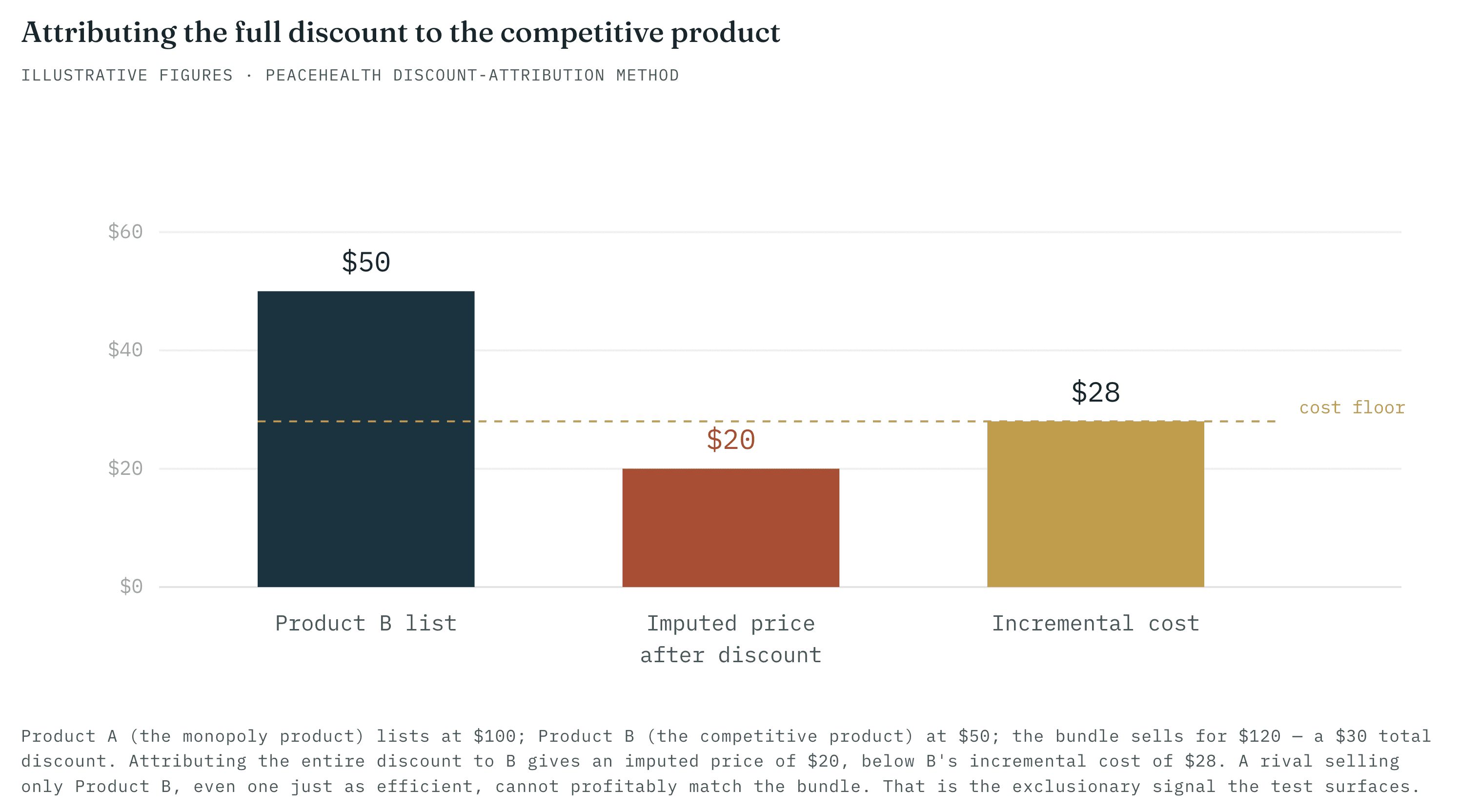
The arithmetic matters less than the operational point: this is computable before a deal is signed, from price-list, cost and quote data that already sit in the ERP. Today it is typically reconstructed by outside counsel after a complaint. That gap between “computable in advance” and “computed in hindsight” is precisely where an agent belongs.
Circuits differ in their treatment of bundled discounts; other courts have applied LePage's foreclosure reasoning or a straightforward Brooke Group analysis. The test above is not universal law; it is the most widely used administrable screen.
Regime Two: Healthcare Billing, The Inverted Risk

The Inversion: In antitrust, bundling is the risk. In healthcare billing, bundling is the requirement and unbundling is the violation.
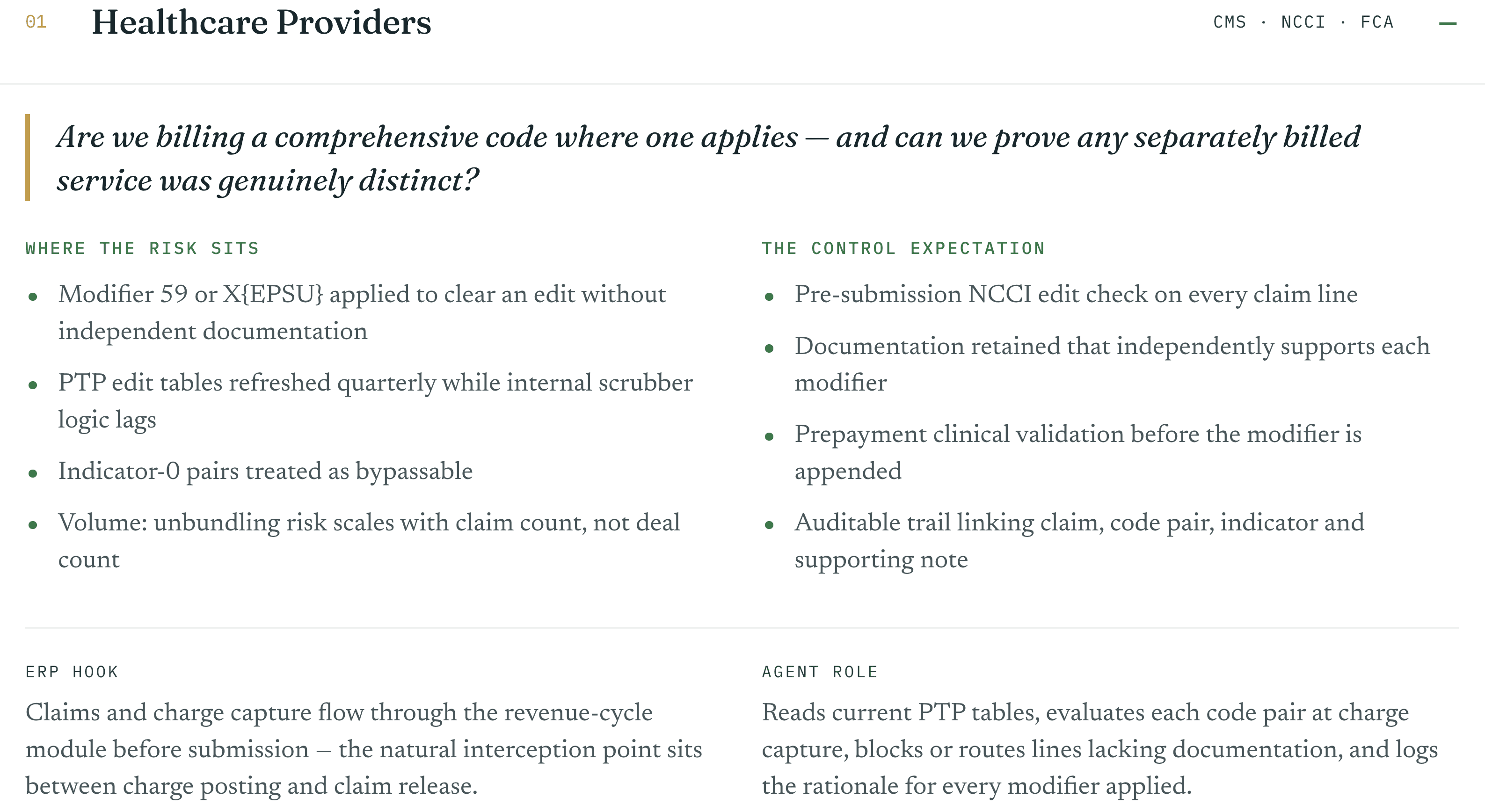
Splitting procedures that should be billed under one comprehensive code inflates reimbursement and creates exposure under the False Claims Act. The operational control is CMS's National Correct Coding Initiative, which publishes Procedure-to-Procedure (PTP) edit pairs identifying which codes may not be billed together for the same patient, by the same provider, on the same date.
How a PTP edit pair works
Column 1: The comprehensive code, the service that is paid.
Column 2: The component code, denied when billed alongside Column 1.
Indicator 0: The edit cannot be bypassed. No modifier overrides it, regardless of documentation.
Indicator 1: May be bypassed with an appropriate modifier where clinical circumstances genuinely support separate reporting.
Indicator 9: Edit deleted or not applicable.
Modifier 59 is NOT a Bypass Key: Modifier 59 (Distinct Procedural Service) and the X{EPSU} modifiers may only be applied where documentation independently supports a genuinely separate service; a different session, a different anatomic site, or a distinct procedure. Applying a modifier solely to clear an edit, without the underlying record, converts a coding error into a false claim. CMS guidance is explicit that 59 is a modifier of last resort, and payers conduct prepayment clinical validation to test whether its use was clinically appropriate.
Two operational facts make this a systems problem rather than a training problem.
→ First, PTP edit tables are updated quarterly; a code pair that was bypassable last quarter may not be this quarter.
→ Second, unbundling risk scales with claim count, not deal count: a mid-sized provider group generates more compliance-relevant decisions in a week than a pricing team makes in a year.
Regime Three: Campaign Finance, The One Bright Line

This is the one regime with a genuinely bright line. Committees receiving two or more bundled contributions from a lobbyist/registrant or lobbyist/registrant PAC that aggregate above the threshold within a covered period must file FEC Form 3L, identifying the bundler, the address, the lobbyist's employer where applicable, and the aggregate amount bundled.

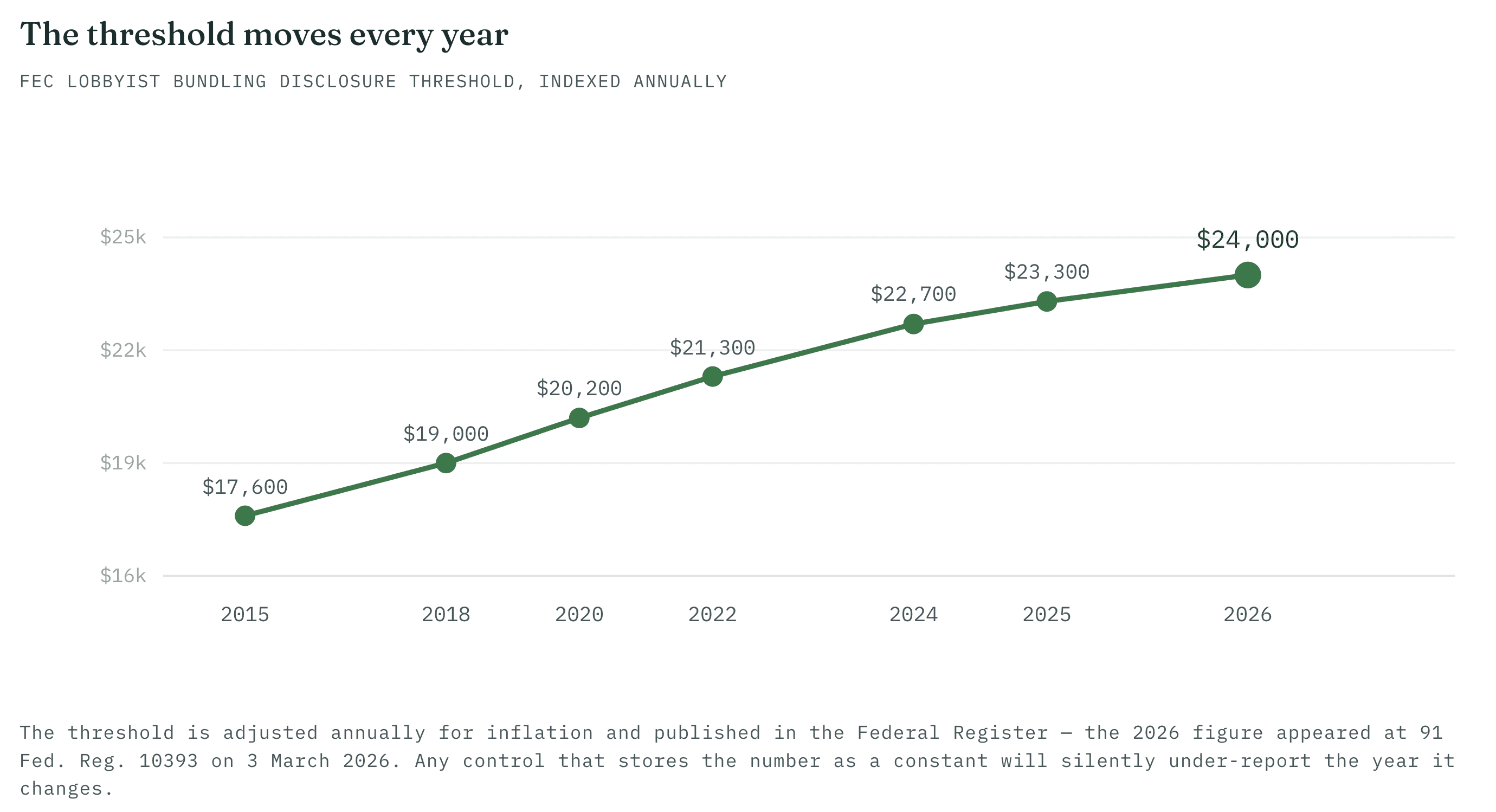
Covered periods align to the committee's quarterly or monthly reporting cycle, with semi-annual periods covering January–June and July–December. The compliance difficulty is rarely the threshold itself; it is aggregation across a period, attributed to the correct bundler, when contributions arrive through different channels and are recorded in different systems.
Regime Four: FDA, Bundling as Filing Strategy

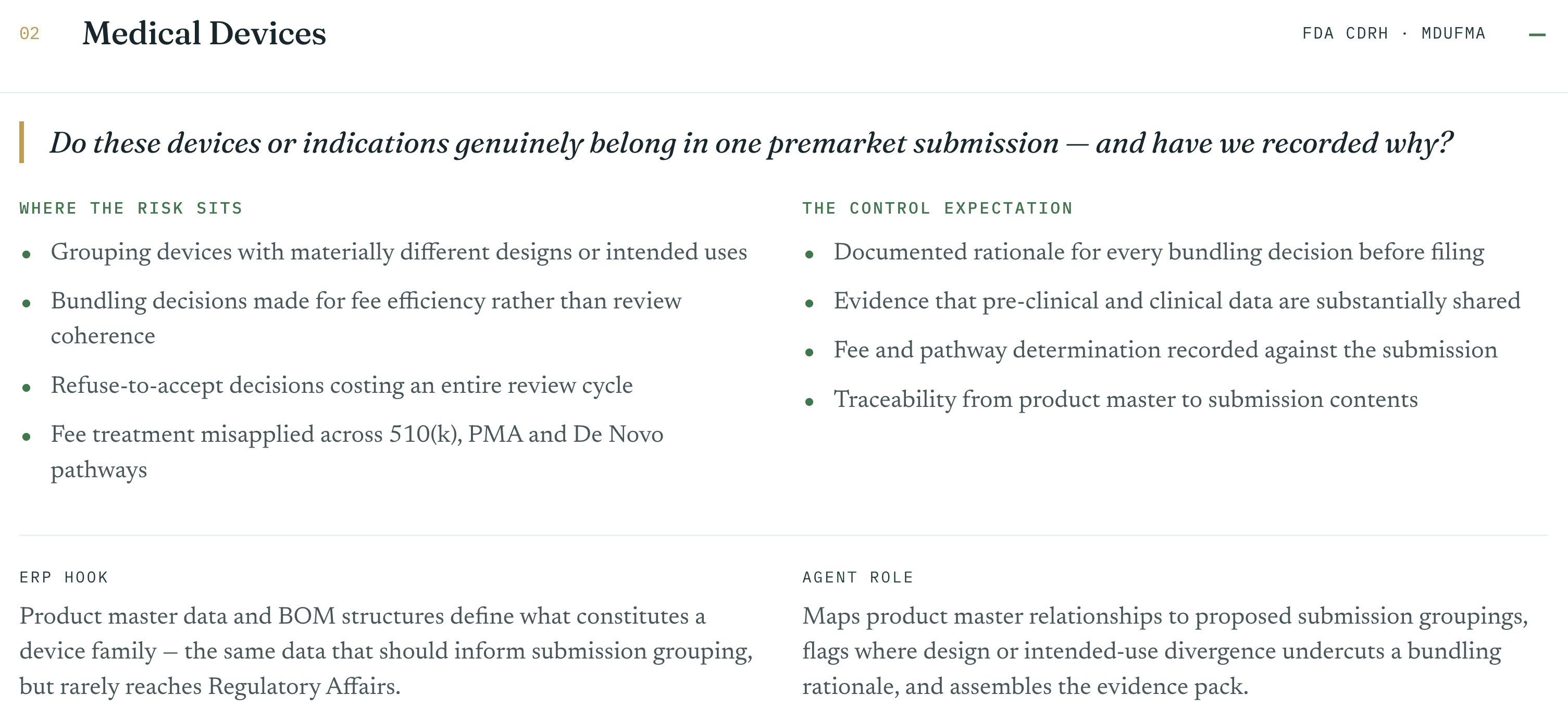
Here “bundling” means something else entirely: packaging multiple devices or multiple indications into a single premarket submission. FDA's guidance (Bundling Multiple Devices or Multiple Indications in a Single Submission, issued 22 June 2007 under Docket FDA-2003-D-0376) describes when that is appropriate. It matters commercially because MDUFMA attaches user fees and review performance goals to submissions.
WHAT IT GOVERNS
Whether multiple devices or indications legitimately belong in one premarket submission for review purposes — 510(k), PMA or De Novo.
→ Why Commercial: User fees and review clocks attach per submission. Bundling decisions change both fee treatment and the review pathway.
→ The Risk: Improper bundling can affect submission acceptability and fee treatment. A refuse-to-accept decision costs a review cycle, not merely a fee.
→ Nature of the Rule: The guidance is explicitly non-binding. It represents FDA's current thinking; alternative approaches are permitted if they satisfy the statute.
The Practical Compliance Point: The question is not “can we file these as one?” but “do these share enough pre-clinical and clinical evidence that a single review is coherent?” Where multiple individual submissions would contain substantially the same supporting information, one submission may be appropriate. Where the devices differ materially in design or intended use, bundling them invites a refuse-to-accept decision and the cost is measured in review cycles.
4 | The Stakes: The Cost of Getting It Wrong is Rising
False Claims Act enforcement reached a record in fiscal year 2025, and healthcare accounted for the overwhelming majority of it. Coding and billing accuracy; the domain where bundling rules bite hardest sits at the centre of that exposure.

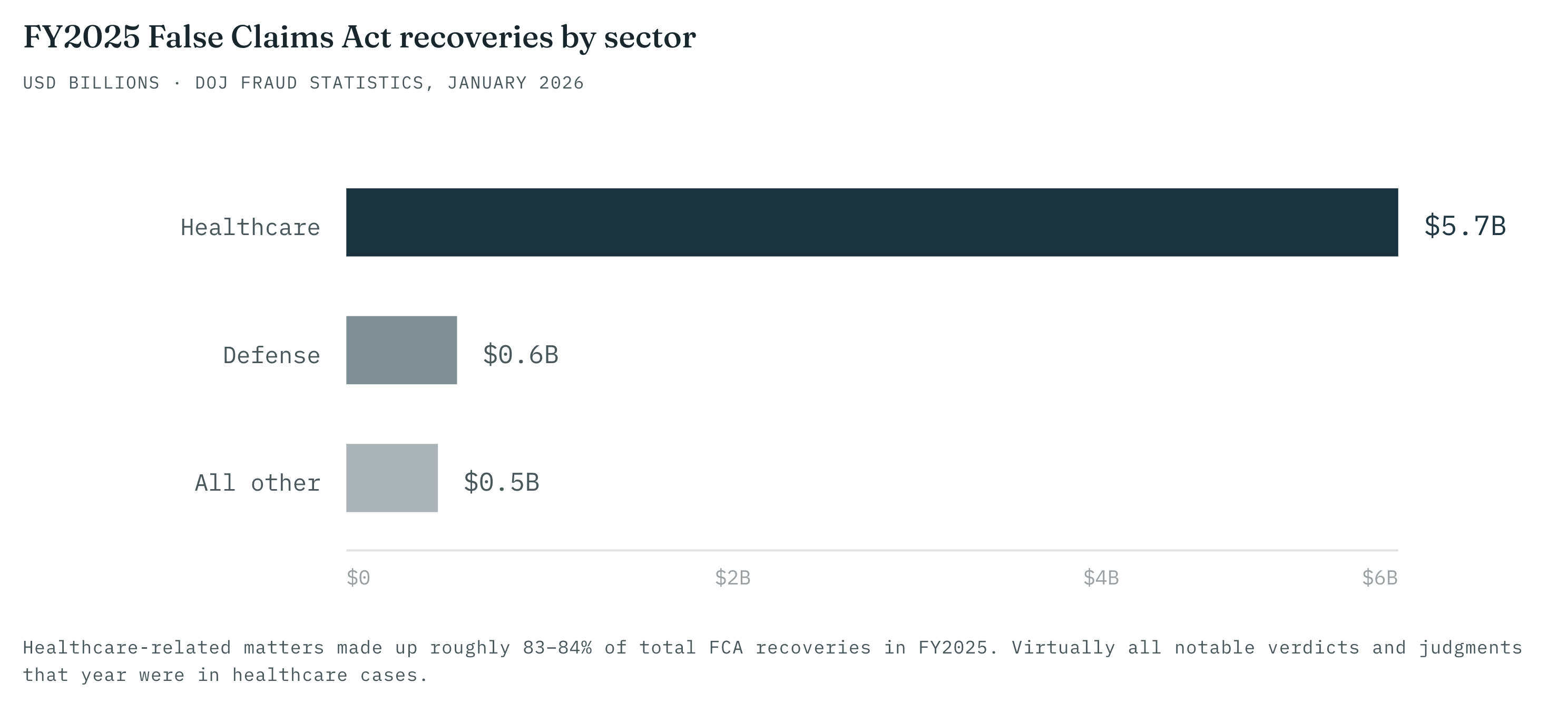
Three features of the current enforcement posture deserve attention from anyone designing controls:
Whistleblowers are driving the docket. Roughly $5.3B of the $6.8B derived from qui tam matters, with a record share coming from cases the government declined to intervene in; meaning relators pursued them to judgment independently.
Regulators are deploying analytics too. CMS and DOJ have signalled expanded use of AI and advanced data analytics for audit and fraud detection. The asymmetry that once favoured volume is closing.
Absence of a program is an aggravating factor. Enforcement guidance increasingly treats the lack of a functioning compliance program not as a neutral fact but as something that worsens the outcome.

5 | Industry View: Nine Verticals, Nine Different Questions
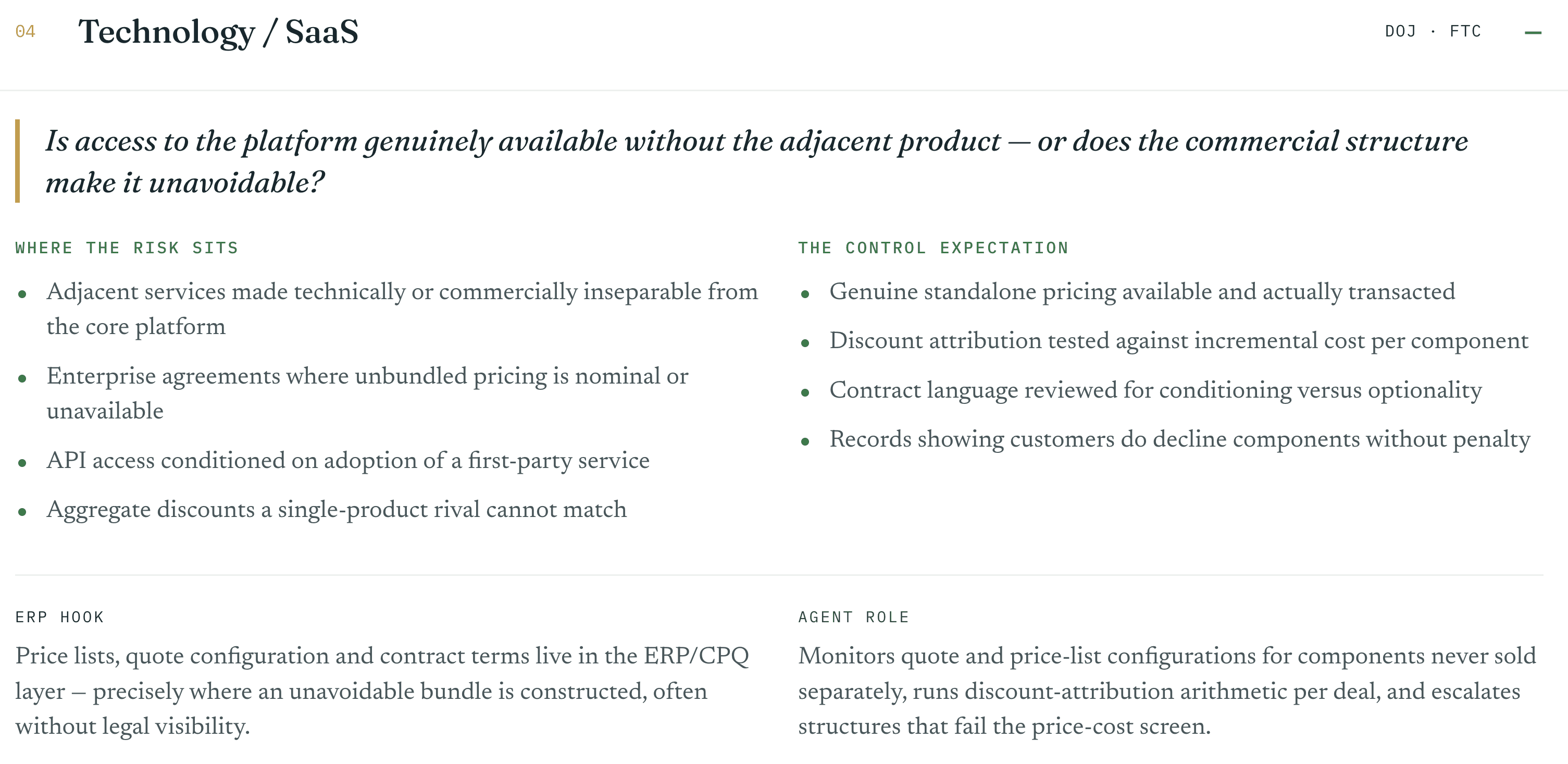
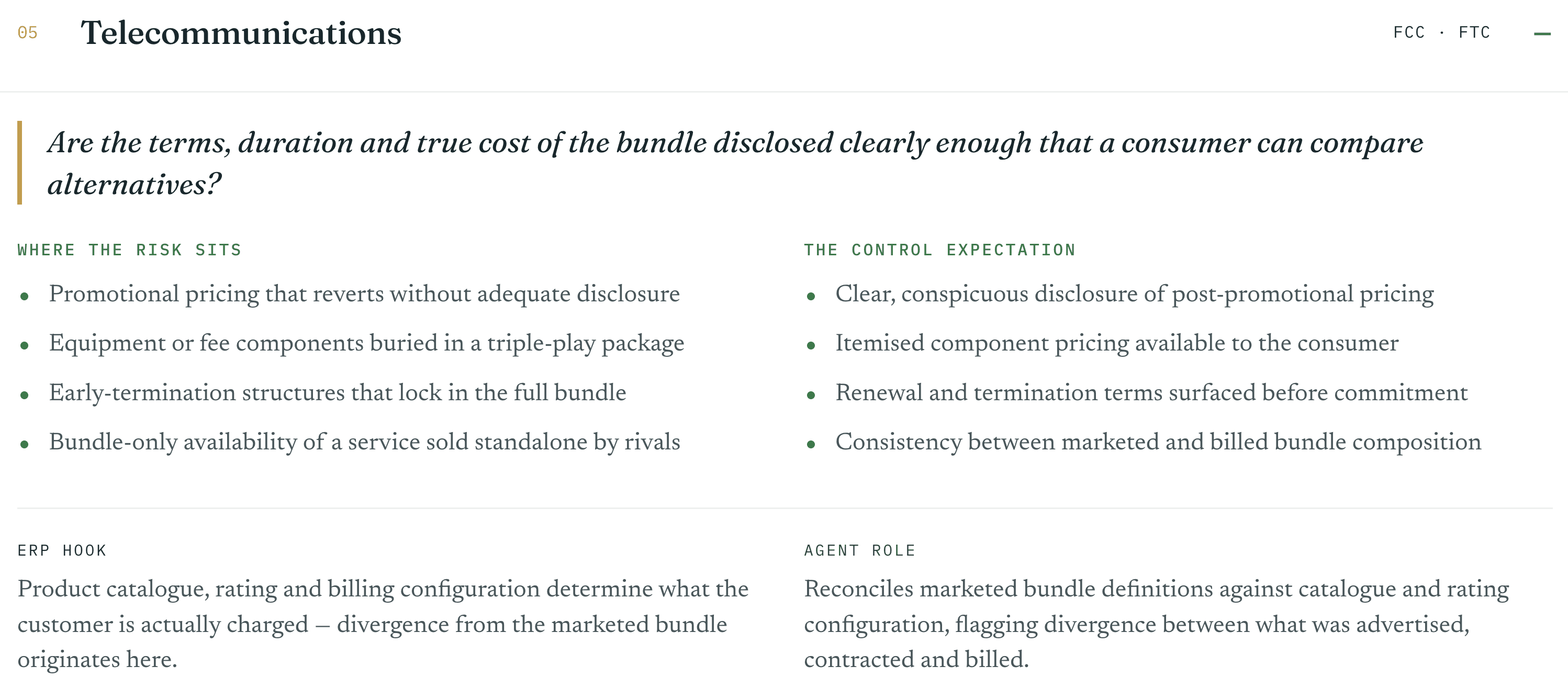
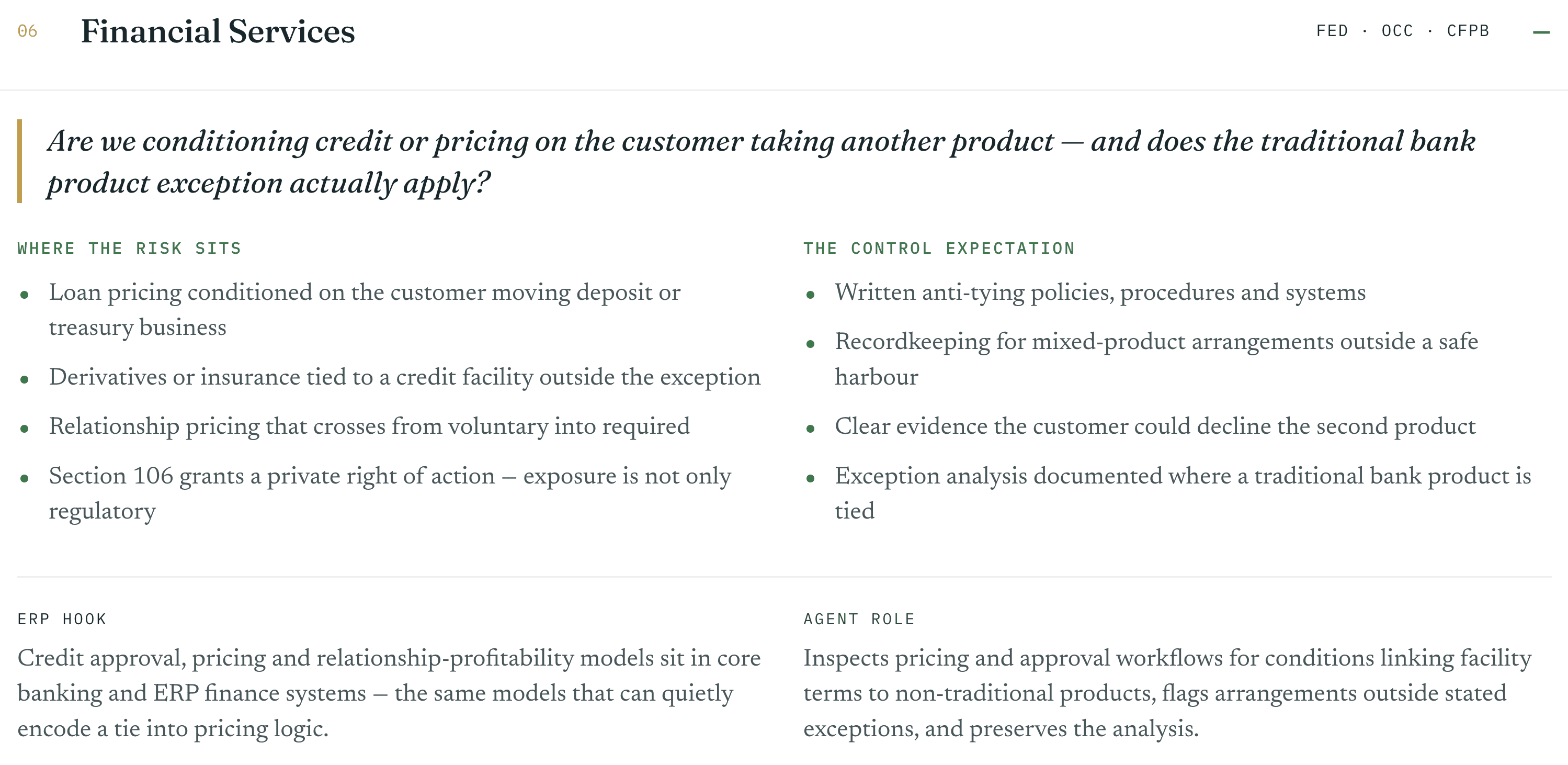
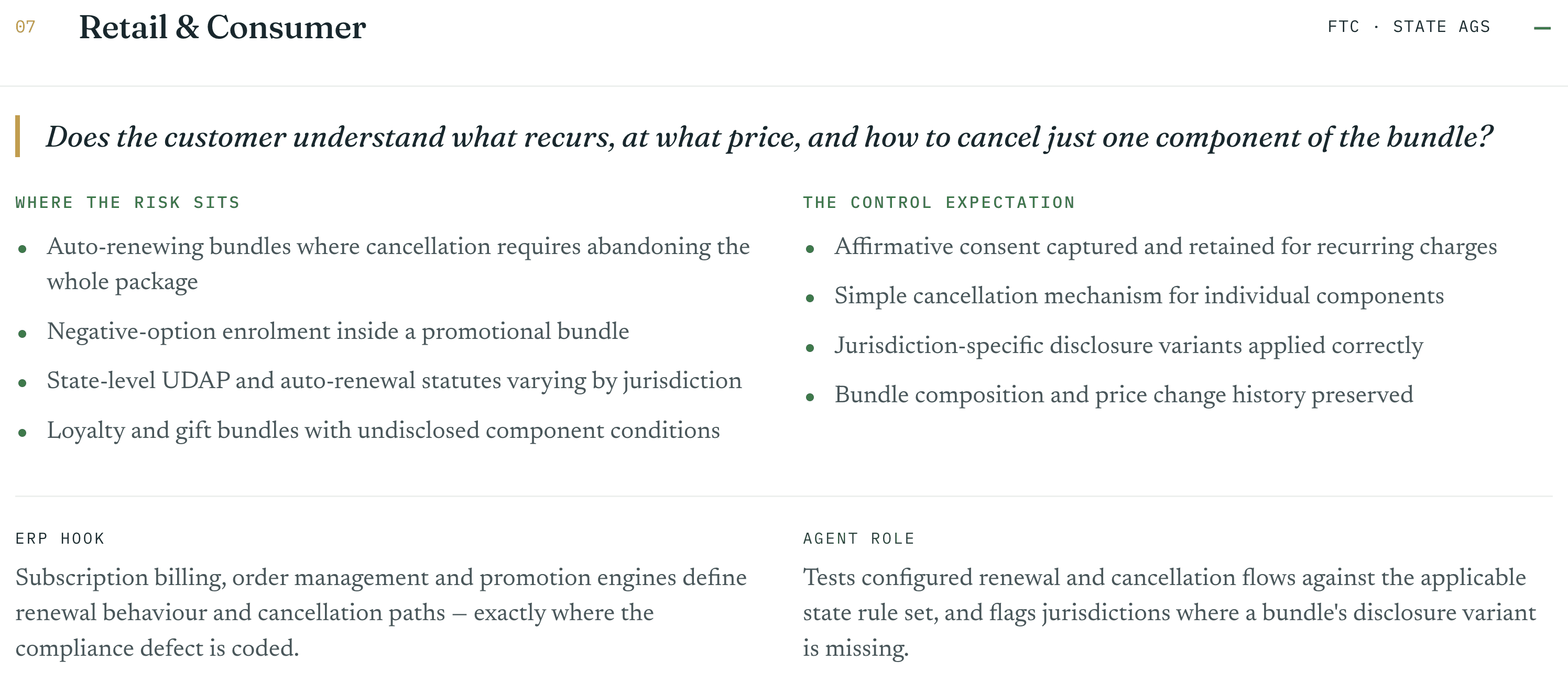
The same word means something different in each sector. This is why a single enterprise-wide “bundling policy” rarely survives contact with operations and why the control has to be built where the sector's transaction actually happens.
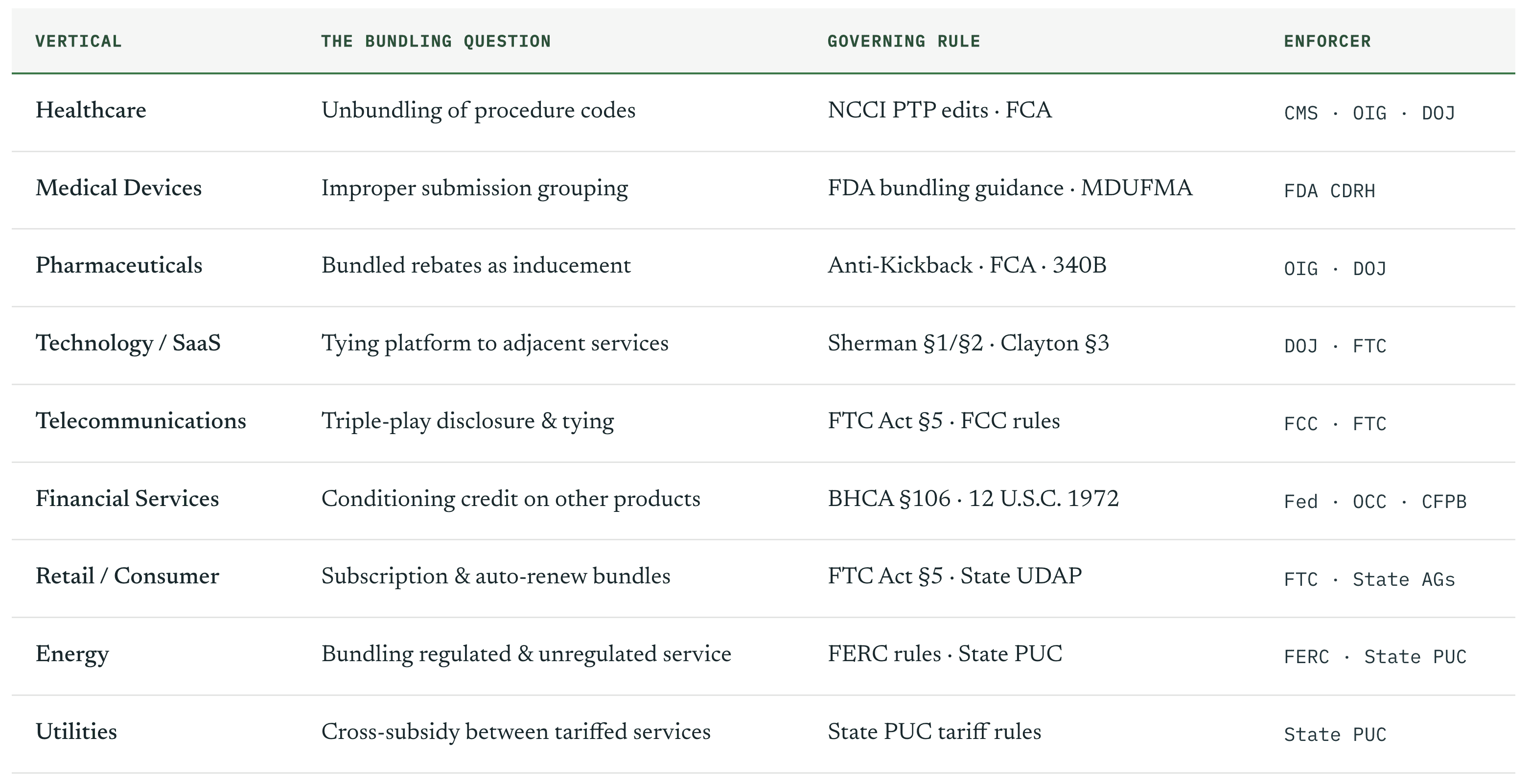
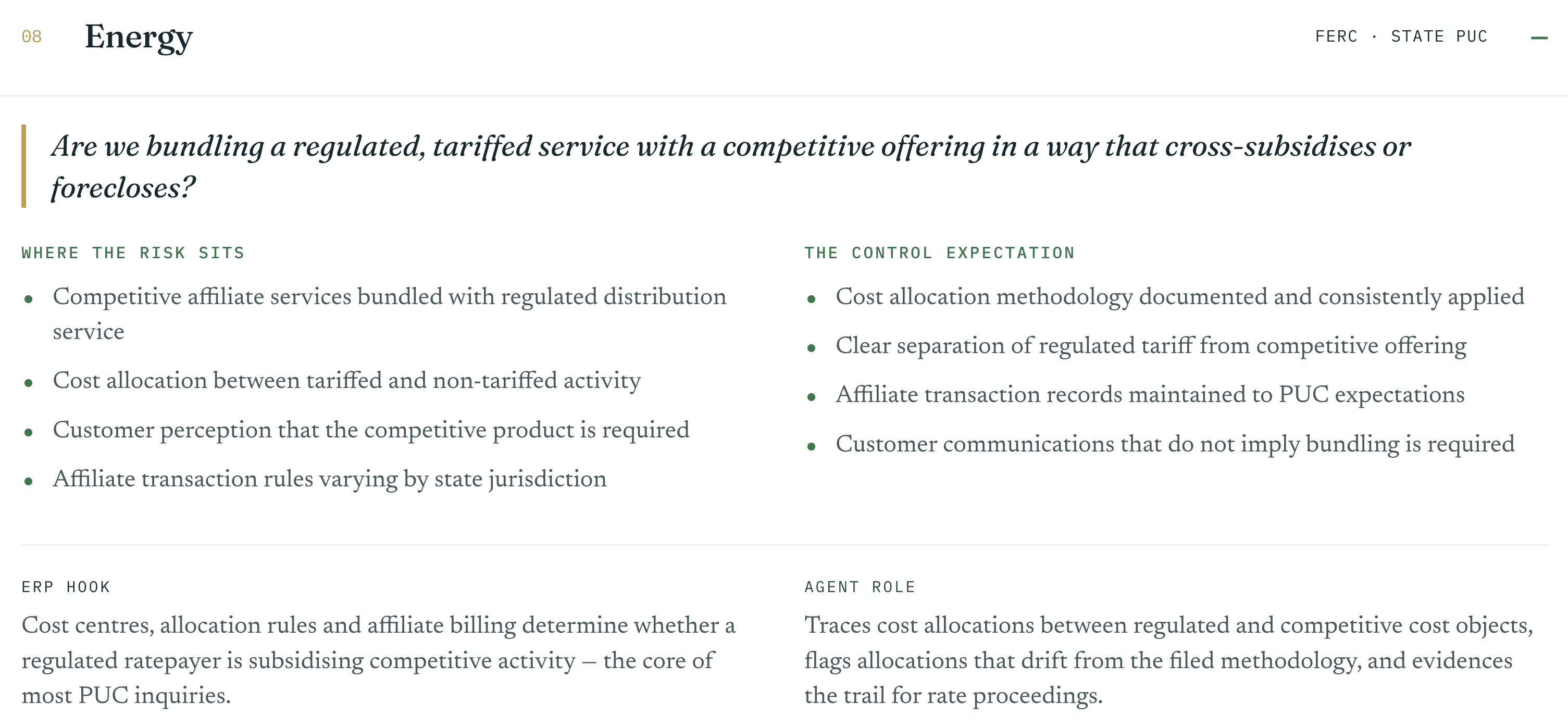
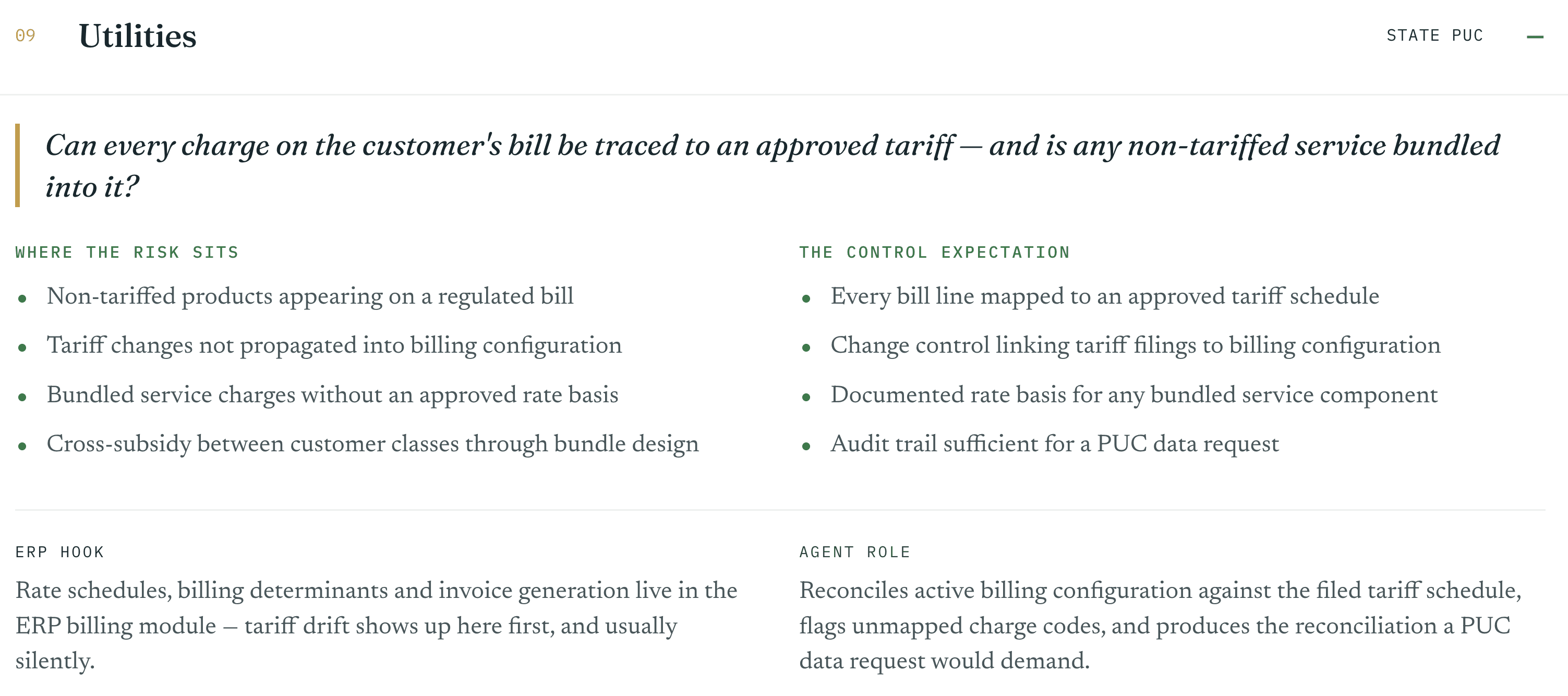
The Verticals in Detail
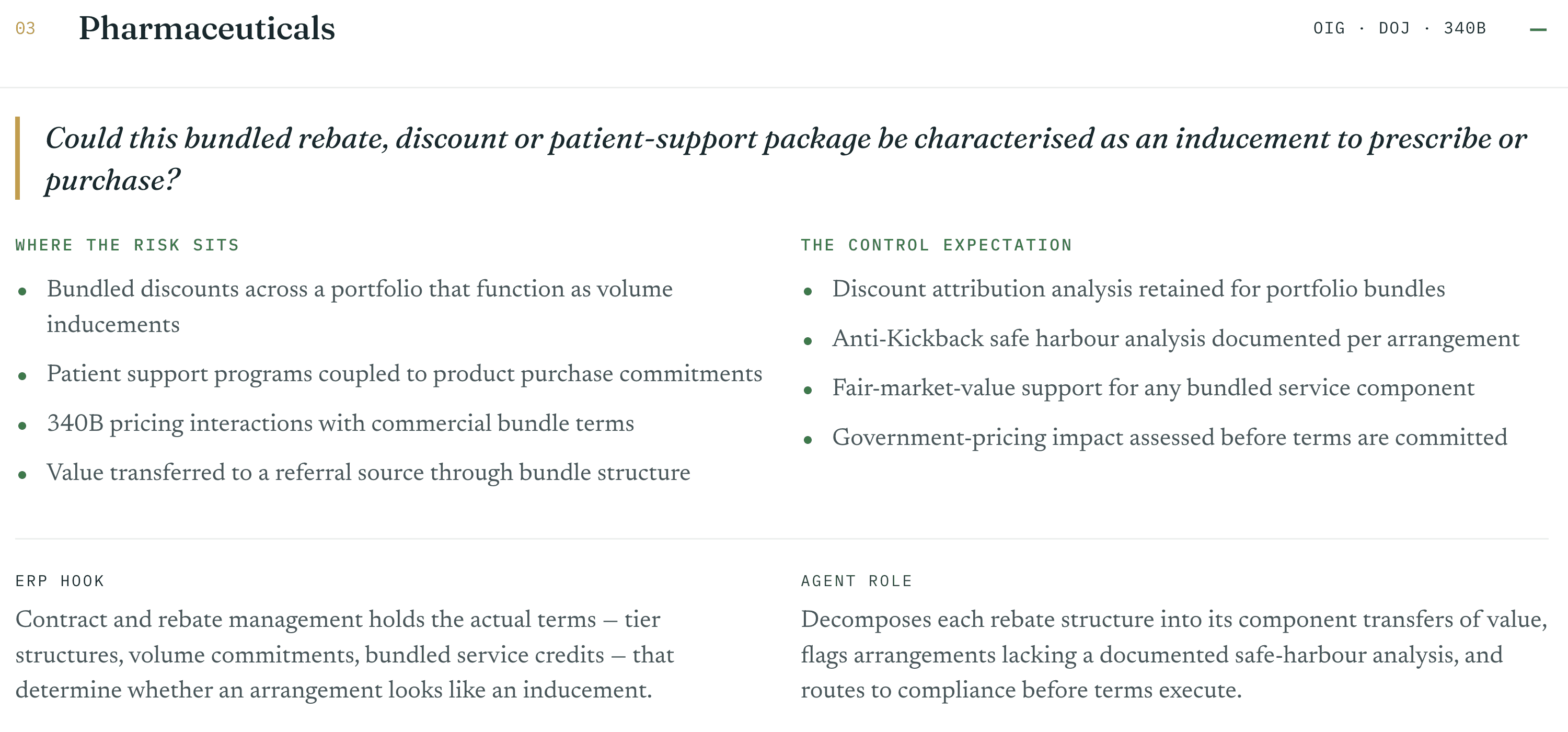
Each expands to show where the risk actually sits, what a regulator expects the control to look like, which ERP object holds the determinative data, and what an agent can legitimately do about it.
6| The Synthesis: One Pattern Under Nine Industry Verticals
Across every vertical, the same structural failure appears: the rule is known, the data exists, and the control fires too late to prevent the act.
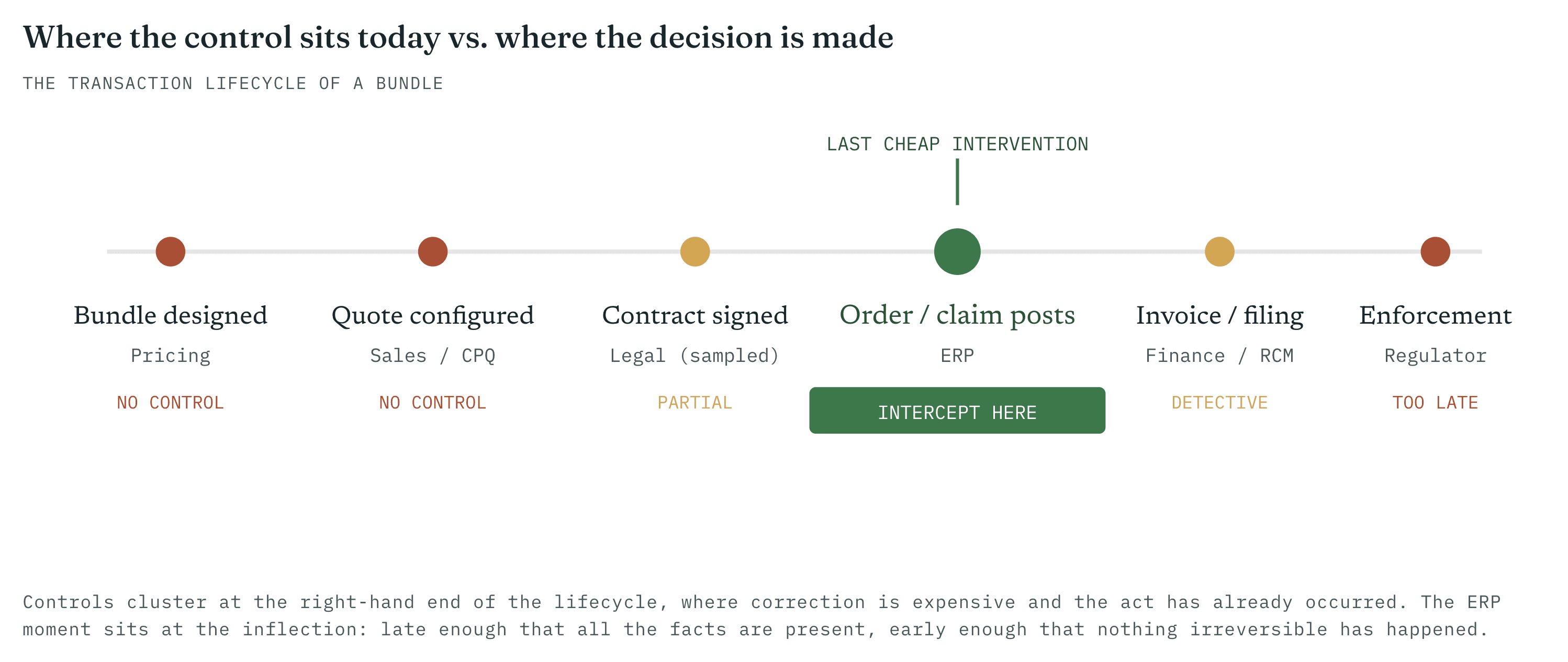

An order that has posted is a commitment. A claim that has been released is a representation to the government. A contribution that has aggregated past a covered period is a filing obligation. In every regime, the ERP moment is the last point where intervention is cheap and the first point where all the evidence is present in one place.
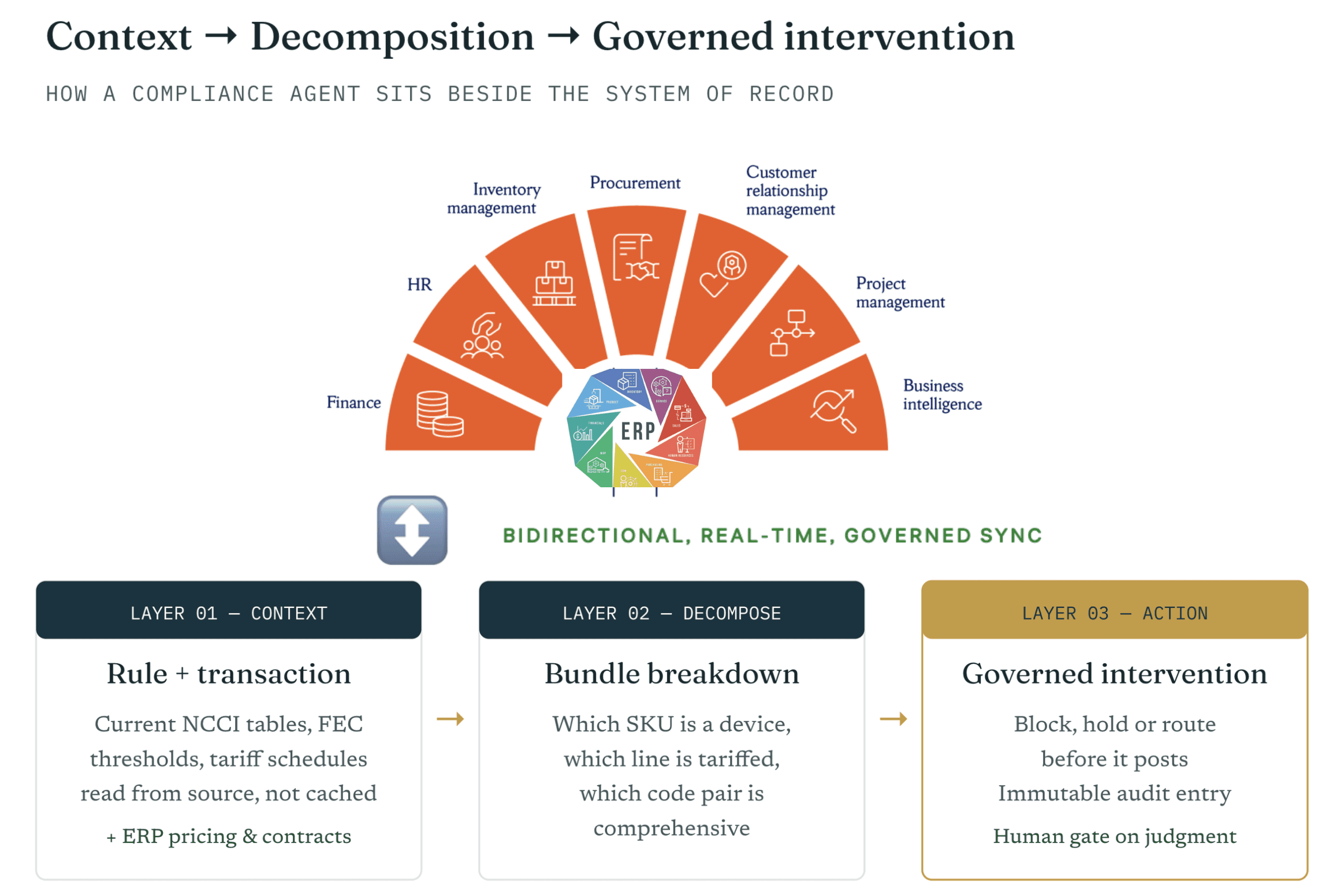
7 | The Architecture: A Governed Agentic Layer BESIDE the ERP
The same three-layer pattern that governs financial and supply-chain agents applies directly to bundling compliance; because the problem is identical in shape: cross-system context, exception-heavy judgment, and an absolute requirement for auditability.
Loop: Watch the transaction → Decompose the bundle → Test against current rules → Block or route → Log immutably.
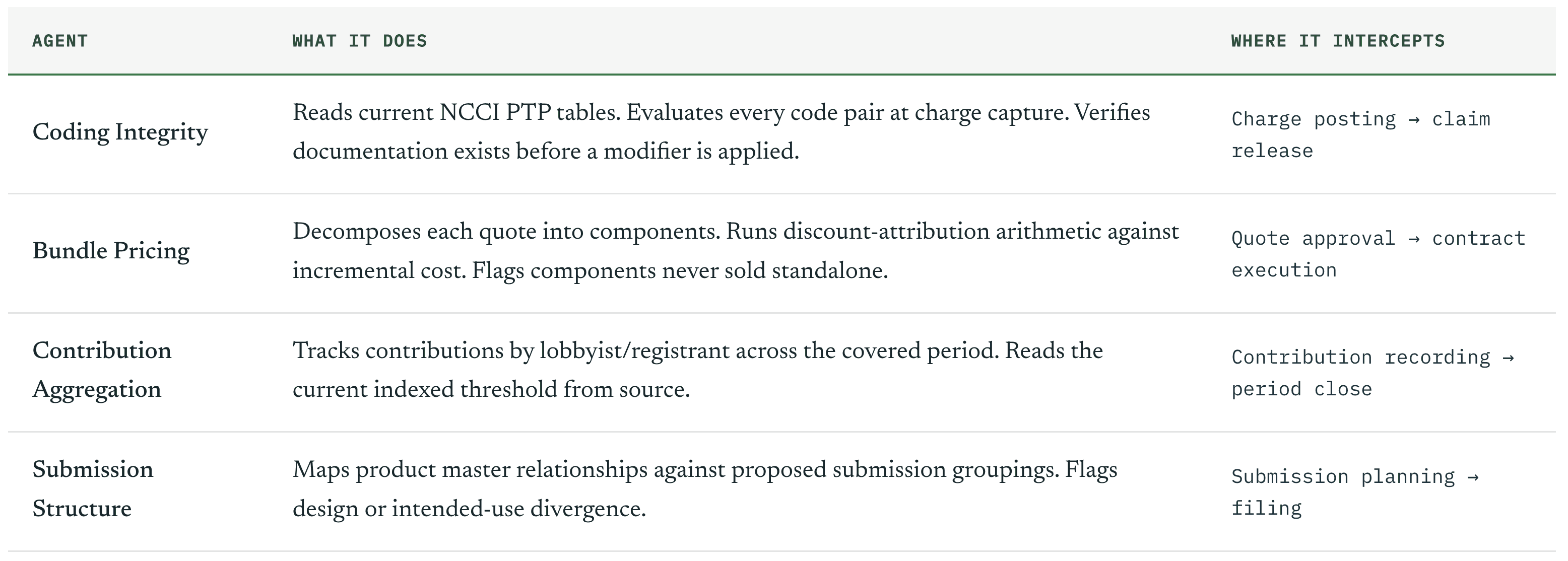
Four Agents, One Governance Model
Each reads a different rule source and intercepts at a different transaction moment, but all share the same audit spine and human-gate discipline.
Worked Example: A Governed Agent Holding a Claim Line
How a single unbundling exception flows through the agentic layer beside the ERP revenue-cycle module; end to end, in seconds, fully auditable.

The Critical Design Choice: The agent did not apply a modifier. It did not decide the service was distinct. It established that the documentation required to support separate billing was absent, held the line, and put a qualified human in front of the decision with the full evidentiary picture assembled. The judgment stayed with the coder; the agent removed the possibility of the claim going out unexamined.
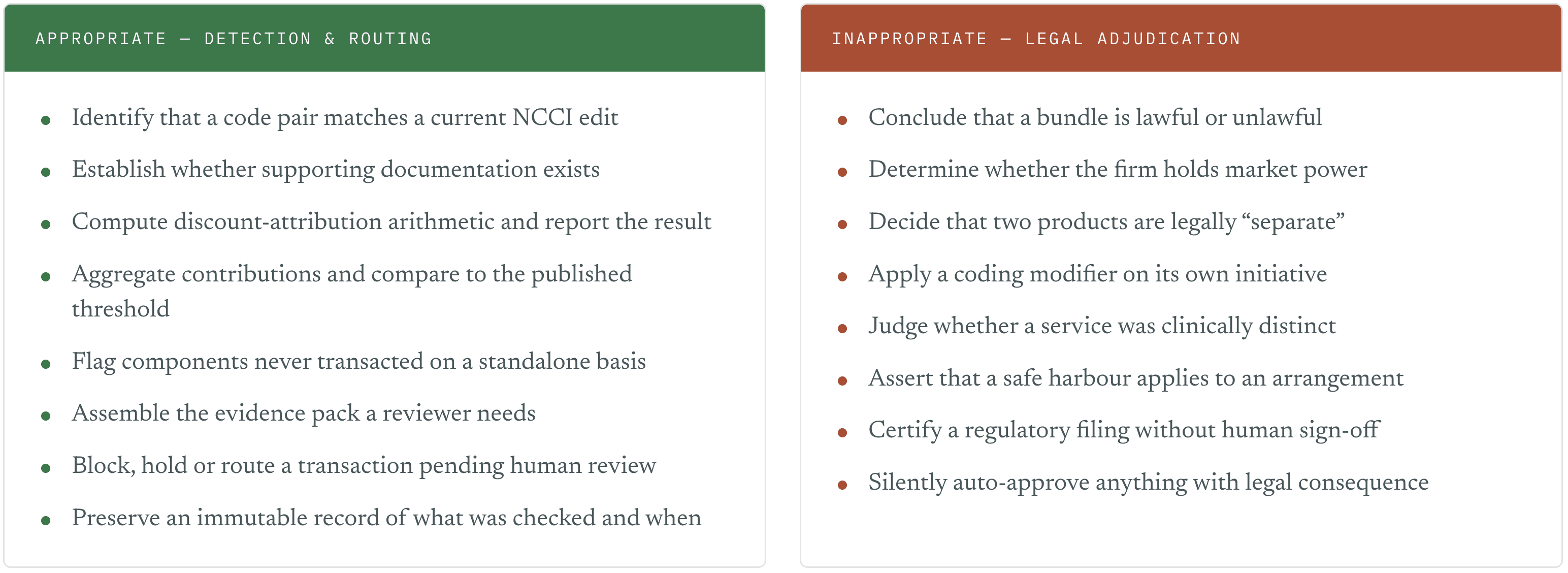
8 | The Boundary: What An Agent MUST NEVER Be Allowed TO DO
This is the section that makes the rest credible. An agentic compliance layer that oversteps is worse than none; it manufactures a documented record of unqualified legal conclusions, discoverable in exactly the proceeding you built it to avoid.

The Governance Posture A Regulator Will / Should ACCEPT
For a control that touches claims, filings and pricing, the question is never “can it detect?” but “who approved this, what did it see, and can we prove it?” Four control families make the difference:

9 | How To Start: Prove it on One Regime, One Workflow
Bundling compliance spans four regimes and nine verticals, which is exactly why it should not be approached as an enterprise-wide programme on day one.
Pick the regime. Where is exposure largest and the rule most codifiable? For most enterprises that is healthcare coding or bundle pricing.
Map one workflow. Trace a single transaction from bundle design to the point it becomes a legal act. Identify the last cheap intervention point.
Wire the rule source. Connect the agent to the live rule table i.e. NCCI quarterly edits, the indexed threshold, the filed tariff, not a cached copy.
Run in shadow mode. Observe-only for one reporting cycle. Measure what it would have caught against what actually happened.
Turn on the gate. Enable blocking and routing with human approval. Governance, audit and kill-switch active from the first held transaction.
The Shadow-Mode Argument: Running observe-only for one reporting cycle produces something rare in compliance: a quantified, evidence-backed answer to “how much are we actually missing?”, without changing a single control. That number, not the technology, is what unlocks the programme.
10 | Frequently Asked Questions
What is bundling compliance in the United States?
Bundling compliance is not one rule set. The same commercial act (selling or filing things together) triggers at least four unrelated bodies of U.S. law: antitrust (tying and bundled discounts under the Sherman and Clayton Acts), healthcare billing (where improper unbundling of procedure codes creates False Claims Act exposure), campaign finance (lobbyist bundling disclosure under FECA), and FDA premarket submissions. Each has a different regulator, a different test, and a different evidentiary expectation.
Is bundling illegal under U.S. antitrust law?
Not inherently. Bundling becomes an antitrust problem when a firm with market power uses the bundle to coerce purchase of a separate product the customer does not want, or to foreclose rivals who cannot match the aggregate discount. Courts apply fact-intensive judicial tests e.g. Jefferson Parish for tying, PeaceHealth discount attribution for bundled discounts, Brooke Group for predatory pricing. There is no fixed numerical threshold for legality; market share and HHI figures are screening benchmarks, not pass/fail rules.
What is unbundling in medical billing, and why is it a risk?
In healthcare the risk inverts: bundling is the requirement and unbundling is the violation. Unbundling means splitting procedures that should be billed under one comprehensive code, which inflates reimbursement and creates False Claims Act exposure. CMS's National Correct Coding Initiative publishes Procedure-to-Procedure edit pairs identifying codes that may not be billed together, each carrying a modifier indicator: 0 (cannot be bypassed), 1 (may be bypassed with an appropriate modifier where documentation supports it), or 9 (deleted).
What is the FEC lobbyist bundling disclosure threshold for 2026?
$24,000 for calendar year 2026 i.e. the $15,000 statutory base multiplied by the 1.59695 cost-of-living factor, rounded to the nearest $100, published at 91 Fed. Reg. 10393 on 3 March 2026. Committees receiving two or more bundled contributions from a lobbyist/registrant or lobbyist/registrant PAC aggregating above that figure in a covered period must file FEC Form 3L. Because the threshold is indexed annually, any control that hard-codes it will silently under-report.
Can AI agents determine whether a bundle is legal?
NO and a system designed to do so is worse than no system. Agents can detect fact patterns, compute discount-attribution arithmetic, check code pairs against current edit tables, aggregate contributions, block or route transactions, and preserve an immutable record. Agents must not conclude that a bundle is lawful, determine market power, decide that two products are legally separate, apply a coding modifier on their own initiative, or certify a filing without human sign-off.
Why should bundling controls sit in the ERP rather than a compliance system?
Because the ERP is the last system that sees the transaction before it becomes a legal act, and the first that holds every fact needed to test it. Most bundling controls today are detective i.e. NCCI edits fire at claim scrubbing, contribution aggregation at period close, bundle pricing review after the deal. Intervening at the ERP moment is the last point where correction is cheap and the first point where all the evidence is present in one place.
How long does it take to deploy a compliance agent?
A scoped agent on one regime and one workflow typically runs in shadow mode within weeks, with a full reporting cycle of observe-only operation before any blocking is enabled. The shadow period is not a technical requirement; it is what produces the quantified business case and gives compliance and audit the evidence they need to approve a preventive control.

References & Sources
Federal Election Commission, “Lobbyist Bundling Disclosure Threshold Increases (2026)”; 52 U.S.C. §30104(i)(3); 11 CFR 104.22; 11 CFR 110.17(e)–(f); Price Index Adjustments notice, 91 Fed. Reg. 10393 (3 March 2026).
Centers for Medicare & Medicaid Services, Medicare NCCI Policy Manual (2026) and quarterly Procedure-to-Procedure edit tables; CMS Medicare NCCI FAQ Library; MLN guidance on Modifiers 59, XE, XP, XS and XU.
U.S. Food and Drug Administration, Bundling Multiple Devices or Multiple Indications in a Single Submission — Guidance for Industry and FDA Staff, 22 June 2007, Docket FDA-2003-D-0376 (nonbinding recommendations); Medical Device User Fee and Modernization Act of 2002, P.L. 107-250.
Jefferson Parish Hospital District No. 2 v. Hyde, 466 U.S. 2 (1984).
Cascade Health Solutions v. PeaceHealth, 515 F.3d 883 (9th Cir. 2008).
Brooke Group Ltd. v. Brown & Williamson Tobacco Corp., 509 U.S. 209 (1993).
U.S. Department of Justice, Antitrust Division, Competition and Monopoly: Single-Firm Conduct Under Section 2 of the Sherman Act, Chapter 6 (bundled discounts).
Board of Governors of the Federal Reserve System, Anti-Tying Restrictions of Section 106 of the Bank Holding Company Act Amendments of 1970; 12 U.S.C. 1972; 12 CFR 225.7; OCC Interpretive Letter #982.
U.S. Department of Justice, Fraud Statistics — Overview (16 January 2026); FY2025 False Claims Act settlements and judgments exceeding $6.8 billion, of which approximately $5.7 billion related to healthcare.
—— DISCLAIMER ——
THIS IS NOT LEGAL ADVICE. The Agentics Co. is an enterprise AI transformation firm, not a law firm. This article is informational thought leadership. It does not constitute legal, regulatory, clinical coding, or compliance advice, and it does not create any advisory relationship.
Every arrangement described here turns on specific facts; bundling analysis, particularly under the antitrust laws, is fact-intensive and outcome-determinative on details this article cannot address. Engage qualified counsel and, where applicable, certified coding and regulatory professionals before acting.
Thresholds cited are current as at July 2026 and subject to change, the FEC threshold is indexed annually and NCCI edit tables are revised quarterly; verify against the primary source before relying on any figure. Illustrative figures in the discount-attribution example are hypothetical and do not represent any actual arrangement.
© 2026 The Agentics Co. | Enterprise Agentic AI | Hello@TheAgentics.Co