
Agentic AI Multi-Agent Architecture Series - Part One: How to Design.
Why companies are shifting from just one chatbot to a team of agents working together, and how they’re designing, managing, and rolling out these systems to really make a difference without spending a fortune on a flashy demo. This whitepapert is divided into nine sections, designed to be read in one go and then revisited before your next architecture review. Part One of the Agentics Multi-Agent Architecture Series dives into the basics: 1) Why is this shift happening? 2) How should we structure it? 3) What might go wrong if we don’t think about governance first?
Posted by
Research Desk
Posted at
Enterprise AI
Posted on
WHAT’S INSIDE
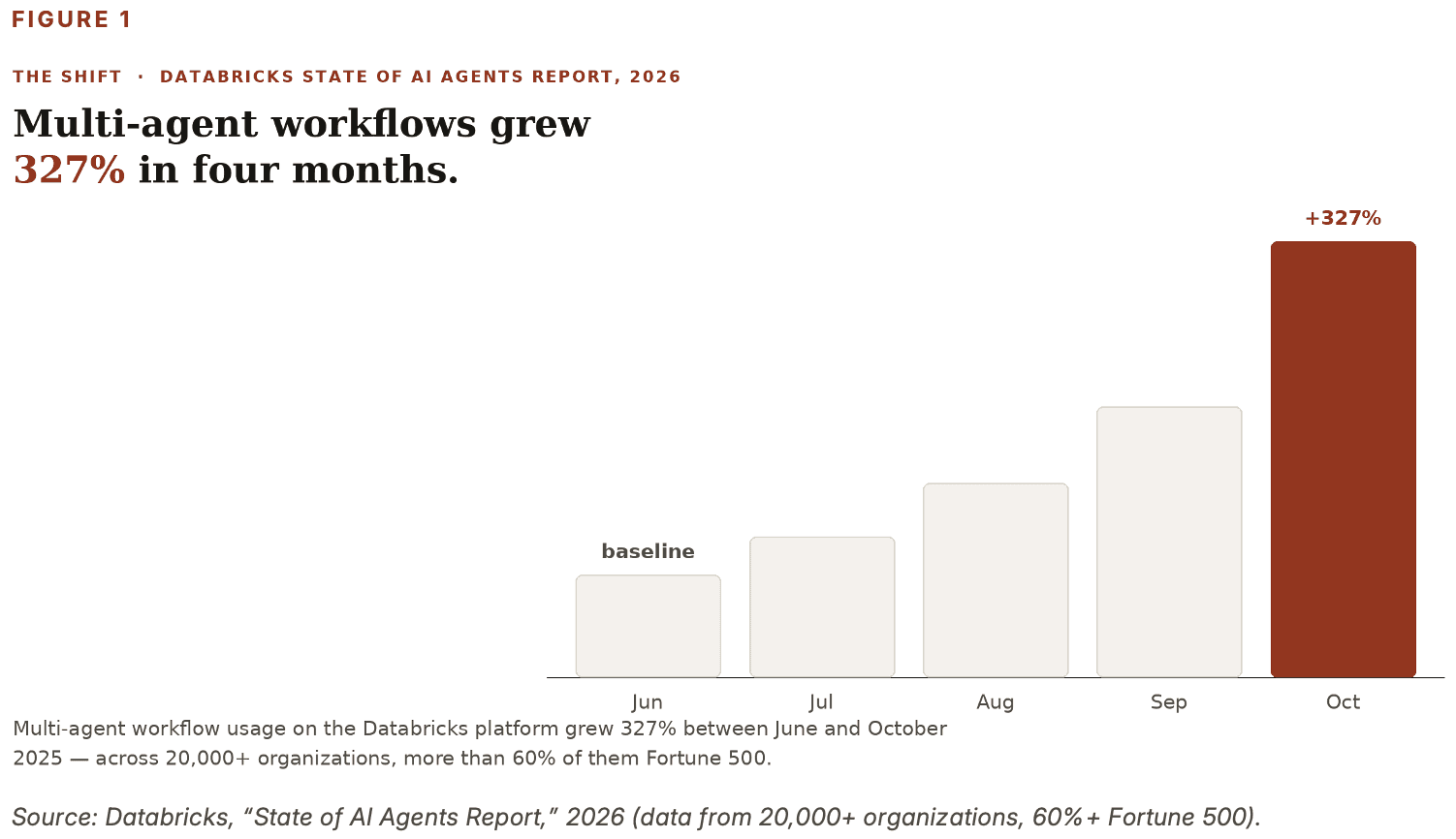
01 The Shift: Businesses are transitioning from single chatbots to coordinated multi-agent systems and it’s happening fast! In just four months, we’ve seen a 327% increase, and the trend is still climbing.
02 Why Single Agents Break at Scale: We’ve explored the three ways specialization addresses failures and the one scenario where adding more agents can actually cause problems.
03 Five Architecture Patterns: Covers different models like sequential, parallel, orchestrator-worker, hierarchical, and router, and how to choose the right one for your specific task.
04 The Infrastructure Question: The challenges of databases, identity, and observability when dealing with machine-speed operators, and what needs to change to support them.
05 Self-Replicating Agents: A deepdive into agents that create, specialize, and retire other agents, the next big thing in architecture, and the tools they need to succeed.
06 The Agentics Framework: Covers architecture, deployment, and optimization to create a consistent operating model, not just a one-time experiment.
07 Governance: Addresses the gap that leads to 40%+ of agentic AI projects being canceled by 2027 and the four key controls that work well in production.
08 Case Study: How a pan-African lender’s origination architecture is designed to handle operations across six markets and three different regulatory environments?
09 The Diagnostic: Nine questions to help you evaluate your next multi-agent architecture review. Be honest with your answers, or skip this part.
BUILT FOR
Business & Technology Leaders: Crafting AI strategies, striking a balance between innovation and risk, and ensuring agents deliver a quantifiable return. → Sections 01, 06, 09.
IT & Enterprise Architects: Exploring the pattern language, the infrastructure it relies on, and where integration debt might be lurking. → Sections 03, 04, 05.
Security & Governance Teams: Addressing the identity gap that can arise with canceled projects and the controls that can help bridge it. → Section 07.
Operations & Functional Leaders: Understanding where agents enhance human capabilities versus replacing a step entirely, and who is responsible for the outcome. → Sections 02, 06, 08.

MULTI-AGENT ARCHITECTURE | THE SHIFT
01 From Single Chatbots → Coordinated Systems.
For two years, the term “AI agent” primarily referred to a single conversational layer integrated into a workflow, encompassing all tasks from intent recognition to execution within a single context window. However, this model is being phased out more rapidly than most transformation roadmaps anticipated.
Databricks’ 2026 State of AI Agents report, based on data from over 20,000 organizations, including over 60% of Fortune 500 companies, revealed a significant increase in multi-agent workflow usage on its platform. The growth was 327% between June and October 2025.
This metric is not a pilot study but rather a shift in production architecture beneath enterprise workloads, while most steering committees were still deliberating whether to conduct a single-agent pilot at all. This trend is not limited to a single vendor’s platform. Gartner has identified 2026 as the pivotal year for multi-agent systems, projecting that by 2027, 70% of multi-agent deployments will utilize narrowly specialized agents instead of generalist ones. This shift aims to enhance accuracy at the expense of coordination complexity.
Forrester also sees things this way: By 2026, specialized, well-coordinated agents will become the go-to approach for businesses.
It’s not the ambition that’s changed → Enterprises were already aiming for this in 2024.
What’s changed is that tool-calling has become more mature across all major model families, orchestration frameworks are no longer just research projects, and the Model Context Protocol has provided agents with a standard way to connect to enterprise systems without needing custom integration for each tool. The infrastructure has finally caught up with the original idea. The architecture question has shifted from “can we” to “how should we.”
This change is felt as much as it is embraced. The 327% growth indicates that production teams are realizing that the issues with a single, large agent (like topic collisions, context overflow, or classification problems as the scope grows) are better addressed by focusing on specialization, rather than simply making the agent bigger or smarter. Section 02 explains why this is the case.

MULTI-AGENT ARCHITECTURE | WHY SINGLE AGENTS BREAK
02 Why Single Agents Break at Scale?
Having just one agent manage everything i.e. from routing and retrieval to reasoning and execution, isn’t really a simplification. It’s more like a bottleneck hiding behind a simpler picture. As the agent’s responsibilities grow, you’ll notice three common issues popping up in real-world use:
1. Topic Collision: When instructions are written for one task, they can subtly affect how the agent behaves on another. This happens because both tasks share the same context and tools.
2. Context Overflow: As conversations or workflows go on longer, the agent’s ability to reason effectively shrinks, and it starts to rely more on guessing than on retrieving information.
3. Degraded Classification: A generalist agent’s ability to accurately understand what it’s being asked to do decreases as the complexity of the task increases.
Specialization can help with this, but it’s not always the case, and it’s often the part that roadmaps don’t cover. Google Research looked at 180 different ways agents could work together and discovered that when tasks can be broken down into smaller, independent parts, working together can really boost performance. However, when tasks are naturally in a sequence, it can actually slow things down.
In tests, every multi-agent setup that tried to work together did about 39–70% worse than a single agent that was well-defined when it came to figuring out things in sequence. But for tasks that can be done in parallel, like navigating the web, using decentralized multi-agent coordination gave a nice +9.2% boost compared to just having one agent.
The Diagnostic.
Before bringing in another agent, think about whether the task can be broken down into smaller tasks that don’t need to constantly debate with each other. If it can, a multi-agent approach usually works best. However, if each step relies on the decision made in the previous step, a single, well-defined agent can often do better than five agents working together, saving you money on both running and managing them.
THE INSTINCT MOST TEAMS FOLLOW | THE DISCIPLINE THAT HOLDS UP |
|---|---|
We’ll include an agent for each part of the process, as it’s easy to set up agents now and they’re affordable. | Let’s break down the workflow step by step, identify which parts can run on their own, and assign one with exactly one accountable agent. |
This discipline distinguishes genuine architecture from a mere collection of capabilities masking as a strategy: start from the actual workflow’s structure, not from the platform’s capacity to generate numerous agents.
MULTI-AGENT ARCHITECTURE | ARCHITECTURE PATTERNS
03 Five Architecture Patterns
Once we’ve broken down a workflow, the focus shifts from figuring out how many agents we need to how they work together. In the BFSI, retail, logistics, and public-sector work, we’ve found that five coordination styles are the most common for getting things done:-
1) Sequential Pipeline: Think of it as a set path where each step is set in stone, like getting a document approved, reporting to the regulators, and going through underwriting.
2) Parallel Fan-Out: Imagine splitting a big goal into smaller tasks that run at the same time and then putting them all together to make one final result.
3) Orchestrator-Worker: A planner agent takes the big goal and breaks it down into smaller tasks, sending each task to a specialist worker who then sends back their part of the answer.
4) Hierarchical Supervisor: Think of domain supervisors (like Finance, Risk, and Operations) who each have a team of workers under them, all working together under a main orchestrator. This works well for platforms that cover multiple areas.
5) Router / Handoff: A triage agent takes all the information and passes it on to exactly one specialist, which is usually how customer-facing service lines work.

MULTI-AGENT ARCHITECTURE | THE INFRASTRUCTURE QUESTION
04 Challenges of databases, identity, and observability when dealing with machine-speed operators, and what needs to change to support them.
Multi-agent systems aren’t just about the application layer; they’re about transforming what happens beneath it → Starting with the database.
Imagine an agent tackling a complex problem. It might need to launch dozens of separate environments simultaneously, test various ideas at once, assess the outcomes, and dismantle everything in mere seconds. Shared-nothing architectures, where computing and storage reside on the same machine and provisioning involves a human filing a ticket, weren’t built for such a high volume. Humans don’t create and destroy hundreds of databases daily; agents do.
The sheer scale of the hand-off is the most convincing proof yet that this isn’t just a trial-and-error experiment. In October 2023, AI agents were responsible for about 0.1% of the new databases on Neon’s serverless Postgres platform (now part of Databricks). By October 2025, that figure had risen to 80%, and branch environments used for testing and development had transitioned from 0.1% to 97% agent-created over the same period.

Databricks’ new database category, “Lakebase,” reimagines the database as flexible, adaptable infrastructure that agents can quickly create, modify, and remove. This approach contrasts with the traditional, static system designed for predictable, human-led processes.
Even if Lakebase doesn’t take the top spot, the fundamental change is here to stay: for four decades, databases were built with the idea that a human would be constantly involved.
When agents take the lead, things change, and we need to rethink our infrastructure. We’ll need to focus on fast provisioning, cost-effective branching, and an identity system that follows the agent, not the engineer who set it up. This isn’t just about one vendor’s telemetry. Industry figures suggest that up to 90% of enterprise data is stored in unstructured silos that weren’t meant to be accessed by tool-calling agents.
The effectiveness of an agent depends on the data it can access, so the architecture and data-readiness discussions are essentially the same.

MULTI-AGENT ARCHITECTURE | SELF-REPLICATING AGENTS
05 A deepdive into agents that create, specialize, and retire other agents, the next big thing in architecture, and the tools they need to succeed.
In addition to managing a set group of agents, we’re now seeing this cool new feature pop up in our production plans: agents that create other agents! Imagine this: an orchestrator notices a sudden increase in workload. They whip up a special configuration for a new agent to handle it, launch it, check how it does, and then take it down when the workload settles down, all without any engineer writing a single line of code for that specific agent.
It’s amazing how quickly the runway for these systems is getting bigger! METR, which keeps an eye on how well AI agents are doing over time, has noticed that the length of tasks agents can handle on their own is doubling every seven months for the last six years. And guess what? That rate has picked up speed, doubling every four months from 2024 to 2025.
This is exactly what self-replication is all about: as the runway for autonomous tasks expands, so does the potential for agents to be trusted to handle things without supervision. You can already see this happening in a more focused and well-explained way.
Cursor has noted that 35% of its own merged pull requests now come from its cloud-based background agents, not from a human starting a session. This means software is writing and shipping a significant portion of its own successor code.
If we take this idea and apply it to enterprise operations agents, the architectural question becomes a real one. This capability is actually here. The potential risks are also proportional to it. A fleet that can create itself without needing a human is also a fleet that could quickly grow into a cloud bill, access control, and audit trail in just one day.
The organizations that are doing the best are treating replication like a managed process, not something that just happens. For example, they set a limit on how many times an agent can make copies before a human checks the history, they have a way to stop all copies at once, they keep a record of everything that happens, and they limit how much they can use, so a runaway situation doesn’t go on forever.
Self-replication is a great example of a rule that applies to everything in this paper: if you take away a human’s role in one part, you have to add a control in the part above it. The way the system is built and how it’s controlled aren’t separate projects. They’re actually the same idea, just applied twice.

MULTI-AGENT ARCHITECTURE | THE AGENTICS FRAMEWORK
06 Architecture → Deployment → Opitimisation
It’s not usually the model’s fault when multi-agent AI fails. The real issue is that the initial setup wasn’t designed to handle a second use case.
Agentics involves three phases for every multi-agent interaction, not separate projects.
Each phase builds on the previous one, creating a continuous cycle that doesn’t quite end.
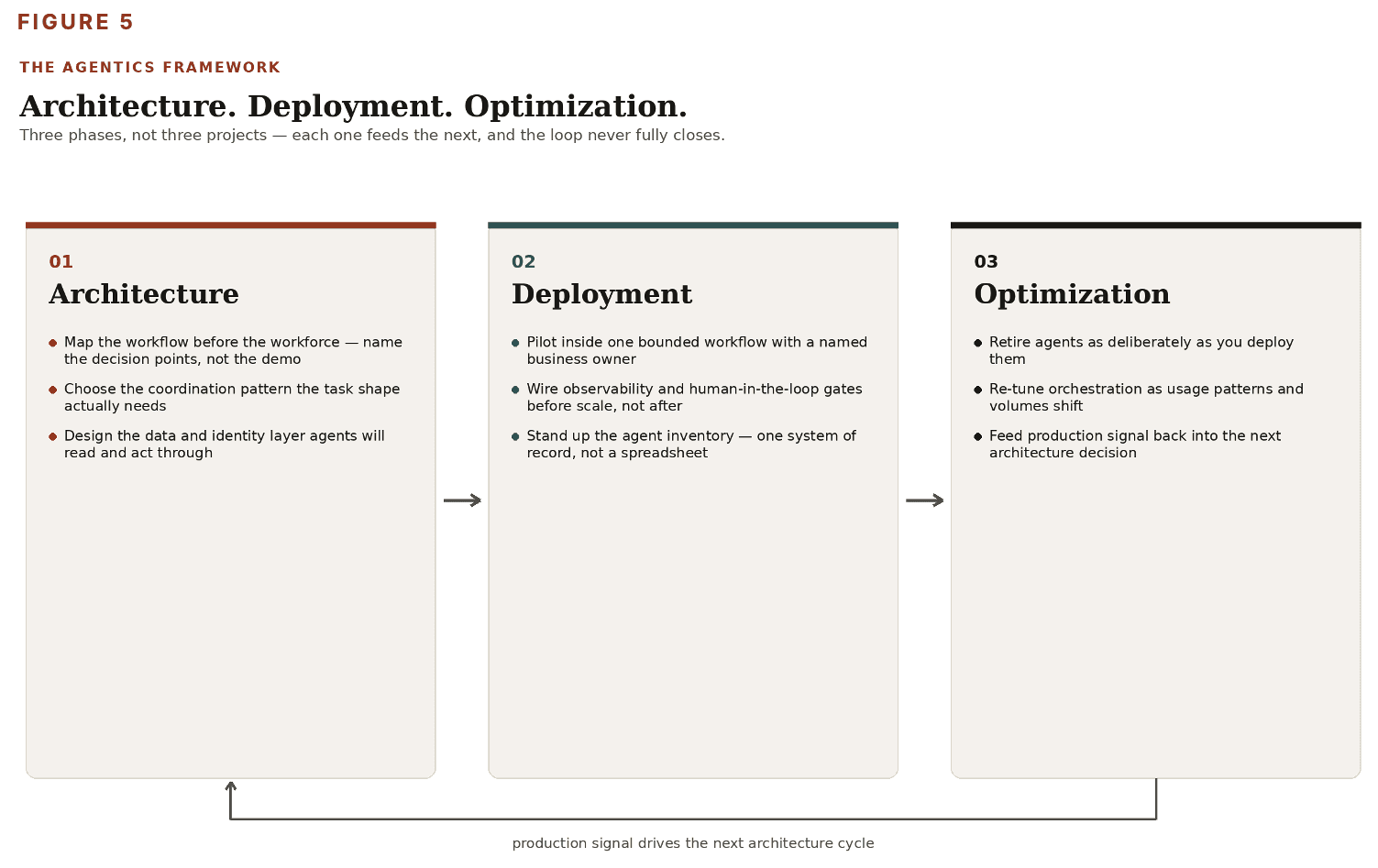
Let’s start with architecture because it’s the only part that costs a lot to fix if you mess it up.
To figure out if everything you build later is a good thing or a bad thing, you need to clearly define the decision points in your workflow (not just the demo or the perfect way to do things). Then, pick a coordination pattern that fits how the task is structured.
Deployment is where we often forget about the important stuff when we’re rushing to meet deadlines.
For example, a pilot project without a designated business owner becomes useless as soon as the person who supported it moves on.
Also, adding observability and human-in-the-loop controls “after we’ve proven it works” almost never happens. They need to be set up before the first production run, not after.
Optimization is the part of the roadmap that most people don’t plan for because it’s not a launch.
It’s about carefully removing agents as you deploy them, adjusting how orchestration works as you see how people use it, and using the production data to make the next architecture decision. That’s why the loop in the diagram keeps going. It keeps feeding information back.

MULTI-AGENT ARCHITECTURE | THE GOVERNANCE
07 The Governance Gap That Kills Projects
Gartner is forecasting that over 40% of agentic AI projects might be called off by the end of 2027.
→ This isn’t due to the technology itself, but rather because costs are climbing, the business benefits aren’t clear, and risk management wasn’t properly planned from the beginning.
The identity gap is a significant part of this issue. A recent survey revealed that 88% of companies have already had an AI-related security breach, and only about one in five are treating their AI agents as identity-bearing entities with proper access controls.
An agent with a valid credential but no allow list isn’t just a productivity tool with a minor flaw; it’s a service account that no one is keeping an eye on.
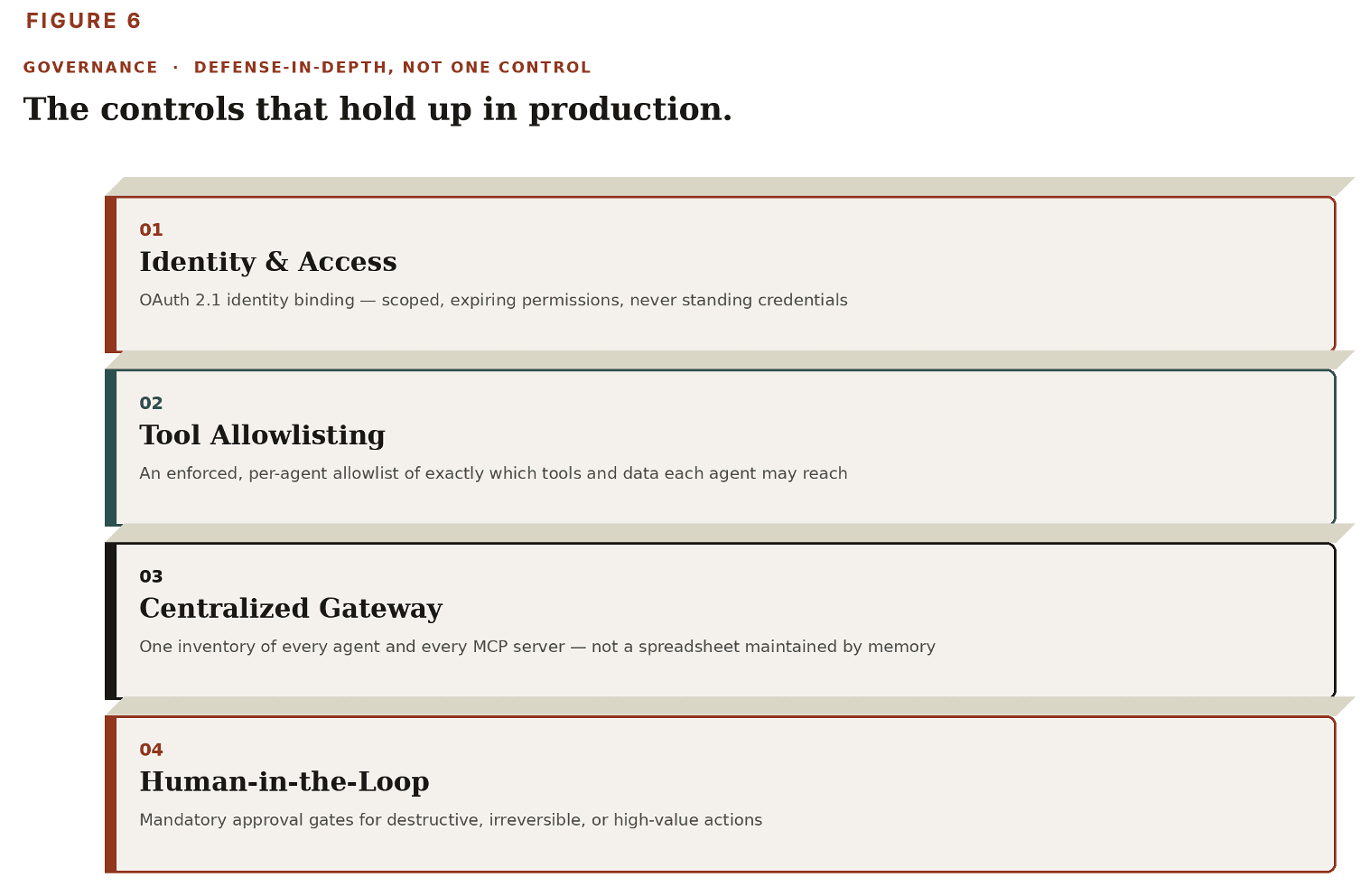
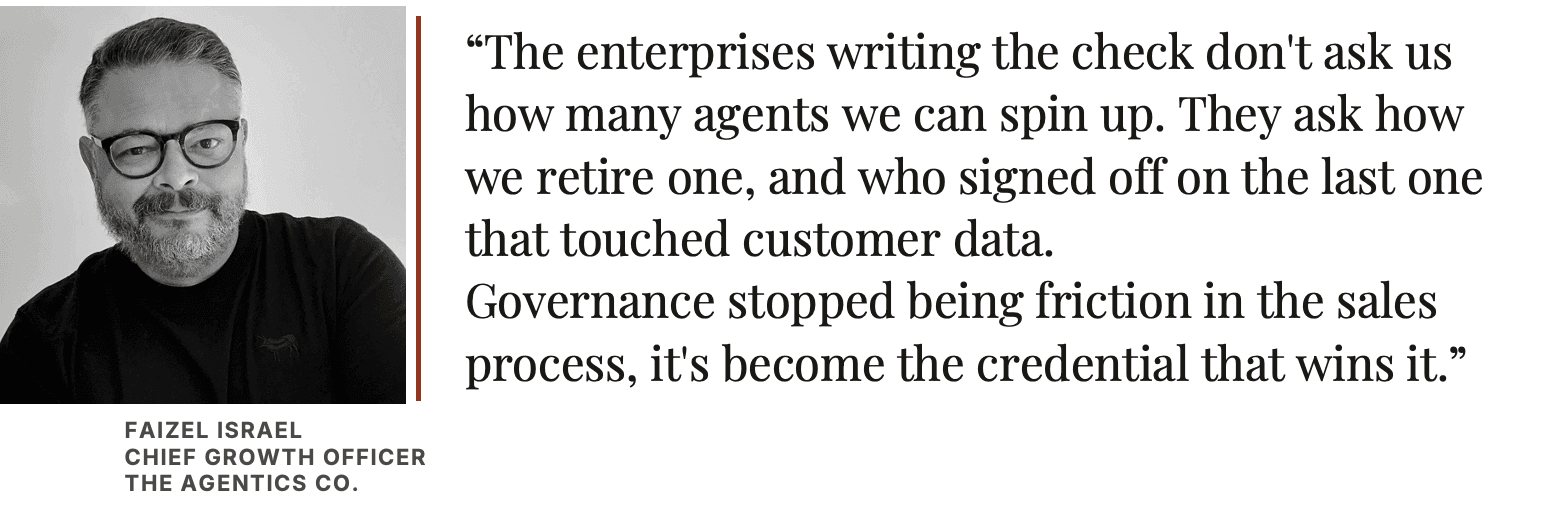
These four controls aren’t exactly groundbreaking. What’s truly unique is using all four simultaneously, all the time, against a real inventory instead of just a spreadsheet that someone updates when they get around to it.
THAT INVENTORY → Every agent, its owner, access level, model version, and review schedule, is the key differentiator between organizations that are still testing out pilots and those that are fully deploying agents on a large scale.
Our research on Model Context Protocol (MCP) deployments, which is the backbone of many multi-agent systems that connect to enterprise tools, revealed a similar issue at the infrastructure level: most public MCP servers have vulnerabilities (like path traversal, command injection, and SSRF), and only a small number use OAuth by default.
Gartner also predicts that the number of enterprise generative AI applications experiencing five or more security incidents annually will increase from 9% in 2025 to about 25% by 2028.

MULTI-AGENT ARCHITECTURE | CASE STUDY
08 One Architecture, Six Markets
For a BFSI client in the MENA region, Agentics crafted a sophisticated multi-agent origination and underwriting system, tailored to six distinct markets, each with its own regulatory body, credit bureau, and language. This architecture is neatly divided into hierarchical and orchestrator-worker patterns, as outlined in Section 03.
The front-office layer features origination agents who manage the initial intake and eligibility checks, ensuring all documents and KYC information are verified, and credit scores are calculated right at the application stage. These results then flow into the back-office layer, where underwriting agents handle risk assessment, compliance checks, and disbursements. A human underwriter is stationed at the decision point for any cases that exceed a pre-set risk limit, while a compliance agent is always required to give their approval, making it a non-negotiable step in every market.
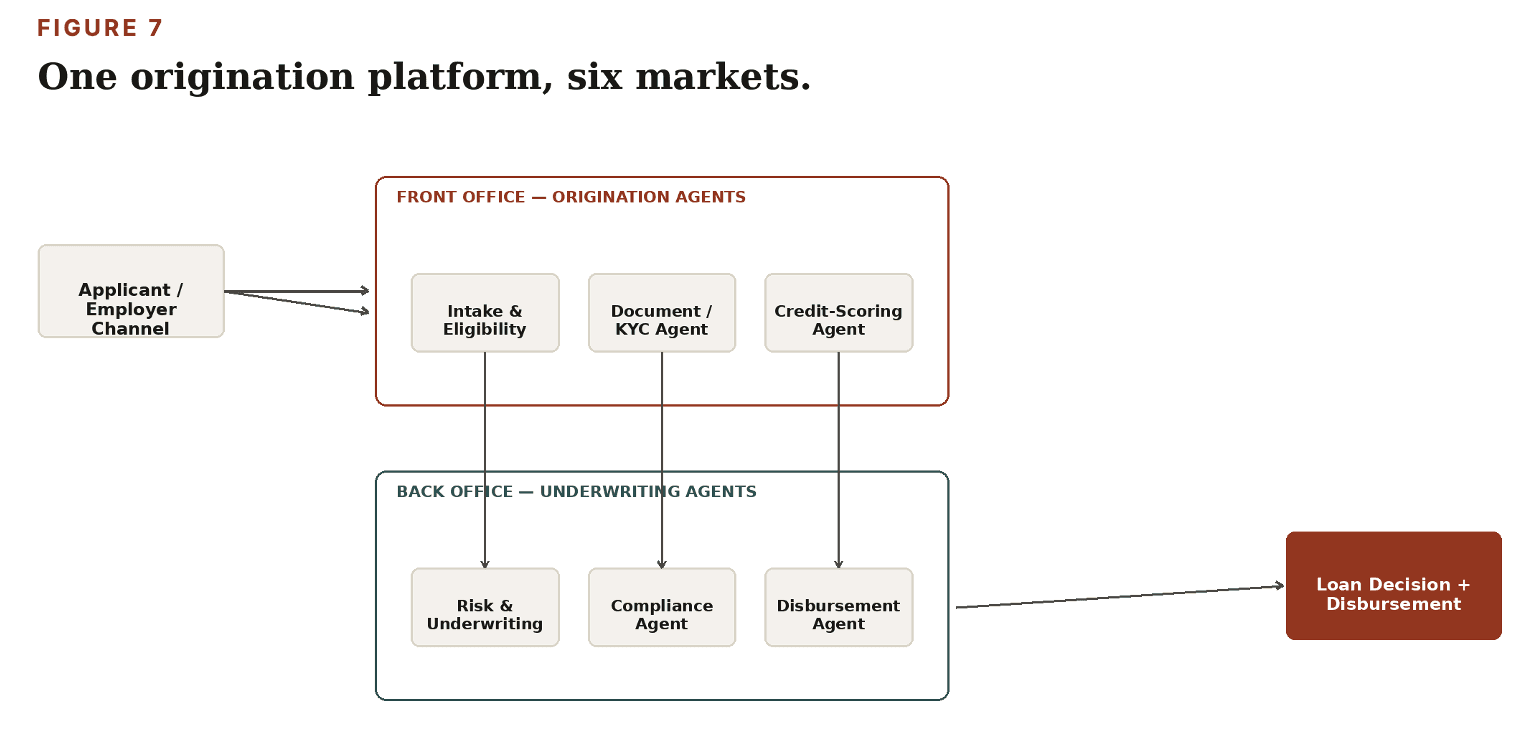
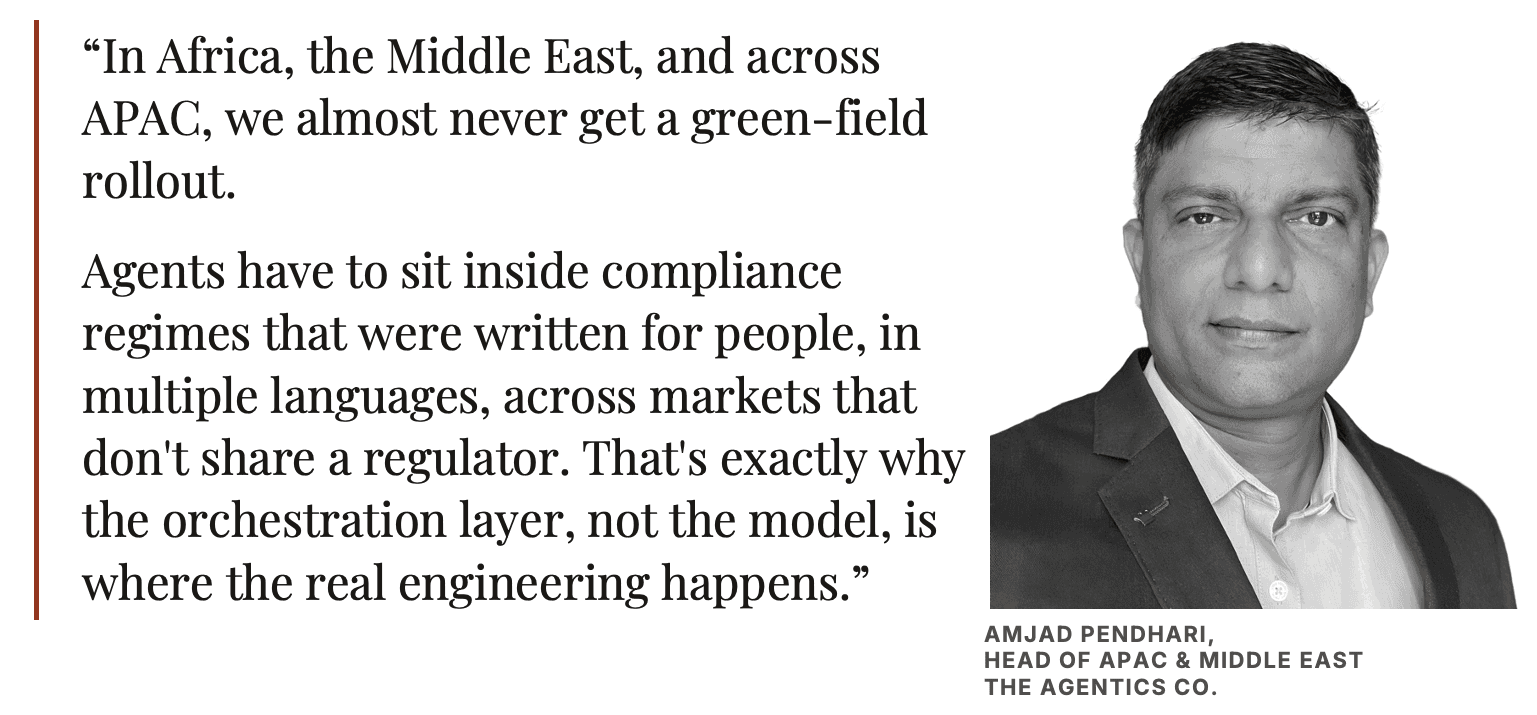
The key to making six markets work together as a single architecture, instead of building them each from scratch, was to clearly distinguish between shared components and local ones. For instance, the agent roles, how things are orchestrated, and the rules for governance are the same across all markets. The credit rules, language packs, and regulatory limits, on the other hand, are just settings that can be adjusted, not part of the code itself.
Think of it like this: an architecture is like a well-thought-out plan, while six pilots all using the same slide template is just a bunch of slides.

MULTI-AGENT ARCHITECTURE | THE DIAGNOSTIC
09 Nine Questions to Ask Before You Start Designing.
DISCLAIMER: If you’re having trouble explaining these concepts simply, without using terms like “agentic,” “platform,” or “model,” it might be best to wait until you’re more comfortable with them before the roadmap meeting.
Q1: Workflow or Org Chart: Should we start by looking at the workflow or the organization chart? Have we broken down the workflow before we split it into agents for each job title? Agent boundaries that match the organization chart usually mean we’re replacing people, not building a new system.
Q2: Which pattern and why? - Which pattern is best for this, and why? Which of the five coordination patterns does this workflow actually need, and can we explain why in just one sentence?
Q3: Who is in charge of each agent? Does every agent in the system have a named business owner, or does “the AI team” own them all by default?
Q4: Would it still work if we added a free feature? If a new lab created a generalist agent tomorrow that did 80% of what our custom system does, would the remaining 20% still make the architecture worth it?
Q5: Can we keep track of everything? Right now, without any rush, can we list every agent in production and every tool each one can access?
Q6: Is there a human check? Is there a human-in-the-loop approval for every action that is destructive, irreversible, or affects customer money or data?
Q7: Is there a limit to how many agents we can create? If an agent can spawn a sub-agent, is there a hard limit on how many generations we can have before a human reviews the lineage?
Q8: Who decides when an agent is retired? Who decides when an agent is retired, and how would we know if one had quietly stopped working?
Q9: Would someone else be able to build it? If we wrote the one-page architecture brief right now, could an engineer who doesn’t know the project well build from it, or does it only make sense in the room where we designed it?
Architect the System. Not JUST the Agent.
The enterprises that lead the next eighteen months will not be the ones that deployed the most agents. They will be the ones whose architecture survives contact with six markets, three regulators, and a workload that doubles without warning. Multi-agent isn't a feature.
It's an operating model and like any operating model, it has to be designed before it's needed, not patched together after the first incident.
ABOUT THE AGENTICS CO.
The Agentics Co. is a boutique Enterprise AI transformation firm specializing in Agentic AI and Multi-Agent Systems, operating across Europe, the Middle East, Africa, APAC, and LATAM through a partner ecosystem model. The firm architects, deploys, and governs multi-agent systems for clients across BFSI, CPG, retail, manufacturing, healthcare, logistics, and ESG.
Email us at hello@theagentics.co.

FREQUENTLY ASKED QUESTIONS on Multi-Agent Architecture
What is a multi-agent system?
Imagine a team of experts, each with their own special skills and tools, working together to get a job done. That’s what a multi-agent system is like! Instead of having one all-rounder taking care of everything, these agents each have a clear role and focus, and they all team up to make sure the workflow runs smoothly.
How fast is multi-agent adoption growing?
According to Databricks’ 2026 State of AI Agents report, the use of multi-agent workflows on their platform skyrocketed by 327% from June to October 2025, impacting over 20,000 organizations. Gartner and Forrester are both predicting that 2026 will be the year when multi-agent systems become the go-to choice for enterprises, replacing single-agent setups.
What are the main multi-agent architecture patterns?
There are five main ways to set up production: Sequential Pipeline (where everything happens in a set order), Parallel Fan-Out (where different branches are created and then combined), Orchestrator-Worker (where a planner sends tasks to experts), Hierarchical Supervisor (where domain supervisors oversee teams of workers), and Router/Handoff (where tasks are directed to the right specialist).
Why are enterprise databases changing because of AI agents?
It’s amazing to see that AI agents are now responsible for creating about 80% of the new databases on Databricks/Neon’s platform! That’s a huge jump from just 0.1% two years ago. This is because agents are setting up and taking down these isolated environments at such a fast and large scale that traditional human-administered, shared-nothing database systems simply weren’t built to handle.
What is a self-replicating agent?
Imagine an agent that can create its own little helpers to tackle tasks, all by itself! This means it can quickly make new versions of itself when needed, without needing an engineer to write each one from scratch, and then it can just get rid of them once the job is done. To make sure everything runs smoothly, we need to set up some rules, like limits on how many helpers it can make, ways to stop it if it gets out of hand, and a record of what it’s doing. These rules should be just right for how much freedom we give it.
Why do agentic AI projects get cancelled?
Gartner is predicting that over 40% of agentic AI projects might be called off by the end of 2027. They’re pointing to rising costs, a lack of clear business benefits, and risk controls that were added after the project was already underway, rather than being part of the original design.
SOURCES: Research cited in this paper.
Industry estimates on enterprise unstructured data (~90% in silos not readily reachable by agents); Cursor / Domino.ai reporting on cloud-agent-originated pull requests (~35%).
Related Post


Everything AI
Sep 3, 2026

Enterprise AI
Aug 19, 2026