
The Enterprise AI Value Realisation Engine Framework
The Enterprise AI Value Realisation Engine Framework, turning AI pilots into enterprise-wide value. Seventy percent of enterprises have adopted AI. Seventy-nine percent see no measurable profit from it. The difference isn't the models; it's whether you've built the machine that captures value from pilot to production. This is ours.
Posted by
The Agentics, Research Desk
Posted at
Enterprise AI
Posted on
THE SHORT ANSWER
Adoption is not value. Around 79% of enterprises report no measurable EBIT impact from generative AI despite roughly 70% adoption, and while some 78% run AI pilots, only about 14% reach enterprise-wide production. The gap is not a technology problem; it is the absence of a system that captures value as an initiative scales.
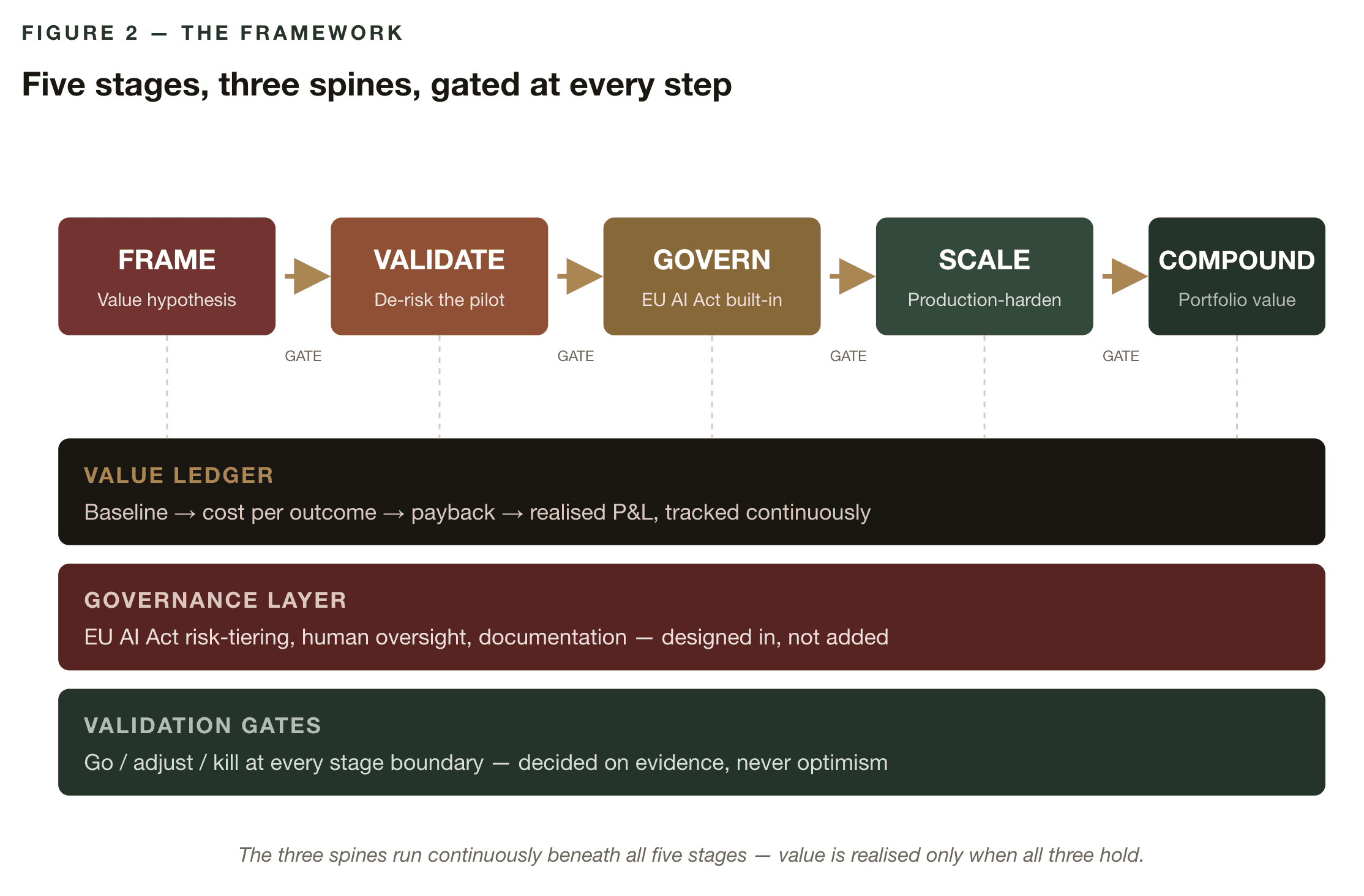
The Agentics Value Realisation Engine is that system. Five stages i.e. Frame, Validate, Govern, Scale, Compound, move an AI initiative from hypothesis to enterprise-wide impact. Three continuous spines run through all five: a Value Ledger that quantifies impact against a baseline, a Governance Layer aligned to the EU AI Act, and Validation Gates that force an honest go/adjust/kill decision at every stage. Value is only counted when it reaches the P&L.
There is a number that should stop every AI steering committee in its tracks: 79% percent of enterprises can point to no measurable profit impact from generative AI, even as adoption crosses seventy percent. Read those two figures together and the shape of the problem becomes clear.
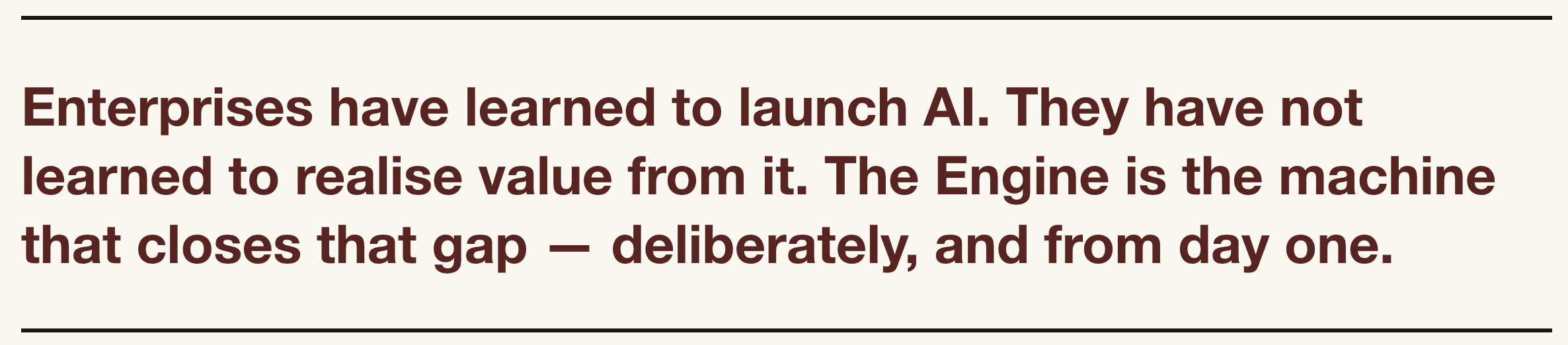
The market has comprehensively solved the question of whether to adopt AI, and has almost entirely failed to solve the question of how to turn that adoption into value that lands on the operating statement.
This is not a story about weak models or timid ambition. Investment is surging, pilots are everywhere, and the technology works. The failure is downstream of all that: enterprises launch AI initiatives without a mechanism to convert them into realised, defensible, compounding value as they move from a controlled pilot into the messy reality of enterprise-wide production. They celebrate launches. They do not engineer value capture. And so the value quietly evaporates in the gap between a pilot that impressed a room and a production system nobody built the machine to sustain.
Over dozens of engagements, we have watched this pattern repeat with enough consistency to build a system against it; one that treats value realisation not as a report produced at the end, but as an operating discipline running from the first pilot to full portfolio scale.
We call it the Value Realisation Engine. It is the connective tissue between three disciplines we have written about separately (de-risking pilots, governing agents, and measuring ROI) fused into a single progression. This is that framework, in full.
The Value Gap
Start with the leak, because it explains why a framework is needed at all. At every step from adoption to realised value, enterprises shed a portion of the initiatives that were supposed to pay off. Nearly everyone adopts; most run pilots; a fraction reach production; and only a small minority (the roughly ten percent that one study calls "Industrializers") consistently capture meaningful, measurable impact. The Engine exists to move an organisation down that funnel without leaking.
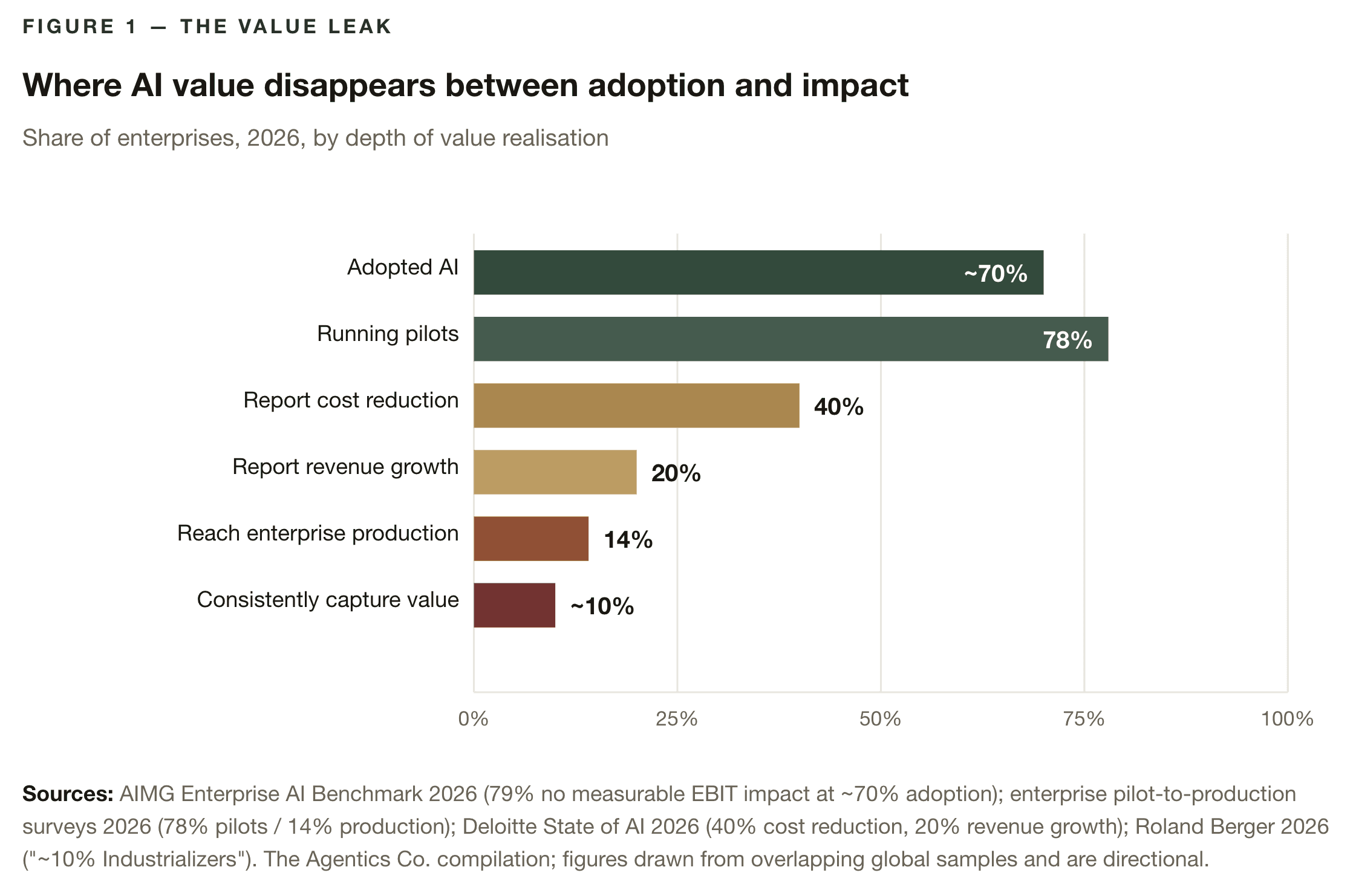
Notice the two cliffs. The first is between running pilots and reaching production (the deployment gap we have written about before). The second, quieter and more expensive, is between reaching production and consistently capturing value: even initiatives that make it live often cannot prove they moved the P&L. The Engine is built to survive both cliffs, which is why measurement and governance cannot wait until the end. They have to be load-bearing from the first stage.
The Agentics: Enterprise AI Value Realisation Engine Framework
The Engine has a simple architecture and a demanding discipline. Five sequential stages carry an initiative from idea to enterprise scale. Three continuous spines run through every stage, so that value, governance and validation are never bolted on; they are the rails the whole thing runs on. And between each stage sits a gate: a documented, evidence-based decision to proceed, adjust, or stop. Nothing advances on optimism.
The Five Stages
Each stage has a job, a failure it prevents, and a gate it must clear before value is allowed to advance. Together they convert an idea into enterprise-wide, measurable impact with an honest exit available at every step.

01 Gate: Baseline signed | Frame to set the value before the build
FRAME THE VALUE
Before a line of code, name the single business outcome the initiative targets, the P&L line it moves, and the current-state baseline it will be measured against. This is where most value is silently lost, not through failure, but through never having defined what success would have looked like. A value hypothesis without a baseline is a wish.
Clears the gate when → the outcome, its owner, and a documented pre-build baseline of cost, time, volume and error are agreed and signed.
02 Gate: Ship-or-kill | Validate the pilot as a de-risking instrument
VALIDATE THE PILOT
Run the pilot as a deliberate de-risking exercise against the known failure modes, not a demo built to impress. Test it on real data, real edge cases, and the reliability threshold production will demand. The pilot's job is not to prove the technology is exciting; it is to earn, or forfeit, the right to scale. Four to eight weeks is usually enough to reach an honest verdict.
Clears the gate when → the initiative meets its evaluation threshold against the human baseline, with cost per successful outcome inside target or is stopped without sunk-cost drift.
03 Gate: Governance signed | Govern to make scale legally and operationally safe
GOVERN FOR SCALE
Governance is the gate between a promising pilot and enterprise scale and the place value most often stalls for months. In the Engine, it is designed in from Frame and formalised here: risk-tier the initiative under the EU AI Act, define human oversight and escalation, and prepare the documentation and transparency the Act requires. Governance built in is a scaling accelerator; governance bolted on is why value-positive pilots die in review.
Clears the gate when → risk tier, oversight model, audit logging and transparency are in place and signed by risk and compliance before scale, not after.
04 Gate: Production-ready | Scale to harden for the whole enterprise
SCALE INTO PRODUCTION
Scaling is a distinct programme, not a bigger pilot. It means integrating with legacy systems, holding output quality at volume, standing up observability, and critically naming a production owner accountable for the initiative's behaviour, cost and improvement. A three-percent error rate that was six cases in a pilot becomes hundreds a week at scale; the Engine hardens against exactly that before the volume arrives.
Clears the gate when → integration, reliability at volume, observability and a named owner are proven in a controlled production rollout, with the Value Ledger showing realised, not projected impact.
05 Gate: Portfolio review | Compound to turn one win into a system
COMPOUND THE VALUE
A single scaled initiative is a result. A portfolio that compounds is a capability. The final stage lifts value realisation from the initiative to the enterprise: consolidate the Value Ledger across initiatives, reinvest realised savings into the next cohort, reuse governed patterns and components, and report portfolio-level impact to the board in the language of the operating statement. This is where the roughly ten percent pull decisively ahead.
Clears the gate when → realised value is consolidated at portfolio level, reinvestment is allocated, and reusable governed patterns are captured for the next initiative.
The Three Spines
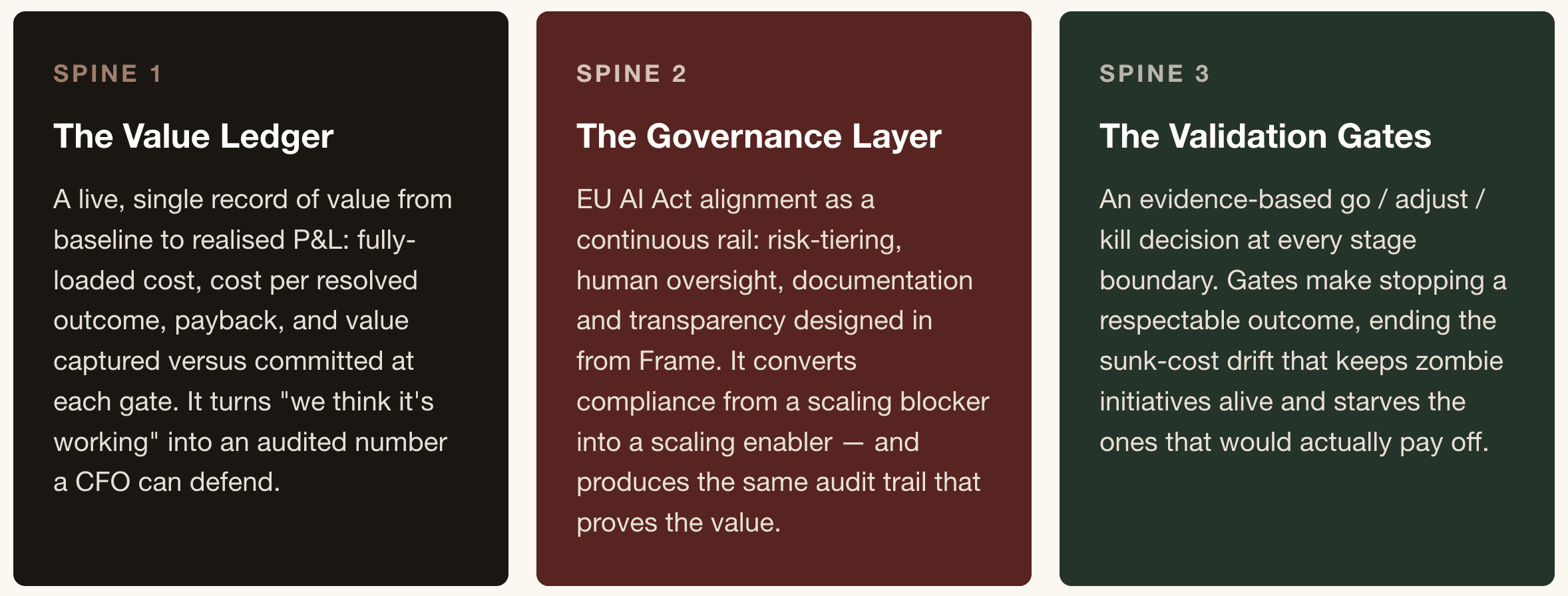
The stages are the visible progression. The spines are what make it a value-realisation engine rather than a project plan. Each runs continuously through all five stages, and value is only realised when all three hold at once; a scaled initiative with no ledger is unproven, a measured one with no governance cannot scale, and either without gates drifts.
The Metric Architecture
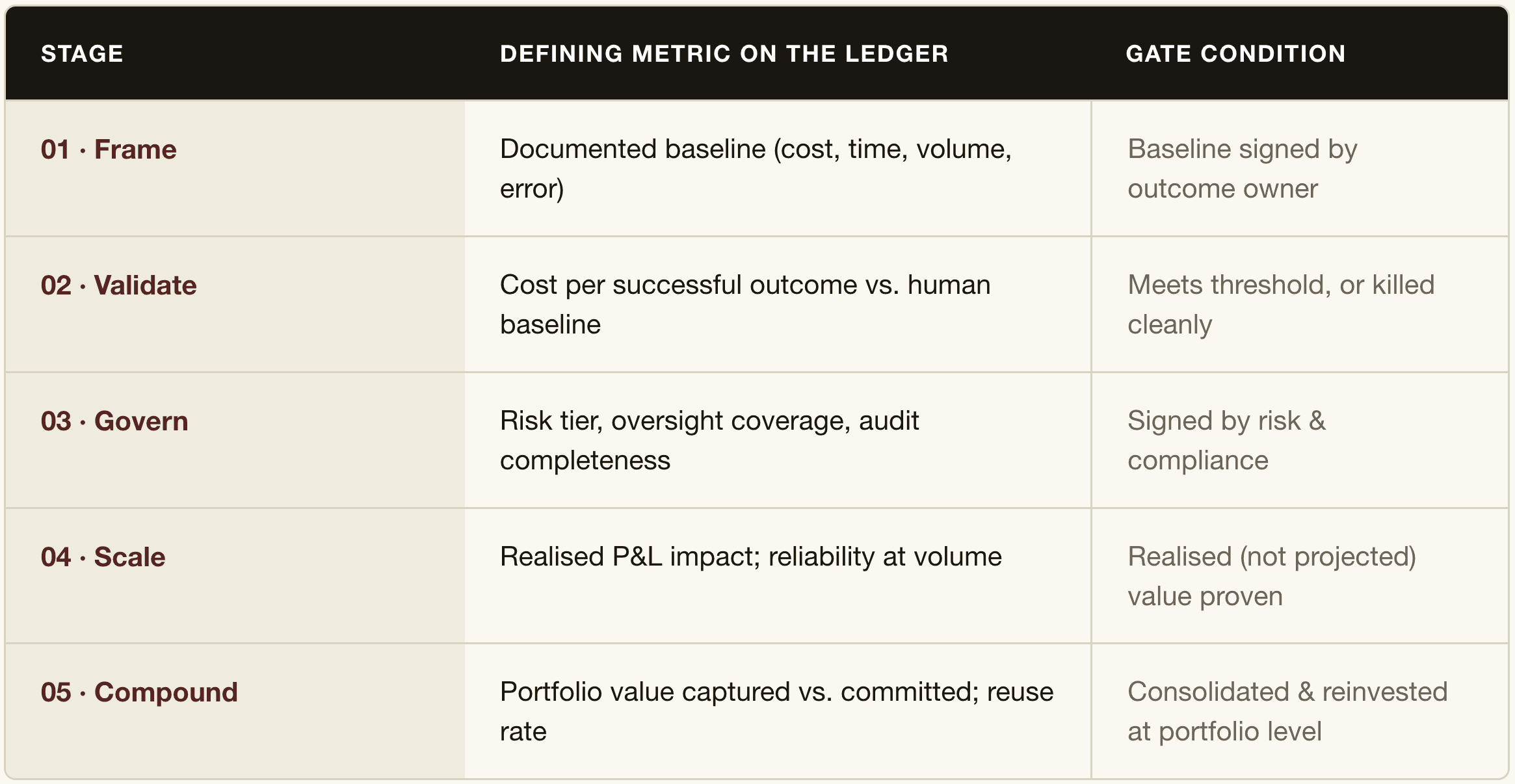
A framework that cannot be measured is a slogan. Each stage of the Engine has a defining metric on the Value Ledger and a gate condition that metric must satisfy. This is the instrumentation that makes value realisation provable rather than asserted and it maps directly onto how a CFO, COO and CIO each read the same evidence.
Putting The Engine To Work
The Engine is deliberately technology-agnostic and sector-agnostic; it governs how value is realised, not which model or platform delivers it. An enterprise can enter at Frame for a new initiative, or bring an existing stalled pilot in at Validate or Govern to diagnose why it isn't scaling. What matters is that the three spines are switched on from the point of entry: a value ledger with a real baseline, a governance layer that anticipates the Act, and gates with the authority to stop things.
Below is the readiness check we use to tell whether an organisation is set up to realise value or merely to launch. It is a fair self-diagnosis: the more of these you cannot yet answer "yes, with evidence," the more of your AI investment is currently at risk of leaking away in the gap between adoption and impact.

The enterprises pulling decisively ahead in 2026 are not running fundamentally different AI. They are running it through a machine that captures value at every stage instead of hoping value appears at the end. That machine can be built, and it does not require more spend; it requires the discipline to frame value before building, to validate honestly, to govern early, to scale deliberately, and to compound relentlessly. The models have been ready for a while. The engine to realise their value is what remains rare.

About this framework
The Agentics Value Realisation Engine i.e. its five stages (Frame, Validate, Govern, Scale, Compound), its three continuous spines (Value Ledger, Governance Layer, Validation Gates), and its metric architecture, is the proprietary intellectual property of The Agentics Co., developed through enterprise AI delivery across Europe, the Middle East, Africa, APAC and LATAM. It unifies the firm's Validation-First method, its EU AI Act governance practice, and its outcome-based ROI discipline into a single value-realisation system. It is offered here for the wider enterprise community and may be cited with attribution.
The Agentics Co. is an Amsterdam-headquartered enterprise AI transformation firm specialising in agentic AI and multi-agent systems. Learn more at theagentics.co.
Citation: The Agentics Co. (2026). The Agentics Value Realisation Engine: A Framework for Turning AI Pilots into Enterprise-Wide Value. Retrieved from https://theagentics.co/insights/the-enterprise-ai-value-realisation-engine.
Benchmark figures cited are drawn from third-party 2026 research across overlapping samples and are directional, not guarantees; individual results vary by use case, data quality and deployment scope. This document is analysis and general information, not financial or legal advice.
Selected Sources & Further Reading
AIMG: Enterprise AI 2026 Benchmark Study (79% report no measurable EBIT impact at ~70% adoption).
Roland Berger (2026): The AI Value Gap ("~10% Industrializers" consistently capture value).
RAND (2025) / Gartner (2026): AI project value-realisation and success-rate data.
The Agentics Co.: The Pilot-to-Production Playbook, The Enterprise AI Governance Handbook, and The AI ROI Benchmark Report 2026, theagentics.co/insights.
Related Post

Everything AI
Sep 3, 2026

Enterprise AI
Aug 19, 2026