
Chief AI Officer to Chief AI Decision-Maker
The fastest-growing seat in the C-suite is also the most fragile. Chief AI Officer hiring nearly tripled in twelve months. The authority attached to the title did not grow at the same speed and the gap between the two is where the role either compounds value or quietly becomes someone to blame.

Posted by
The Agentics
Posted at
Enterprise AI
Posted on
In 2025, roughly one in four large organizations had a Chief AI Officer. By 2026, three in four did. No C-suite role in the last decade (not the CDO, not the CDO's predecessor the Chief Digital Officer) has scaled this fast. The question this briefing asks isn't whether the role is real. It's whether most of the people holding it have been given anything to actually run.
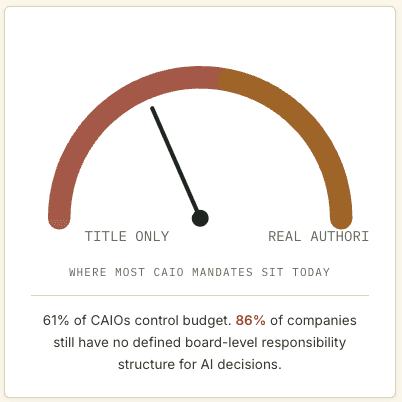
01 : The Growth from a novelty title to a near-default hire in one CEO cycle.
Three independent surveys, three different methodologies, the same direction of travel.
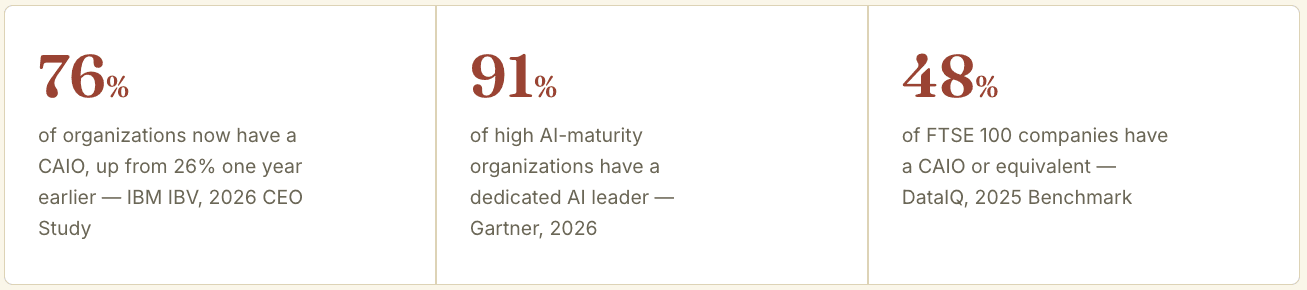
Growth this fast should raise one question the adoption headlines mostly skip: is the authority scaling at the same speed as the title?
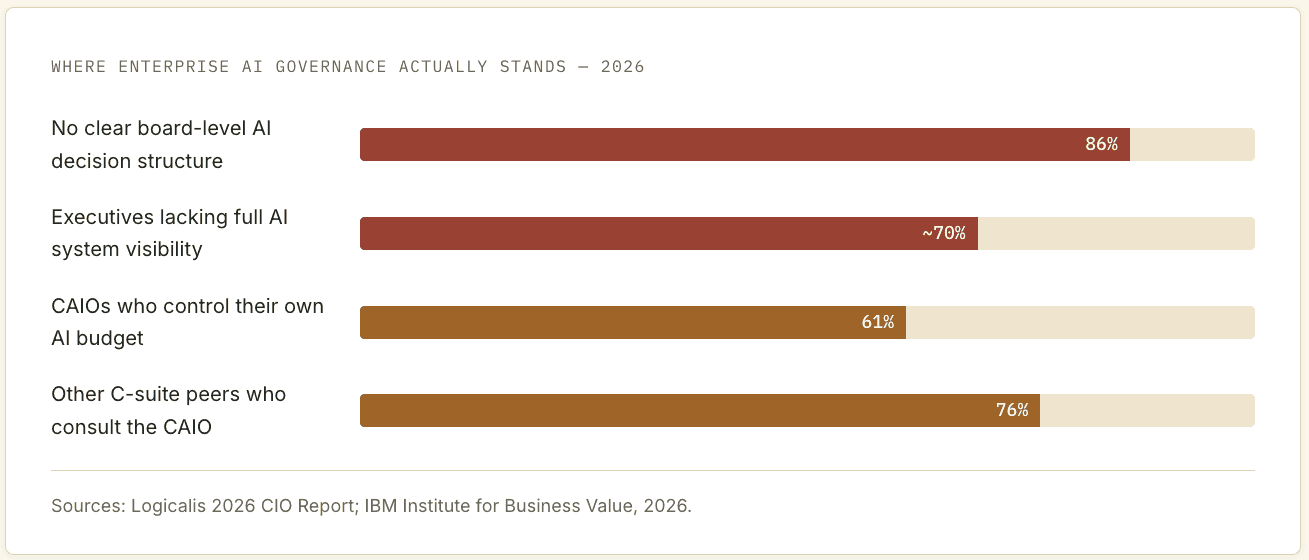
02: The Gap - Underneath the title, governance is still mostly undefined.
The appointment rate and the readiness rate are measuring two different things.
A Chief AI Officer without budget authority functions, in practice, as a consultant with a title but able to advise, unable to compel. — Industry commentary on enterprise AI governance models, Digital Chiefs, 2026
The pattern holds across every recent survey: consultation is common, control is not. Three in four CAIOs are asked their opinion. Just over three in five can actually direct spend. The remainder are the ones most exposed when a decision made "with AI input" turns out badly, because nobody can point to the moment they were handed the authority to have stopped it.
03 : The Precedent - The Chief Data Officer already ran this experiment.
Two prior waves of tech leadership hiring show what happens on either side of this gap.
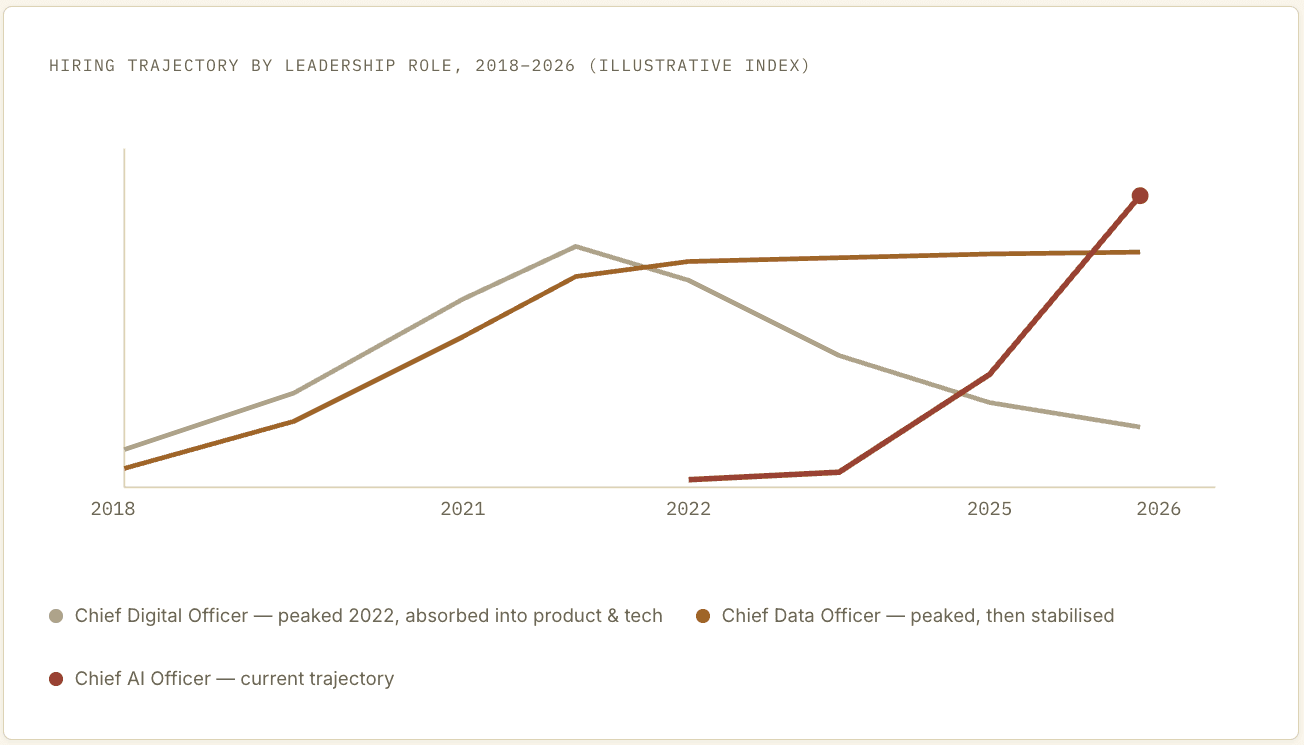
The CDO's staying power is the encouraging precedent: governance-and-risk-bearing roles tend to persist once the capability underneath them becomes load-bearing, rather than fading once the initial hype cycle passes. But the CDO comparison also carries a warning most CAIO commentary leaves out.
Even six years into a legally mandated federal CDO function in the U.S., a stronger authority footing than almost any private-sector CAIO has today. Deloitte's 2025 Federal CDO Survey found data leaders still explicitly asking for clearer guidance on where CDO, CIO, and CAIO authorities begin and end.
If a role backed by statute still struggles to convert mandate into resourced authority after six years, a voluntarily created CAIO title with no legal anchor is starting from a weaker position, not a stronger one.
04: The Payoff, When it's REAL
Structure beats the label and the data shows the difference in dollars.
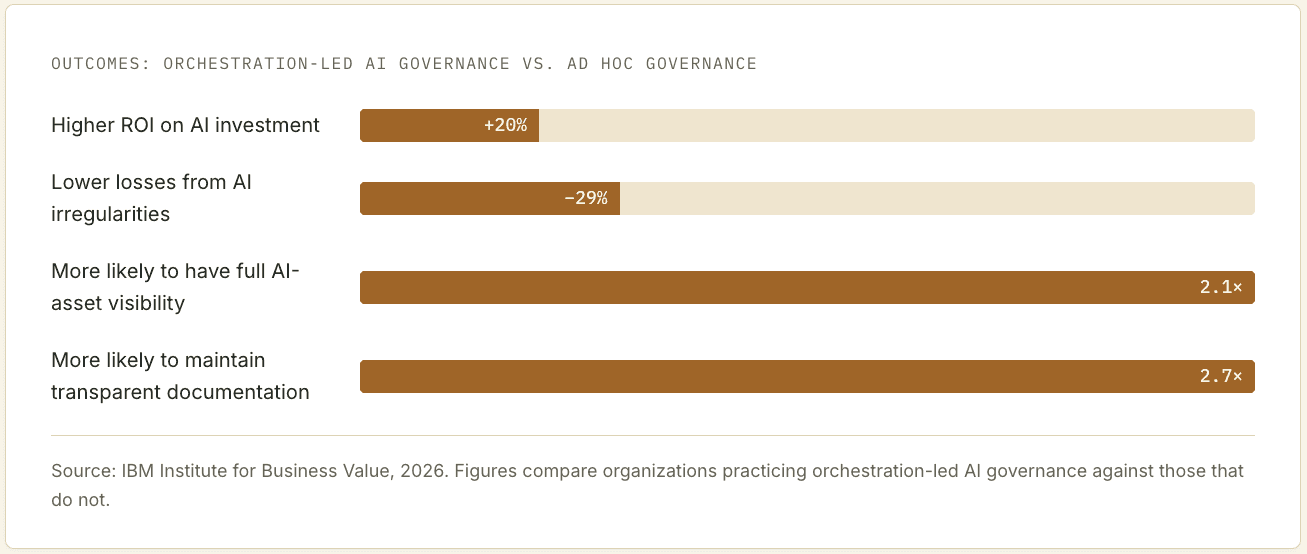
The advantage was never the existence of the title. It's what the title was actually allowed to control. A CAIO wired into budget decisions and given real standing across the C-suite produces measurably different outcomes than one appointed to "own AI" in name only.
05: The Risk Nobody Names
Without authority, the role doesn't disappear. It becomes an accountability sink.
Here is the failure mode worth stating directly. When a CAIO is appointed with a mandate that really amounts to coordinate the pilots, no claim over role redesign, no authority over the data foundations underneath AI initiatives, no clear line on where automation stops and a human is accountable; the role changes function rather than vanishing. It stops being the owner of AI strategy and becomes the name attached when an AI decision goes wrong. Present in the org chart. Absent from the P&L.
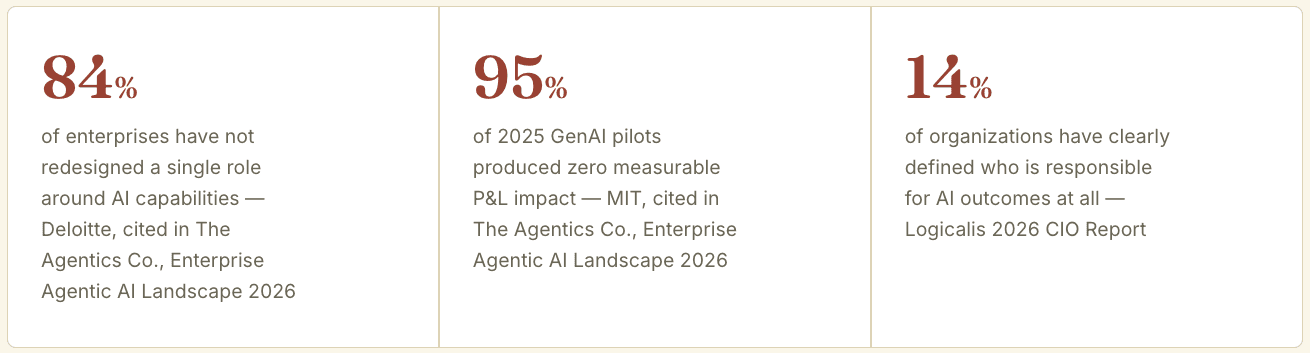
A CAIO without real decision rights over exactly that kind of role redesign is not positioned to close the 84% gap. They're positioned to be blamed for it.
06: What Durable Looks Like
Three things need to be true before the title means anything.
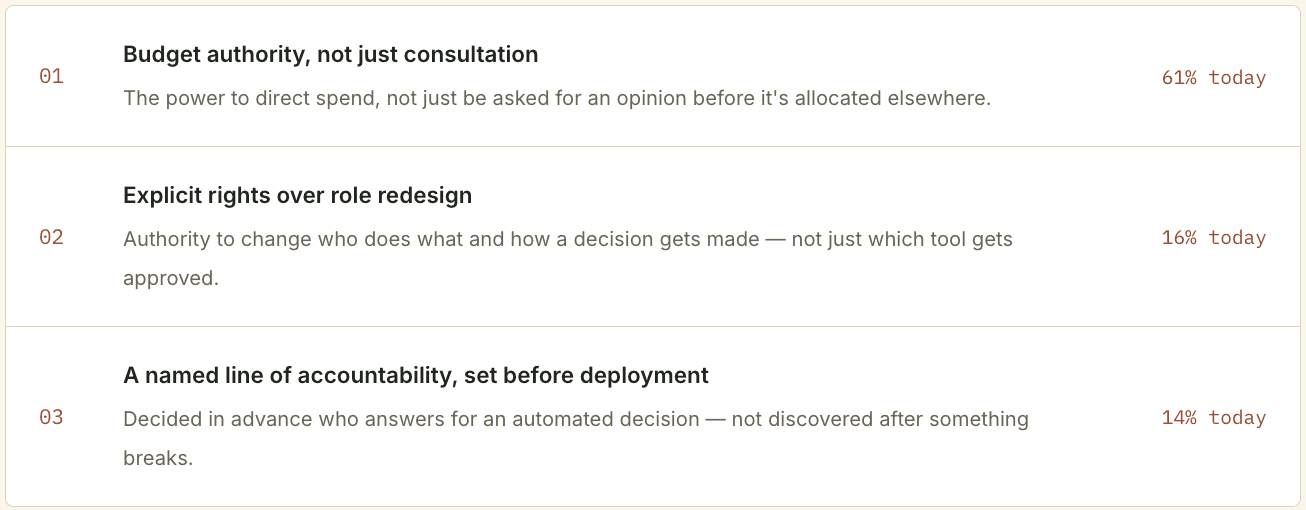
The CAIOs still holding real authority in three years will likely look less like today's evangelist-model appointments and more like early Chief Technology Officers: fewer in number, more senior, sitting close enough to operations that governance is how decisions actually get made, not a policy document referenced after the fact.
No one person should own AI. It has to be shepherded.
— Lula Mohanty, Managing Partner, IBM Consulting Middle East, co-author of IBM's Chief AI Officer research
The rise of the CAIO is real, and the data behind it is not hype. The more interesting question for the rest of 2026 isn't how many organizations have appointed one. It's how many gave that person enough authority to actually own the outcome and how many quietly built themselves a well-titled place to point the finger instead.
Sources
IBM Institute for Business Value, 2026 CEO Study (2,000+ organizations, 33 geographies).
Gartner, 2026 survey of high AI-maturity organizations.
DataIQ, 2025 CAIO Benchmark (FTSE 100).
Logicalis, 2026 CIO Report.
Deloitte, 2025 Federal Chief Data Officer Survey, in collaboration with the Data Foundation.
The Agentics Co., Enterprise Agentic AI Landscape 2026, synthesising Deloitte, Celonis, MIT, and Digital Commerce 360 data.
Figures are drawn from the cited public research and reflect each source's own survey methodology; readers should consult original reports for full methodology notes.
Related Post


Everything AI
Sep 3, 2026

Enterprise AI
Aug 19, 2026