
The Enterprise MCP Guide 2026 - The Agentics
The Agentics Paper on "How the Model Context Protocol went from a November 2024 open-source release to critical enterprise infrastructure and the Governance, Security, and Compliance work that separates production deployments from stalled pilots."

Posted by
The Agentics
Posted at
Enterprise AI
Posted on
The Model Context Protocol (MCP), open-sourced by Anthropic in 2024, has rapidly become enterprise infrastructure, with 97 million monthly downloads and 41% of technical leaders reporting production use. However, while adoption is high, governance lags, with only 11-14% of pilots reaching production due to challenges in identity management, auditability, and vendor lock-in. Security concerns also persist, as many MCP servers exhibit exploitable risks and lack proper authentication measures.
The rapid adoption of multi-agent platforms (MCPs) in enterprise generative AI applications raises significant security concerns. Gartner projects a rise in security incidents linked to MCP-driven attack surfaces, emphasizing the need for robust governance. The EU AI Act mandates compliance for high-risk actions performed by AI agents, including those facilitated by MCPs, highlighting the importance of data governance, logging, human oversight, and cybersecurity resilience.
The Model Context Protocol (MCP) enables AI models and agents to connect to external tools and systems. While widely adopted, MCP requires governance to ensure security and compliance, particularly with regulations like the EU AI Act. Enterprises should prioritize validating use cases, governing access, and implementing robust security measures before scaling MCP deployments.
What CIOs need to know
MCP is now cross-vendor infrastructure, not an Anthropic side project. Donated to the Linux Foundation's Agentic AI Foundation in December 2025 with OpenAI, Google, Microsoft, AWS, Salesforce, and Snowflake as backers.
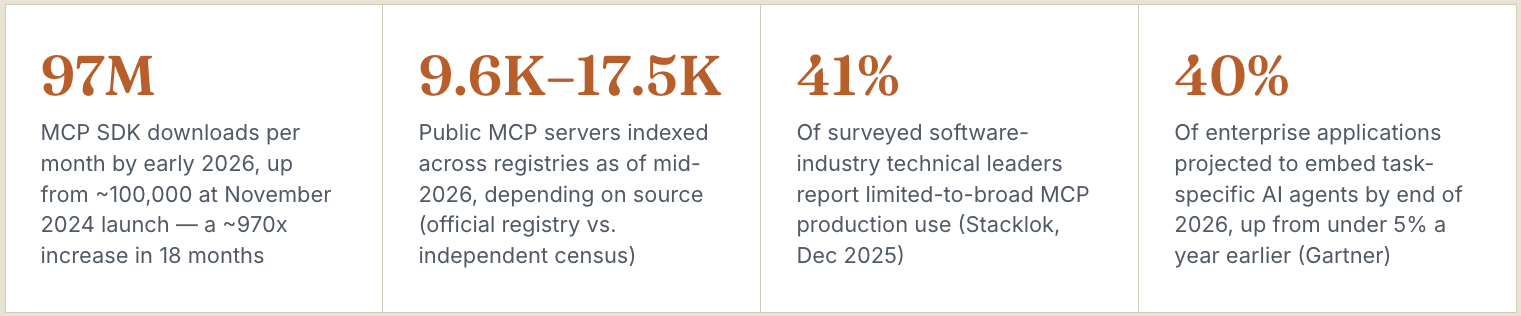
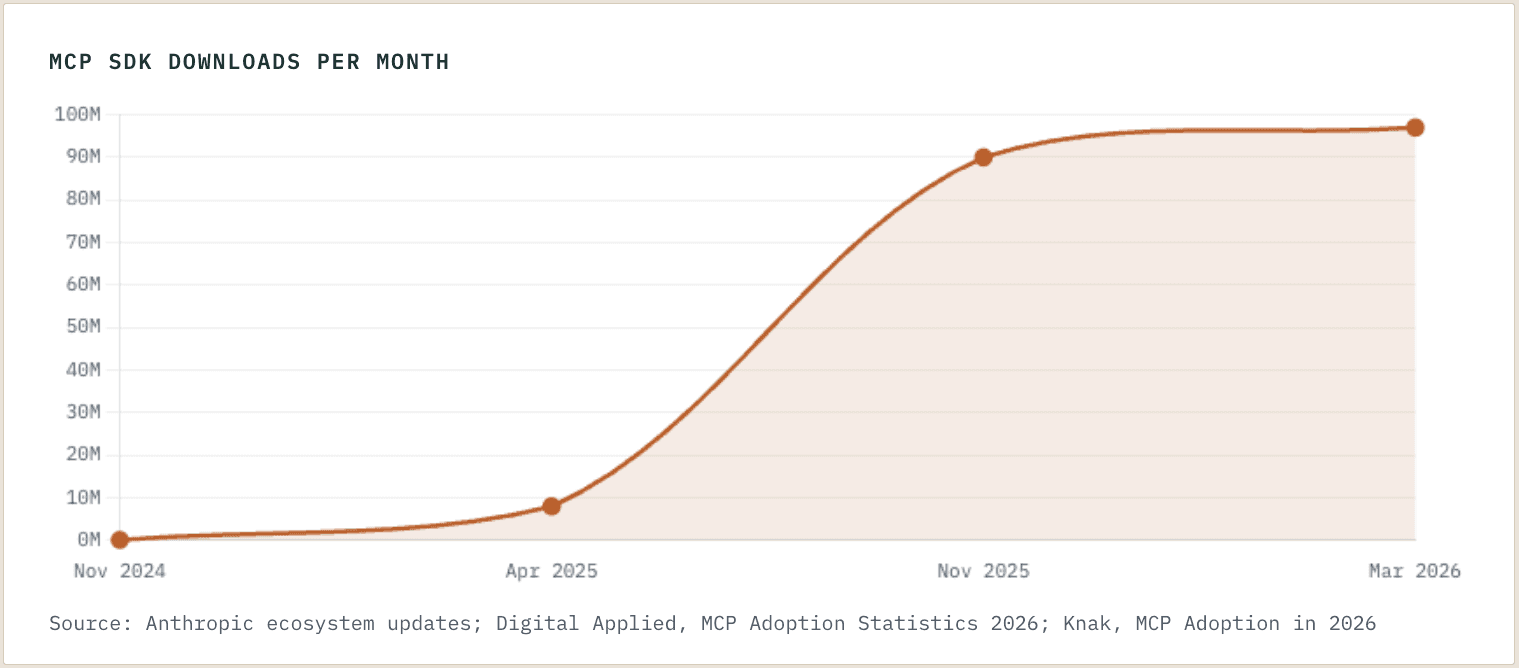
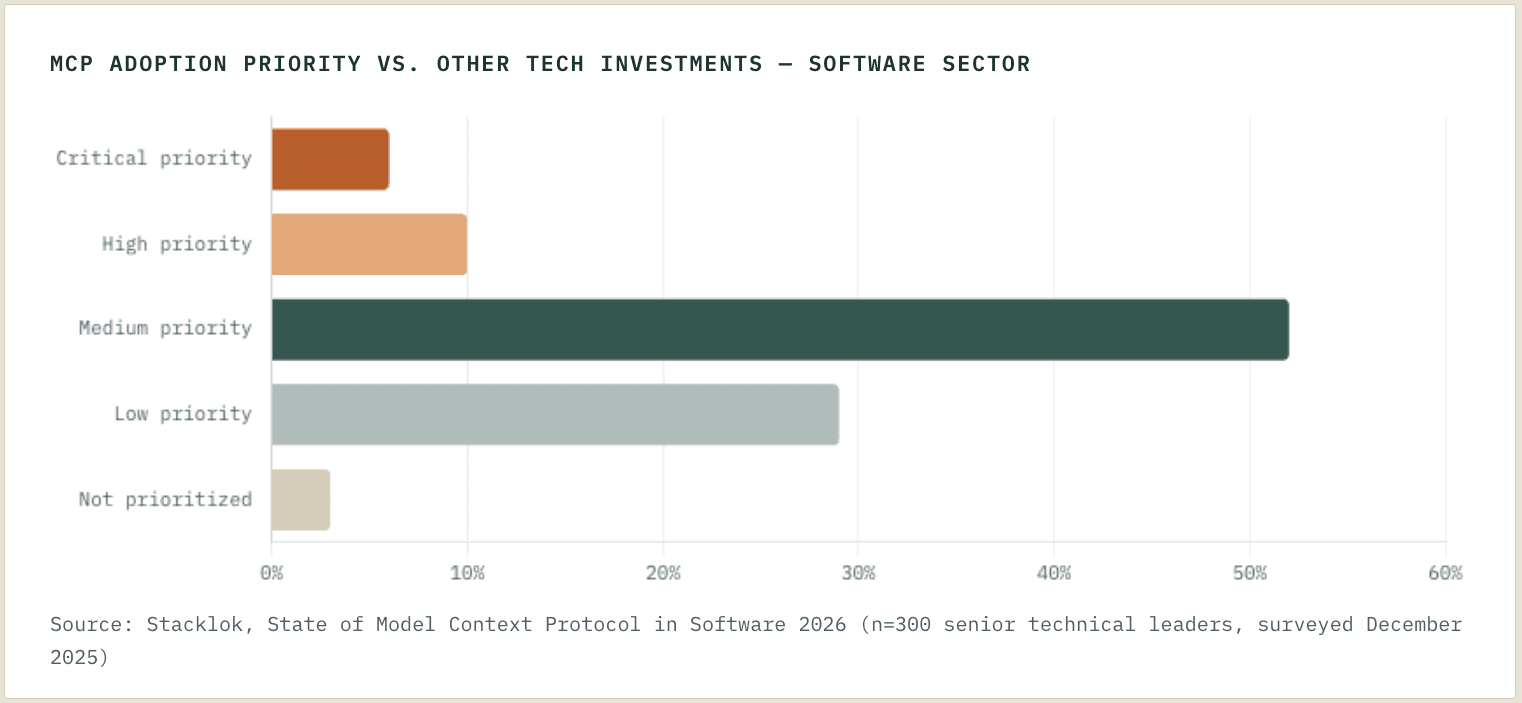
Adoption is real but uneven. SDK downloads hit ~97M/month by early 2026; roughly 41% of software-industry technical leaders report their org is already in limited-to-broad MCP production.
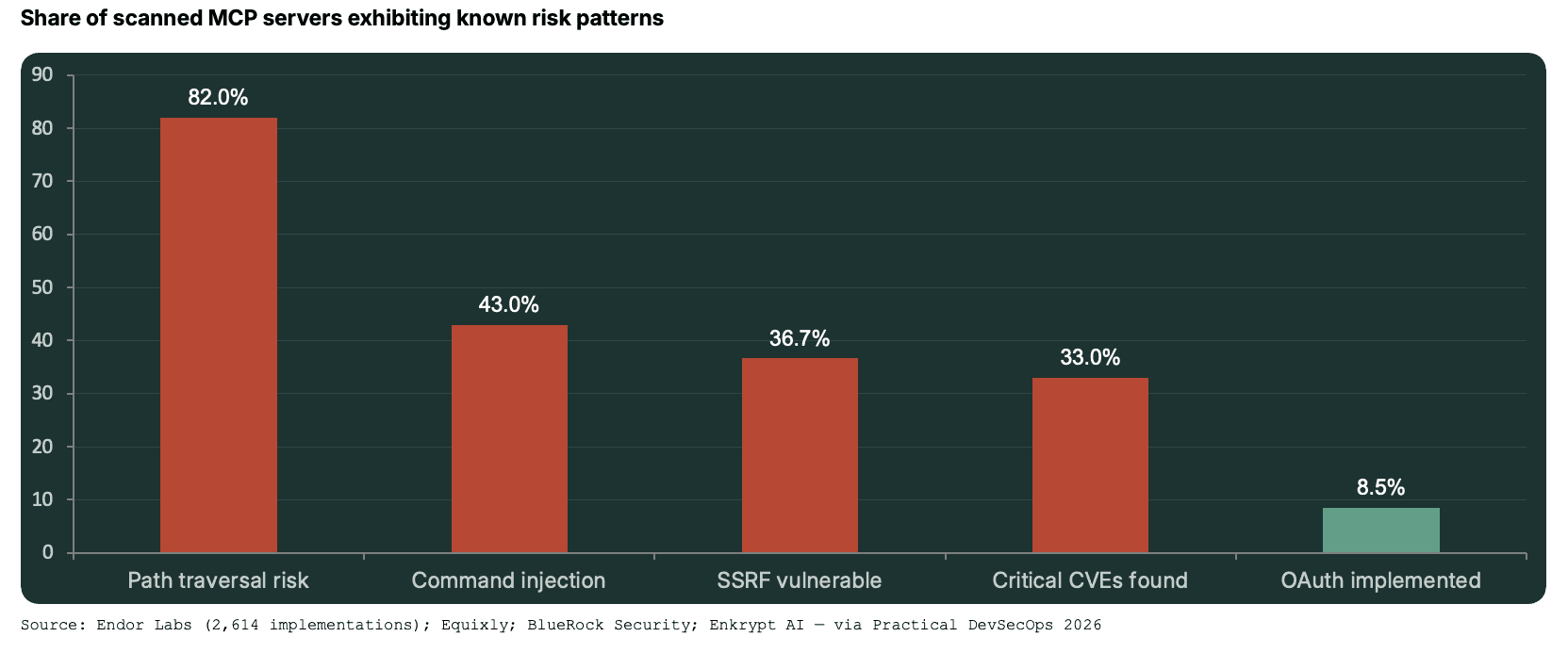
Security has not caught up with adoption. Independent scans found a majority of public MCP servers carry exploitable risk; only a small fraction use OAuth by default.
The EU AI Act reaches the tool-calling layer. High-risk obligations became enforceable August 2, 2026; MCP gateways used on regulated data are inside scope.
Governance, not ambition, decides who scales. An estimated 11–14% of enterprise agentic AI pilots reach production; the rest stall on identity, audit, and access-control gaps.
Adoption Data: The State of Enterprise MCP Adoption in 2026
MCP's growth curve is one of the fastest of any open developer standard on record but "downloaded" and "in governed production" are two very different numbers, and the gap between them is where most of this guide lives.
Every major AI platform vendor now ships MCP support: OpenAI, Google DeepMind, Microsoft Copilot Studio, and AWS all added it within roughly thirteen months of launch.
On the enterprise application side, the pattern repeats across CRM (HubSpot, Salesforce Agentforce, Microsoft Dynamics 365), marketing automation (Adobe Marketo Engage), and developer tooling (Cursor, Windsurf, Zed).
Among the twenty most-searched MCP servers, roughly 80% are offered as remote, vendor-hosted servers rather than local installs; enterprises are consistently choosing the deployment model that is easier to govern centrally.
The honest caveat: no registry can tell you how many of those servers are actually wired into a production agent versus sitting unused after a hackathon. Treat server counts and download figures as adoption-intent signals, not usage proof and demand your own internal inventory before trusting anyone's aggregate number, including this one.
The Governance Gap: Why Most Agentic AI Pilots Never Reach Production
2026 is being described across the industry as the year MCP moves from pilots to enterprise-wide adoption. The data on how many pilots actually make that jump is far less optimistic than the download charts suggest.
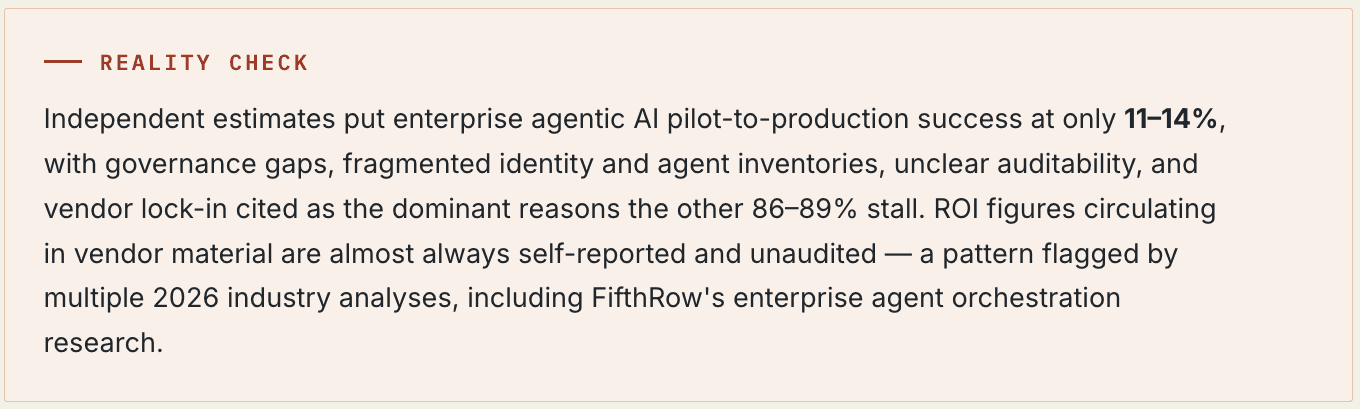
The obstacles enterprises report are consistent across sectors: technical complexity mapping MCP tools to legacy internal systems, change-management friction between IT, security, and business stakeholders, and, most often, the absence of a registry, approval workflow, or audit layer before agents are given write access to anything that matters. Enterprise teams increasingly demand these controls before broad deployment, which is precisely why "MCP adoption" and "MCP governance maturity" need to be tracked as two separate metrics internally, not one.

Security & Risk: Adoption has Outpaced Governance
MCP servers routinely aggregate credentials for multiple enterprise systems behind a single interface. That convenience is also the risk: a compromised server can become a single point of failure across every system it touches and every other consumer of that same server.
"The urgency lies in governing MCP deployments before they scale unchecked." — Gartner, MCP Cybersecurity Guide, 2026
Gartner's Strategic Planning Assumptions put numbers on that urgency: By 2028, roughly 25% of enterprise generative AI applications are projected to experience five or more minor security incidents a year, up from 9% in 2025.
Gartner analyst Aaron Lord has separately projected that 15% of enterprise GenAI applications will suffer at least one major security incident annually by 2029, up from 3% in 2025; explicitly tying the rise to MCP-driven attack surfaces.
The Cloud Security Alliance frames the deeper issue plainly: AI agents are now privileged identities that sit between traditional user accounts and service accounts, executing on behalf of humans with permissions that often exceed the humans they act for.
OWASP's MCP Top 10 project has since formalized the threat categories security teams now test against: tool poisoning (malicious instructions hidden in tool metadata), schema poisoning, tool shadowing, command injection through unsanitized agent input, shadow MCP servers deployed outside formal governance, and context over-sharing across shared agent sessions.
The Coalition for Secure AI's January 2026 whitepaper maps roughly 40 distinct threats across twelve categories; a scale of risk surface that did not exist in traditional API integration.
What holds up in practice: Defense-in-depth, NOT a Single Control. The highest-leverage measures enterprises are converging on in 2026 are an enforced tool allowlist per agent, OAuth 2.1-based identity binding so agents inherit scoped user permissions rather than standing credentials, a centralized MCP gateway that gives security teams one inventory instead of a spreadsheet, and mandatory human-in-the-loop approval for destructive or irreversible actions e.g. database deletions, financial transactions, bulk record changes, and outbound data transfers.
Regulatory Compliance: MCP and the EU AI Act
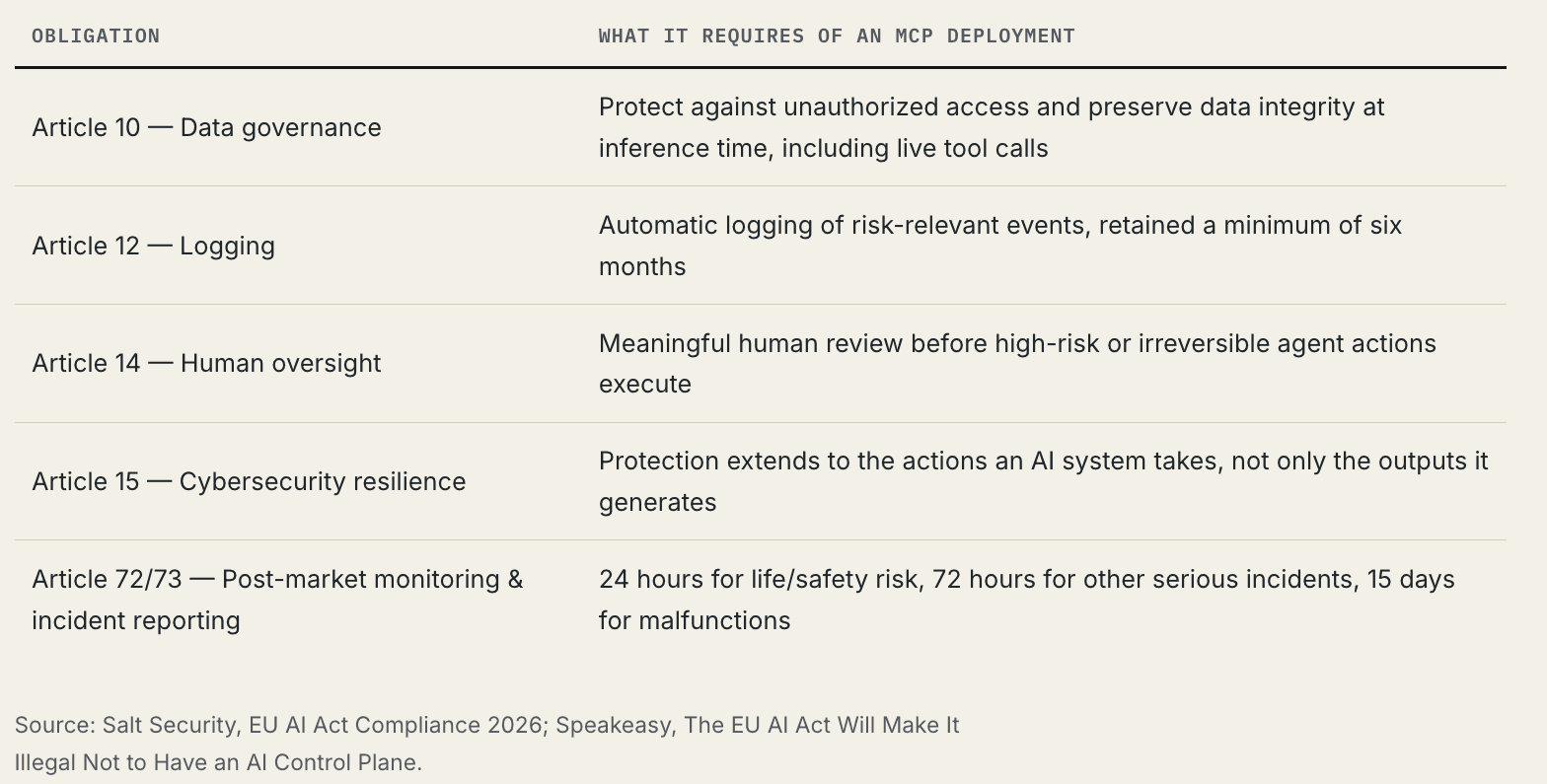
The tool-calling layer is in scope. The Act doesn't mention MCP by name. It doesn't need to. Where an AI agent uses an MCP server to take a high-risk action, that action inherits the Act's obligations; a point the regulation makes explicit for chained, multi-agent architectures.
High-risk provisions became enforceable on August 2, 2026, covering risk management, data governance, technical documentation, logging, human oversight, and cybersecurity resilience.
Recitals 99 and 100 address multi-agent chains directly: in a sequence of AI agents, the compliance boundary extends to every agent performing a high-risk function, not just the model that started the chain.
For MCP specifically, that means the gateway layer, not only the LLM, needs to produce audit-ready evidence: who called which tool, with what data, under what authorization, and when.
Forrester projects that 60% of Fortune 100 companies will appoint a dedicated head of AI governance in 2026. The organizations treating the deadline as a formality rather than a fire drill share a pattern: they built an MCP gateway, a registry, and an agent identity system before the compliance clock forced them to i.e. Governance as infrastructure, not paperwork bolted on afterward.
Enterprise Case Studies: What production MCP looks like at scale?
The strongest evidence for MCP's enterprise case isn't the download counter; it's the handful of large, regulated organizations that have run it in production long enough to publish what broke, what they rebuilt, and what it returned.
Bloomberg: From Demo Velocity to Governed Production
Bloomberg used MCP to close what its engineering team calls the "productionization gap"; the lag between a working GenAI demo and a deployable, compliant application across 9,500+ engineers.
By treating prompts and toolchains as configuration and building identity-aware, multi-tenant MCP servers, Bloomberg cut experimentation cycles from weeks to minutes.
Its January 2026 flagship agent, ASKB, was built on a hard-won lesson: MCP gives you interoperability, not out-of-the-box guardrails; trustworthiness and correctness still have to be engineered in.
JPMorgan Chase: Governance-first at $1.8B scale
JPMorgan built its agentic AI platform governance-first, with C-suite oversight and compliance embedded from day one, ahead of a broader $18B annual technology budget.
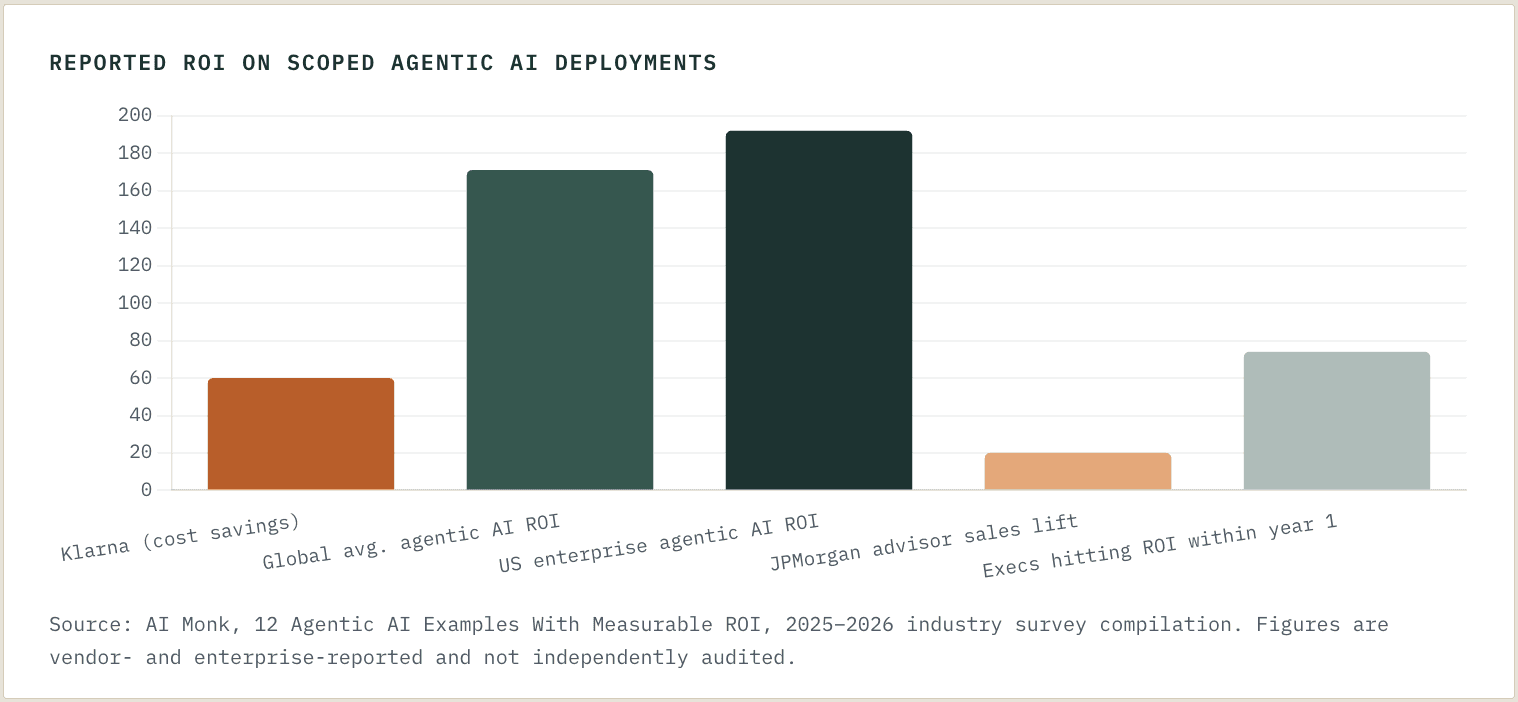
The bank now runs 450+ AI agent use cases in daily production including generating investment-banking presentations in roughly 30 seconds, work that previously took junior analysts hours and reported a 20% gross sales lift from AI-assisted advisor outreach during periods of market volatility.
Klarna: Customer service at FTE scale
Klarna's customer-service AI agent handled workload equivalent to 853 full-time employees and delivered roughly $60M in savings by Q3 2025; one of the most cited agentic AI deployments in enterprise financial services, and a case study in what happens when a scoped use case meets connected data infrastructure and a defined KPI from day one.
Forbes: Removing developer dependency from content ops
Forbes reported saving roughly 18,000 hours annually and doubling landing-page conversion rates after removing developer dependency from its content and marketing workflow via production MCP infrastructure; evidence that MCP's ROI case extends well beyond engineering and coding-assistant use cases into marketing operations.
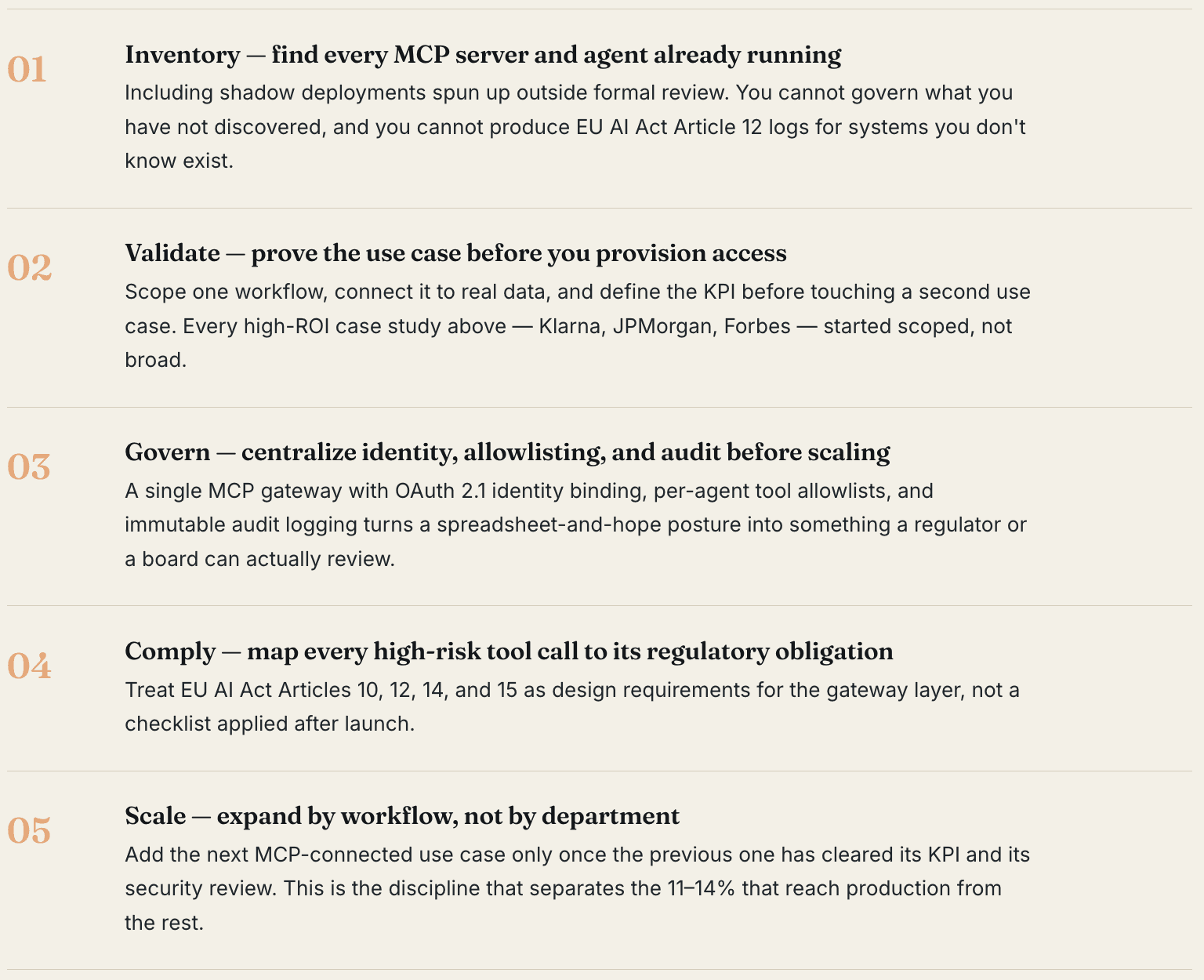
The Agentics Framework: Validate, Govern, then Scale — Not The Reverse
Most of the failure modes in this guide trace back to one sequencing error: enterprises scale MCP access before they validate that the governance layer can hold it. The Agentics Co.'s Validation-First Framework applies to MCP deployment as directly as it does to any other agentic AI investment.
“ MCP solved the integration problem enterprises actually had but it quietly created a governance problem most of them don't know they have yet.
The organizations getting real value in 2026 aren't the ones with the most MCP servers connected. They're the ones who treated the gateway, the identity layer, and the audit trail as part of the architecture from day one, not as a compliance task bolted on before an August deadline.
Validate the use case, govern the access, then scale, in that order. Every enterprise we've worked with that skipped a step has had to go back and rebuild it under pressure." — Nishith Srivastava, Founder, The Agentics Co.
Looking Ahead: What changes between now and 2027 in Enterprise MCP?
Three shifts are already visible in the roadmap Anthropic and the Agentic AI Foundation have set for MCP: OAuth 2.1 authentication moving from optional to default, Streamable HTTP transport replacing local stdio connections so MCP servers can live behind proper cloud load balancers and API gateways, and formal tool governance and observability becoming table-stakes features rather than premium add-ons.
In parallel, the Agent-to-Agent (A2A) protocol, now in production use at more than 150 organizations, is emerging as MCP's horizontal complement: MCP governs agent-to-tool connections, A2A governs agent-to-agent delegation, and the two together form the backbone most analysts expect multi-vendor enterprise orchestration to run on through 2027.
None of this makes governance optional. If anything, the maturing protocol stack raises the bar: NIST's AI Agent Standards Initiative, launched February 2026, is expected to publish an interoperability profile in Q4 2026, and regulators on both sides of the Atlantic are converging on the same conclusion the security research already reached; the tool-calling layer is where enterprise AI risk actually lives, and it is where enterprise AI governance investment needs to go next.
FAQs: Enterprise MCP
What is the Model Context Protocol (MCP)?
An open standard, introduced by Anthropic in November 2024, that lets AI models and agents connect to external tools, data, and enterprise systems through one common interface instead of a custom integration per model-tool pair. It's frequently described as a USB-C port for AI applications.
How widely has MCP been adopted by enterprises in 2026?
SDK downloads reached roughly 97 million per month by early 2026. Public server counts range from about 9,600 to 17,500 depending on the registry and date. Gartner projects 40% of enterprise applications will embed task-specific AI agents by the end of 2026, with MCP as the dominant connective layer.
Is MCP secure enough for enterprise production use?
Not by default. Independent scans found the majority of public MCP servers carry meaningful risk such as path traversal, command injection, or SSRF exposure, and only a small fraction implement OAuth out of the box. Production use requires a governed gateway: identity binding, tool allowlisting, audit logging, and human-in-the-loop approval for high-risk actions.
Does MCP fall under the EU AI Act?
Indirectly, yes. Where an AI agent uses an MCP server to take a high-risk action, that action falls inside the Act's cybersecurity, logging, data governance, and human-oversight obligations, enforceable from August 2, 2026 for high-risk systems.
What's the real ROI of enterprise MCP and agentic AI deployments?
Enterprises with scoped, production-grade deployments report average ROI around 171% (192% in the US), per 2025–2026 industry surveys. Treat these as vendor- and enterprise-reported, not independently audited and note that only an estimated 11–14% of pilots reach production at all.
What should a CIO do first to govern MCP at enterprise scale?
Inventory every MCP server and agent already running, including shadow deployments. Centralize access through a governed gateway with OAuth-based identity binding, per-agent tool allowlists, and full audit logging before scaling past a handful of pilots. Validate, govern, then scale.
Sources: References & Further Reading
Zuplo — The State of MCP — Adoption, Security & Production Readiness
Medium / Gary Weiss — The Rise of MCP: Protocol Adoption in 2026
Advisable — The MCP Revolution: What MCP Means for SaaS in 2026
Gupta Deepak — The Complete Guide to MCP Enterprise Adoption
FifthRow — AI Agent Orchestration Goes Enterprise: April 2026 Playbook
ITECS — MCP Tool Poisoning: Enterprise AI Agent Security in 2026
SentinelOne — Model Context Protocol (MCP) Security: Complete Guide
Cyber Desserts — AI Agent Security Risks 2026: MCP, OpenClaw & Supply Chain
Security Point Break — Gartner Warns One-Size-Fits-All AI Agent Governance Will Backfire
TrueFoundry — MCP Security Risks & Best Practices: Enterprise Guide
ZenML LLMOps Database — Bloomberg: AI-Powered Developer Productivity Platform with MCP
Agentic AI Foundation — Building Trust Into the Protocol: Bloomberg's MCP Contributions
Glama — Scaling Enterprise GenAI with MCP — Bloomberg Case Study
Speakeasy — The EU AI Act Will Make It Illegal Not to Have an AI Control Plane
Frends — MCP for Regulated Enterprises: EU Data Residency, GDPR
MintMCP — AI Agent Security: The Complete Enterprise Guide for 2026
All statistics reflect publicly reported, vendor-reported, or independently surveyed data as of the publication date and should be independently verified before use in regulatory or investment decisions. This paper is for informational purposes and does not constitute legal, compliance, or investment advice.
Related Post


Everything AI
Sep 3, 2026

Enterprise AI
Aug 19, 2026