
The Enterprise AI Pilot-to-Production Playbook 2026
Why 86% of enterprise AI agent pilots fail and the six design constraints that fix it. The models work. The demos impress. And then nine in ten agent projects quietly disappear before they touch a real customer. Our field data says the failure is structural and predictable enough to design against.
Posted by
The Agentics, Research Desk
Posted at
Enterprise AI
Posted on

The Short Answer
Most enterprise AI agent pilots do not fail because the technology is immature. Independent 2026 studies put the pilot-to-production failure rate at 86–88%, and the blockers named again and again are the same: pilots built as demos, no agreed definition of "good enough," governance brought in too late, agents bolted onto broken processes, no owner after launch, and reliability that was never measured.
In our delivery work across Europe, the Middle East, Africa and APAC, we see the same six failure modes recur with almost boring consistency. The good news buried in that consistency: if the failure is predictable, it is designable. This report names the six modes and the six constraints that neutralise each one.
There is a specific silence that settles over a steering-committee room about four months after an AI agent pilot was declared a success. The demo went well. Someone said the word "transformational." A budget line got approved. And then…nothing shipped. The pilot is still a pilot. The agent that was going to reshape customer operations is running in a sandbox that three people have access to, quietly accruing cloud costs and no revenue.
This is the most expensive silence in enterprise technology right now, and it is astonishingly common. Across three independent studies published in early 2026 (from McKinsey, Gartner, and a cross-sector analysis by the AI Governance Institute) the enterprise AI agent pilot failure rate lands between 86 and 89 percent. Composio's 2026 agent report found that 97% of executives reported deploying agents in the past year, while only 12% of those initiatives reached production at scale. Deloitte's global survey of more than 3,200 leaders across 24 countries found that roughly three-quarters of enterprises expect to use agentic AI within two years, yet only 21% have a mature governance model for the agents they are racing to deploy.
The instinct, when a pilot stalls, is to interrogate the technology. Was the model accurate enough? Was the data clean enough? Was the vendor's platform mature enough? It is the wrong first question, and asking it guarantees the next pilot fails for the same reason wearing a different technical costume. The models, in the overwhelming majority of cases we have audited, are fine. What breaks is the operating model around the model.
What the deployment gap actually looks like?
Before the fixes, it helps to see the shape of the problem. The gap between adoption and production is not a rounding error; it is the defining feature of the 2026 enterprise AI market. Ambition is near-universal; governed, value-generating execution is the exception.
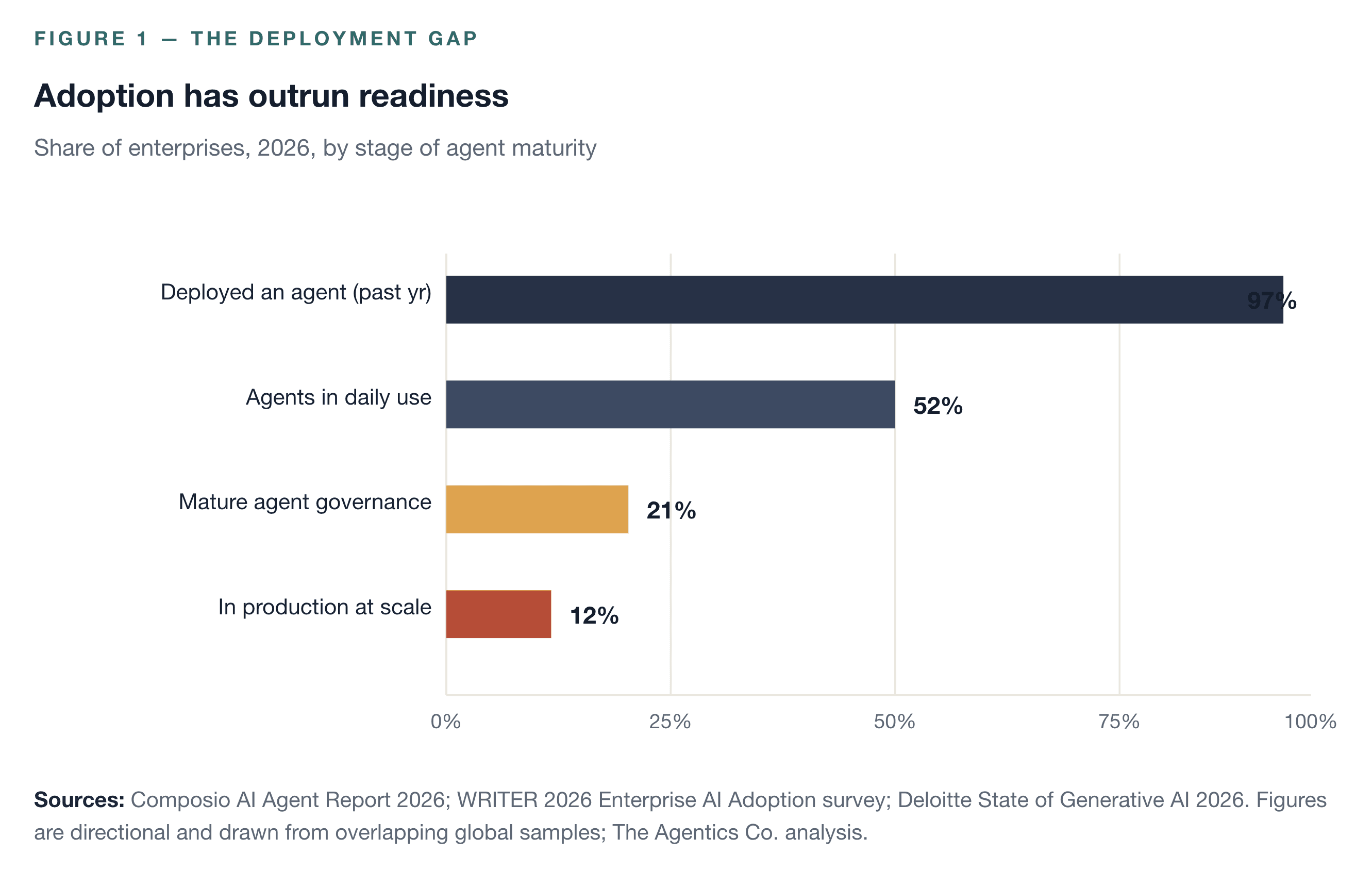
Read that chart from top to bottom and you are watching intent leak away at every stage. Nearly everyone has deployed something. Half have agents people actually use. Only a fifth have governed them properly. And barely one in ten has an agent doing real work at scale. Each step down is a place where pilots go to die and, as it turns out, they die of a small number of repeatable causes.
The Six Failure Modes
We have distilled our engagement post-mortems, cross-referenced against the published 2026 research, into six recurring failure modes. They are not exotic. That is precisely the point: they are common enough to anticipate, and specific enough to design against before a single line of agent logic is written.

01 The pilot was built as a demo, not a first phase
A demo's job is to impress a room. A pilot's job is to be the first, deliberately de-risked phase of a production system. When teams optimise for the applause of the steering committee with clean data, happy-path scenarios, a curated set of inputs, they build something that cannot survive real traffic. A pilot that cannot state its graduation criteria in one sentence before it starts is unlikely to graduate.
THE FIX → Write the production definition first. Before the pilot begins, name what "ready to ship" means in measurable terms, and what real-world conditions the pilot must face to earn that verdict.
02 No agreed definition of "good enough" i.e. The Evaluation Gap
This is the deepest and most under-appreciated failure. Traditional ML has clean labels: an output is correct or it isn't. An agent workflow has ambiguous success criteria, context-dependent correct behaviour, and quality that depends on the entire execution history, not just the final answer. Most teams took a shortcut in the 2025–26 wave: they defined success as "did the agent finish the task," which is not the same as "did it finish it well." Without an agreed evaluation threshold, nobody can honestly say whether the agent is ready, so the project stalls in indefinite review.
THE FIX → Define evaluation thresholds against a human baseline before deployment. Use both offline test sets and online measurement, and measure cost per successful task, not cost per attempt.
03 Governance and compliance were engaged too late
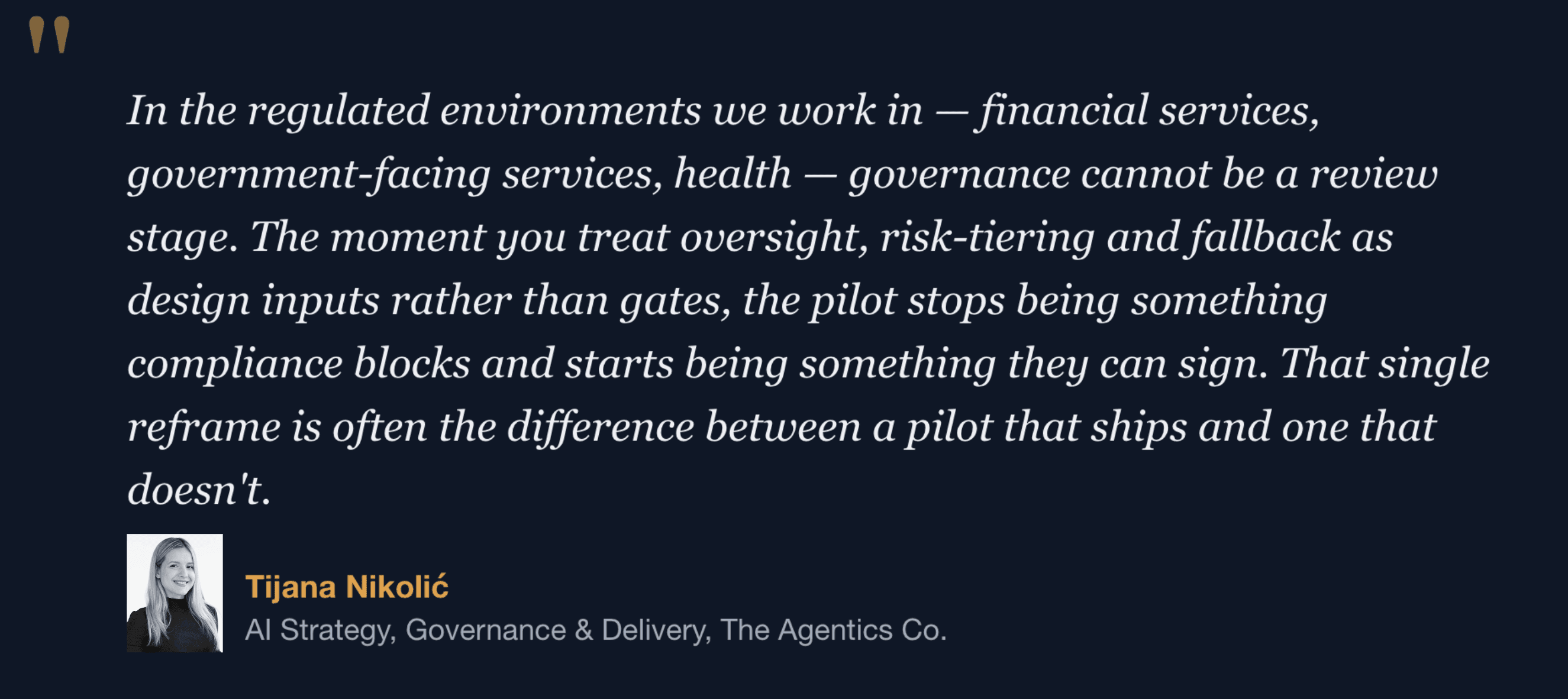
When a pilot moves toward production, governance has to answer three questions: what can the agent do without approval, who is liable when it is wrong, and what happens when it fails. Most organisations start those conversations only when the pilot is already "done" and the project then freezes for months while risk, legal and compliance catch up. In the EU, with the AI Act's core obligations applying from August 2026, engaging governance late is no longer just slow. It is a legal exposure.
THE FIX → Build governance into the pilot from the first week. Classify the risk tier, define the human-oversight checkpoints, and bring compliance into the design…not the review.
04 An agent was layered onto a broken process
Automating a broken workflow produces a faster broken workflow. This is the failure that looks like a technology problem and is actually an operations problem. The organisations that succeed ask a harder question first: if we were building this process for an agent from scratch, what would it look like? That question almost always produces a different and better workflow than the one that currently exists.
THE FIX→ Redesign the process for the agent before automating it. Map every decision point and remove the human-era workarounds the agent would otherwise inherit.
05 No named owner after launch
A striking number of stalled pilots have no answer to a simple question: who owns this agent in production? Ownership was implicit during the pilot…the build team had it. But the build team is not the run team, and when the hand-off is undefined, the agent enters an accountability vacuum. Nobody is responsible for its drift, its incidents, or its improvement, so it is quietly left where it is.
THE FIX → Name a production owner before launch. One accountable person or function for the agent's behaviour, incidents, cost and iteration, assigned on day one, not discovered on day ninety.
06 Reliability was never measured
An agent can return a response with zero latency errors and still have hallucinated a fact, chosen the wrong tool, or quietly corrupted a downstream record. Legacy application monitoring was built for deterministic systems: same input, same output. Agents are probabilistic, stateful and multi-step, and most enterprises try to run them on monitoring stacks that simply cannot see what the agent actually did. What is not measured cannot be trusted, and what cannot be trusted cannot be scaled.
THE FIX → Instrument observability from day one with full execution traces, tool-call success rates, cost and latency per step, and stability across reruns. Treat evaluation as a first-class engineering function, not a QA afterthought.
How the failure modes concentrate
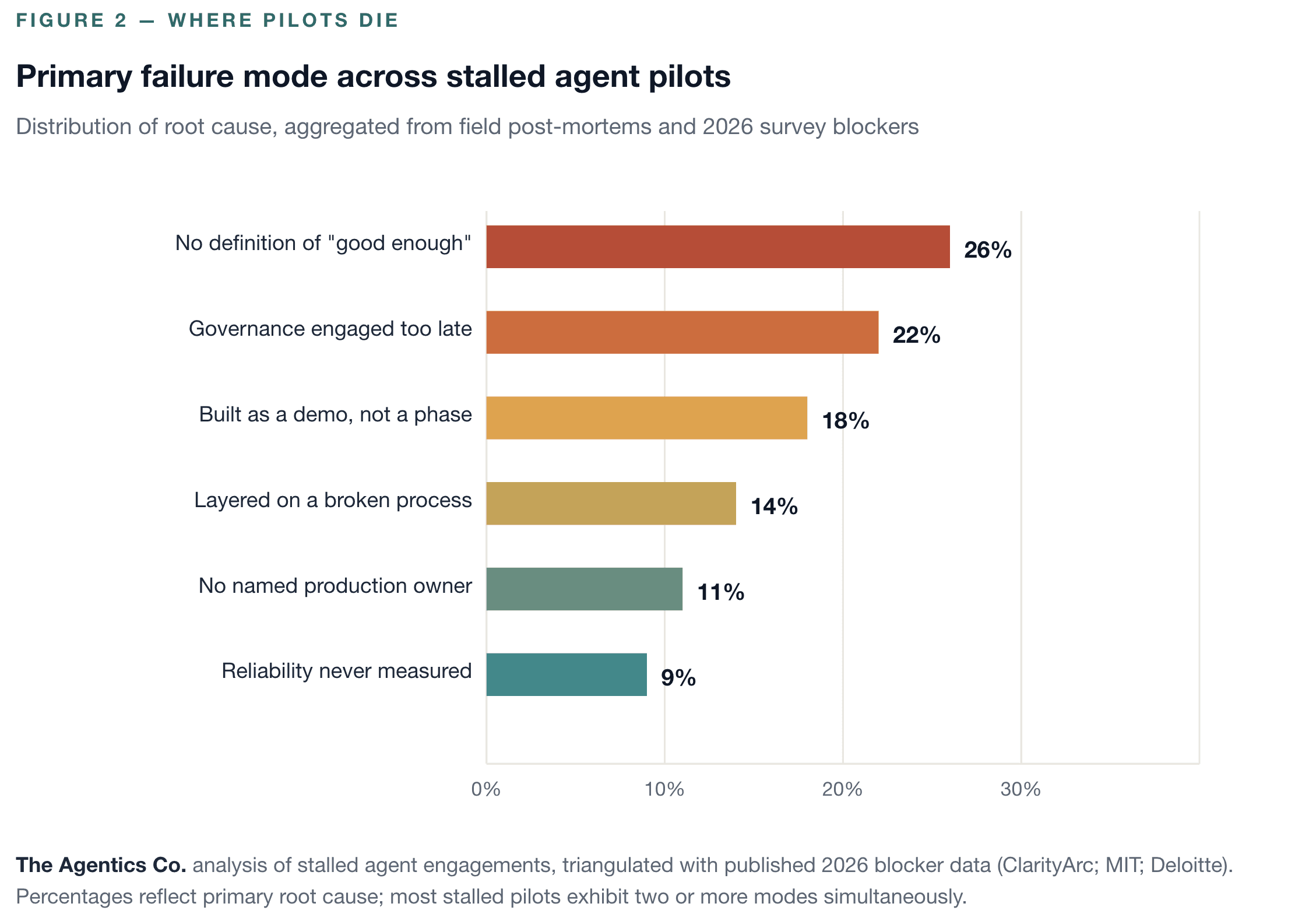
Not every failure mode carries equal weight. When we tag stalled engagements by their primary cause, the distribution is lopsided in a way that should reassure any leader staring down a stuck pilot: fix the top three and you have addressed the majority of the risk.
THE FIX: Six Design Constraints, Applied Before You Scale
Everything above resolves into a single discipline. We call it validating first i.e. designing the controls that make an agent trustworthy before it is given scope, rather than discovering their absence in production. Each failure mode has a matching constraint. Treat this as the pre-flight checklist a pilot must clear before it earns the word "production."
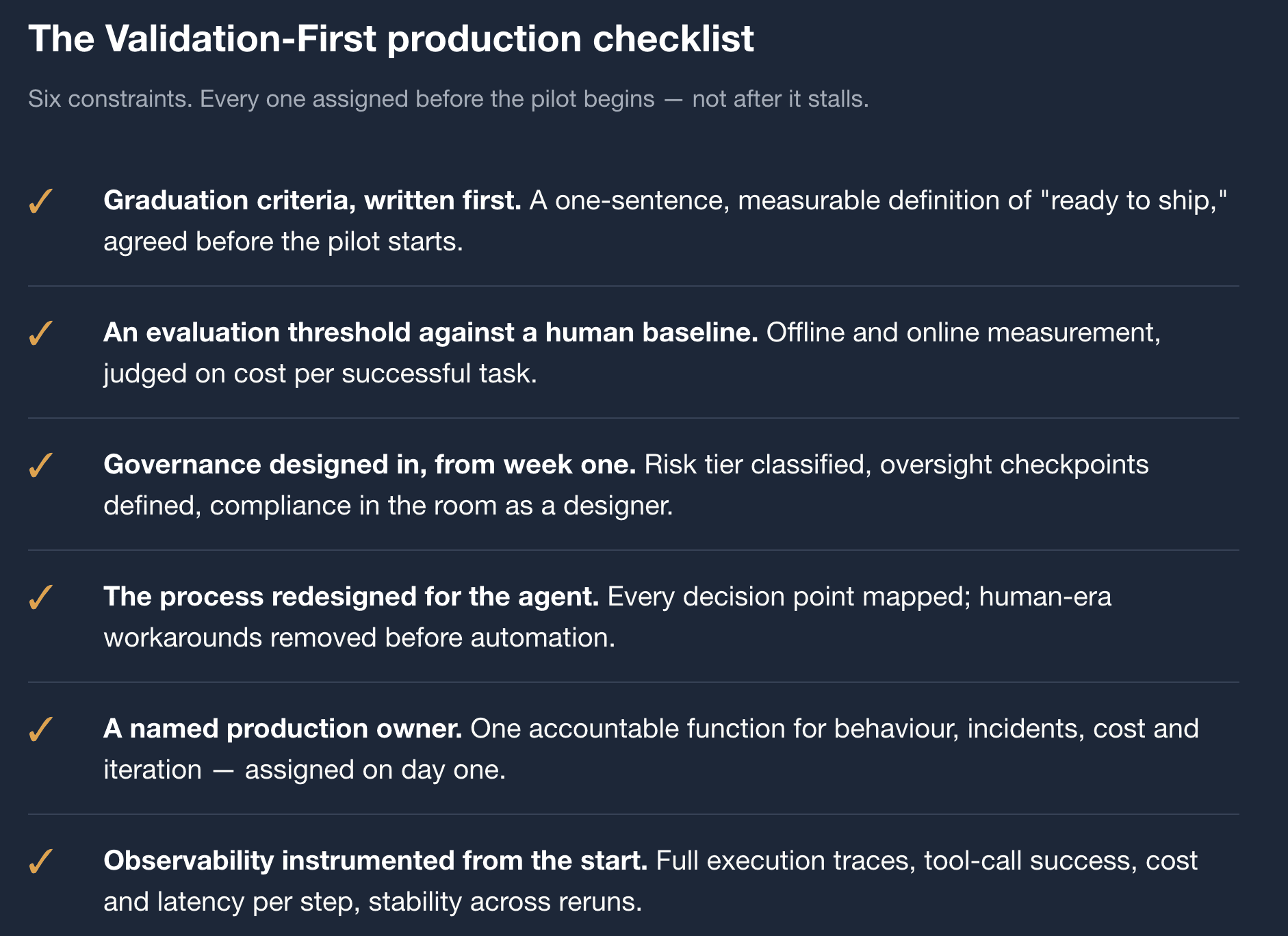
None of these constraints is expensive on its own. What is expensive is discovering their absence after four months, when the sunk cost is high, the political capital is spent, and the honest move (killing a zombie pilot) has become the hardest one in the room. A well-scoped agent can usually be proven or killed in four to eight weeks. A pilot that has drifted past a quarter without a ship-or-kill decision is telling you something, and it is rarely about the model.
What this means for the enterprise buyer?
The economics are not the obstacle. Where use cases are narrow and well-chosen, payback is fast: 2026 benchmark data puts median payback at roughly four months for customer service, around seven for marketing operations, and about nine for engineering workflows. A contained customer-service ticket resolved by an agent can cost a fraction of the human-handled equivalent. The average enterprise agent ROI reported across surveys sits near 171%. The value is real and, in the successful cases, it arrives quickly.
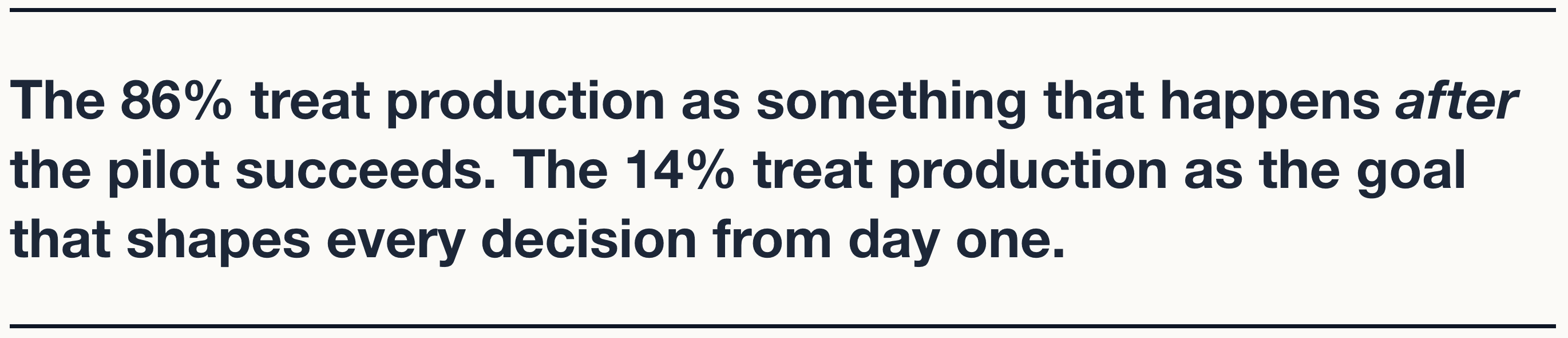
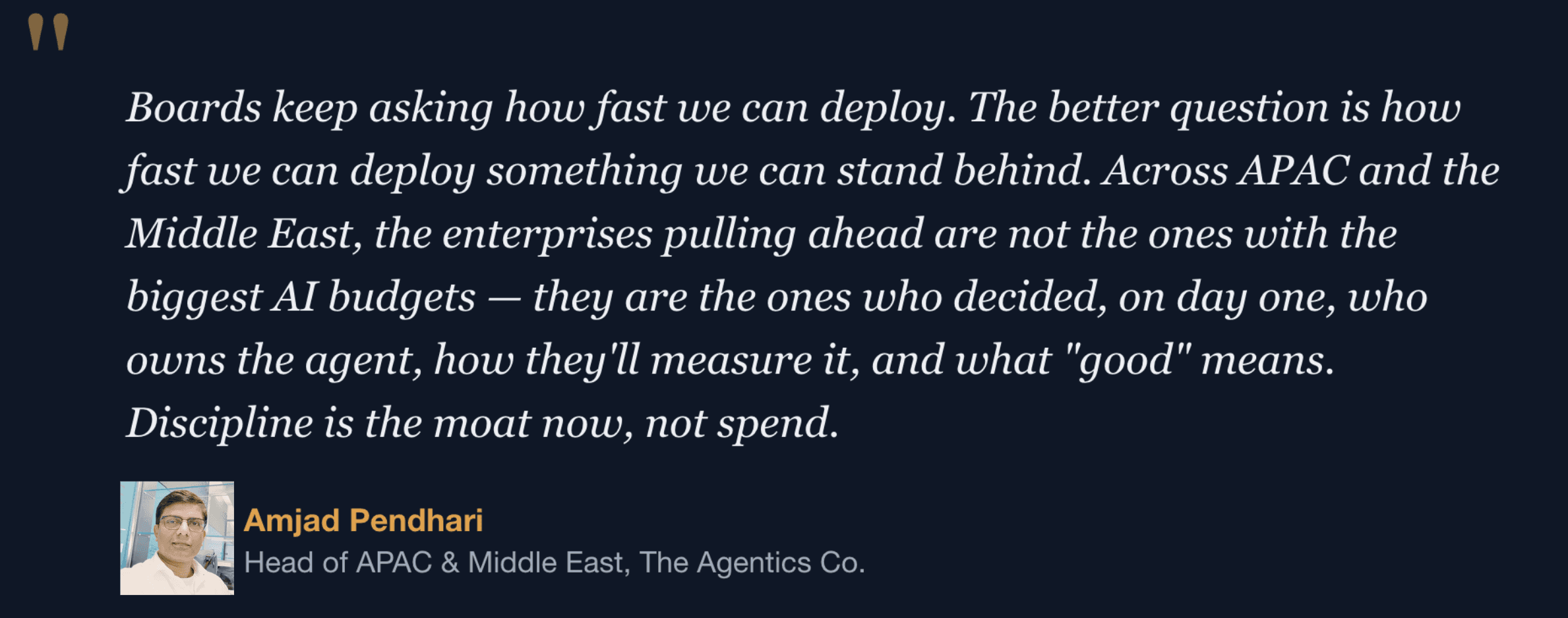
The obstacle is the 86% → The vast middle of enterprises who have proven agents can work and cannot get them to work at scale. That gap is not closed with a better model or a bigger licence. It is closed by treating the six failure modes as design constraints from the first week of the first pilot. The technology has been ready for a while. The discipline is what's scarce.

About this research
This report synthesises The Agentics Co.'s delivery post-mortems across enterprise agent engagements in Europe, the Middle East, Africa and APAC with the leading published 2026 datasets on enterprise AI adoption and agent deployment. The six-failure-mode taxonomy and the Validation-First production checklist are The Agentics Co.'s own analytical frameworks, developed through client delivery and offered here for the wider enterprise community.
The Agentics Co. is an Amsterdam-headquartered enterprise AI transformation firm specialising in agentic AI and multi-agent systems, operating across Europe, the Middle East, Africa, APAC and LATAM. Its Validation-First Framework underpins every client engagement. Learn more at theagentics.co.
Citation: The Agentics Co. (2026). The Pilot-to-Production Playbook: Why 86% of Enterprise AI Agent Pilots Fail and the Six Design Constraints That Fix It. Retrieved from https://theagentics.co/insights/pilot-to-production-playbook
Selected sources & further reading
Composio, AI Agent Report 2026 — 97% executive deployment vs. 12% production at scale.
Deloitte, State of Generative AI in the Enterprise 2026 — governance maturity; ROI measurement as top challenge.
WRITER & Workplace Intelligence, 2026 Enterprise AI Adoption Survey — 97% agent deployment, 52% employee use.
Gartner, 2026 Hype Cycle for Agentic AI — adoption curve and project-cancellation forecast.
MIT, 2025 generative-AI pilot study — measurable P&L impact of pilots.
ClarityArc (2026), Why Most AI Agent Pilots Never Reach Production — evaluation, governance and reliability as top blockers.
Bain, 2026 Agentic AI Benchmark — median payback by function.
BCG (2026), Agentic AI Strategy for CIOs and CTOs — leadership framing of production discipline.
The Agentics Co. — The Enterprise Agentic AI Landscape 2026, theagentics.co/insights.
Related Post

Everything AI
Sep 3, 2026

Enterprise AI
Aug 19, 2026