
AI Governance & the EU AI Act 2026 - A Field Guide
The deadline moved. Most enterprises are reading it wrong, here's what actually comes due. Europe just pushed its heaviest AI rules to December 2027. That is not permission to stand down. A field guide to what still applies, what didn't move, and how to govern AI agents in a way that survives the next deadline and the one after that.

Posted by
The Agentics, Research Desk
Posted at
Enterprise AI
Posted on

THE SHORT ANSWER
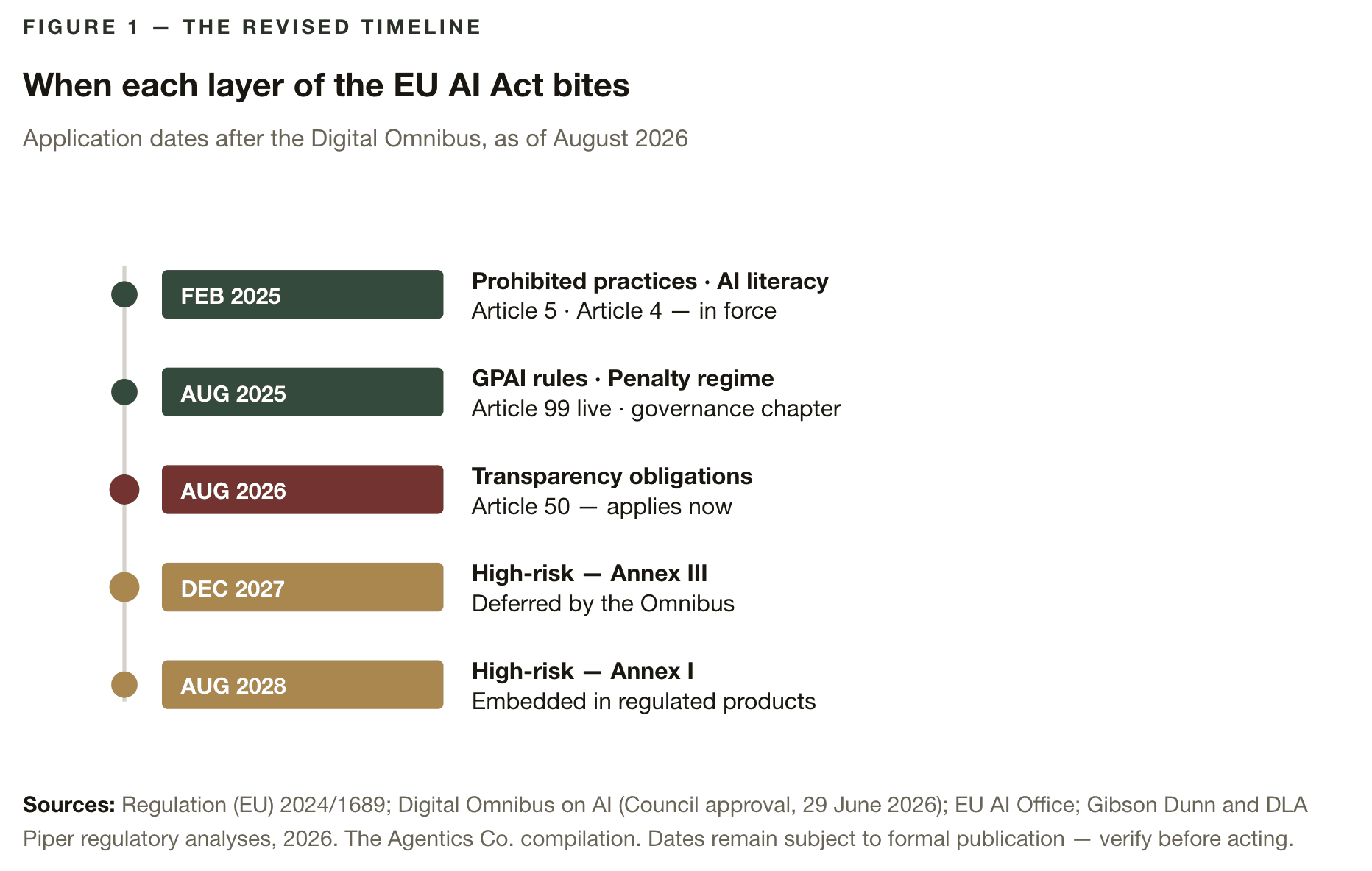
The EU AI Act's high-risk deadline of 2 August 2026 has moved. Under the Digital Omnibus on AI (given final Council approval on 29 June 2026) the heavy conformity regime for standalone Annex III high-risk systems now applies from 2 December 2027, and for AI embedded in regulated products (Annex I) from 2 August 2028.
But the delay is narrow, and widely misread. Four things did not move: the Article 50 transparency obligations (live from August 2026), the Article 4 AI literacy duty, the prohibited-practices ban, and the GPAI and penalty regimes, all already in force. The Act's architecture is entirely intact. December 2027 is roughly 21 months away, not years. Reading this as a reprieve is, in our view, a strategic mistake.
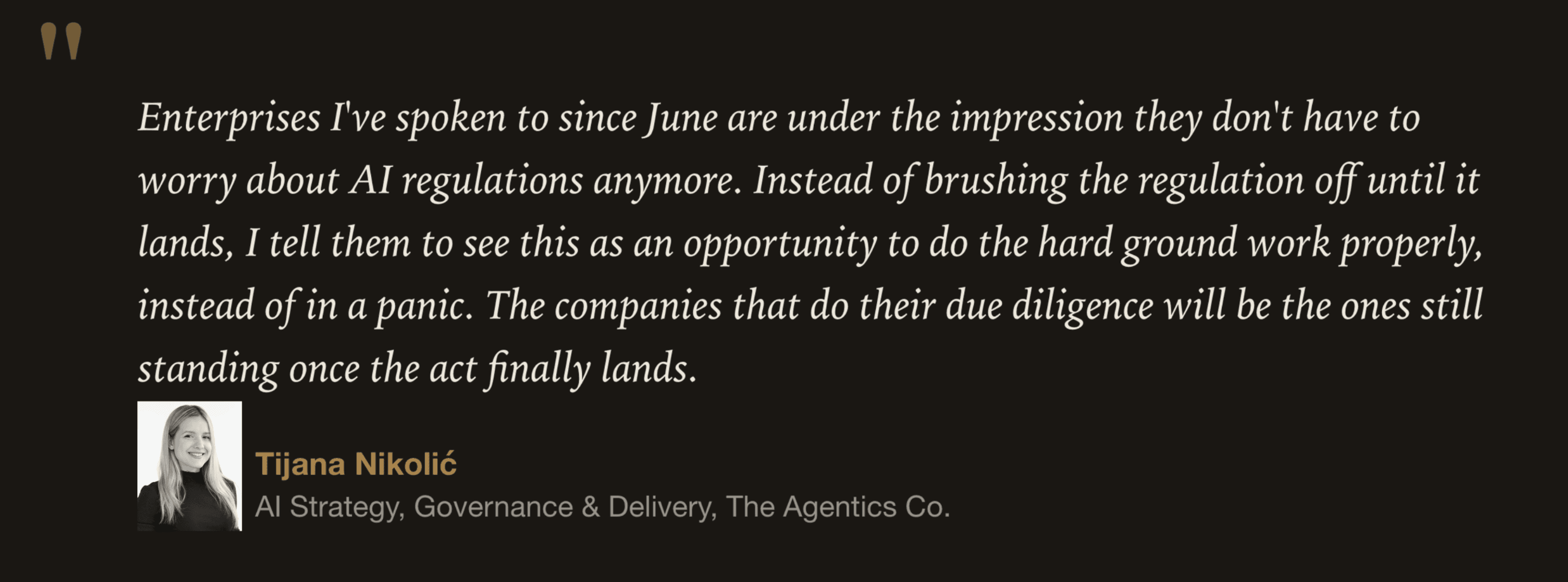
For most of the past year, one date organised enterprise AI compliance planning across Europe: 2 August 2026. It was the day the EU AI Act's obligations for high-risk systems were scheduled to bite, and it drove a great deal of budget, roadmap and boardroom attention. Then, at the end of June, it moved. The Council gave final approval to the Digital Omnibus on AI, and the high-risk obligations that anchored everyone's planning slid to 2027 and 2028.
The instinct in a lot of organisations was immediate and understandable: exhale, reallocate the compliance budget, and revisit AI governance next year. We think that instinct is wrong on the facts and wrong on the strategy and the reason is that the delay is far more surgical than the headlines suggested. The heaviest single regime moved. Almost everything an enterprise already feels in practice did not.
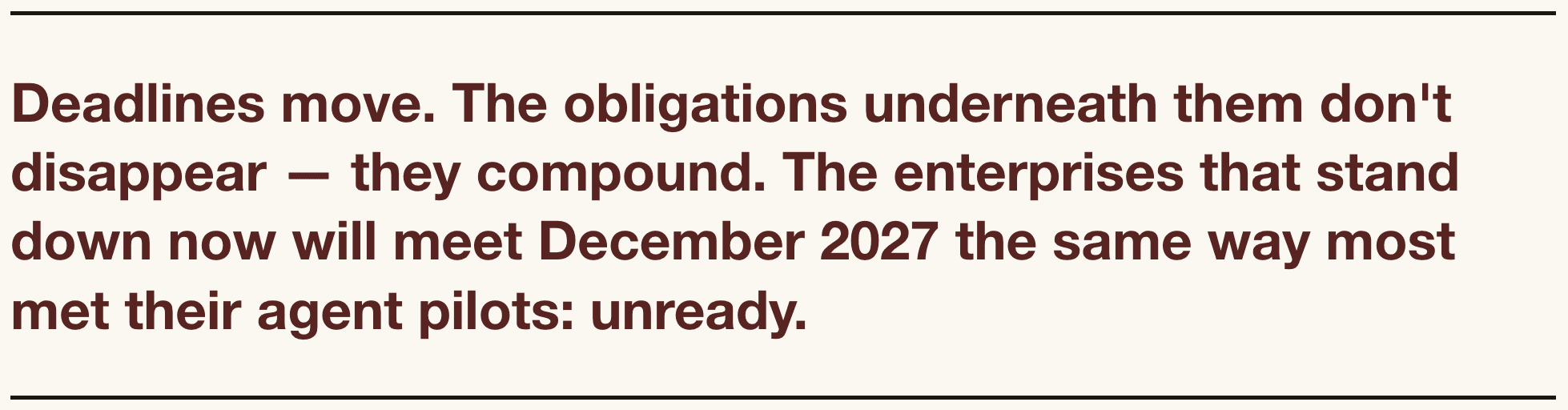
This handbook does two things. First, it draws the line precisely: what shifted, what stayed, and what an enterprise deploying AI, and especially AI agents, actually owes from August 2026 onward. Second, and more durably, it lays out the eight-pillar governance framework that satisfies the Act whenever its deadlines land, plus a maturity checklist you can score yourself against today. Deadlines move. The obligations underneath them don't disappear; they compound.
What Moved, and What Didn't?
The single most important thing to understand about the Digital Omnibus is that it postponed one regime, the big one, and left the rest of the Act exactly where it was. Here is the split, in plain terms.
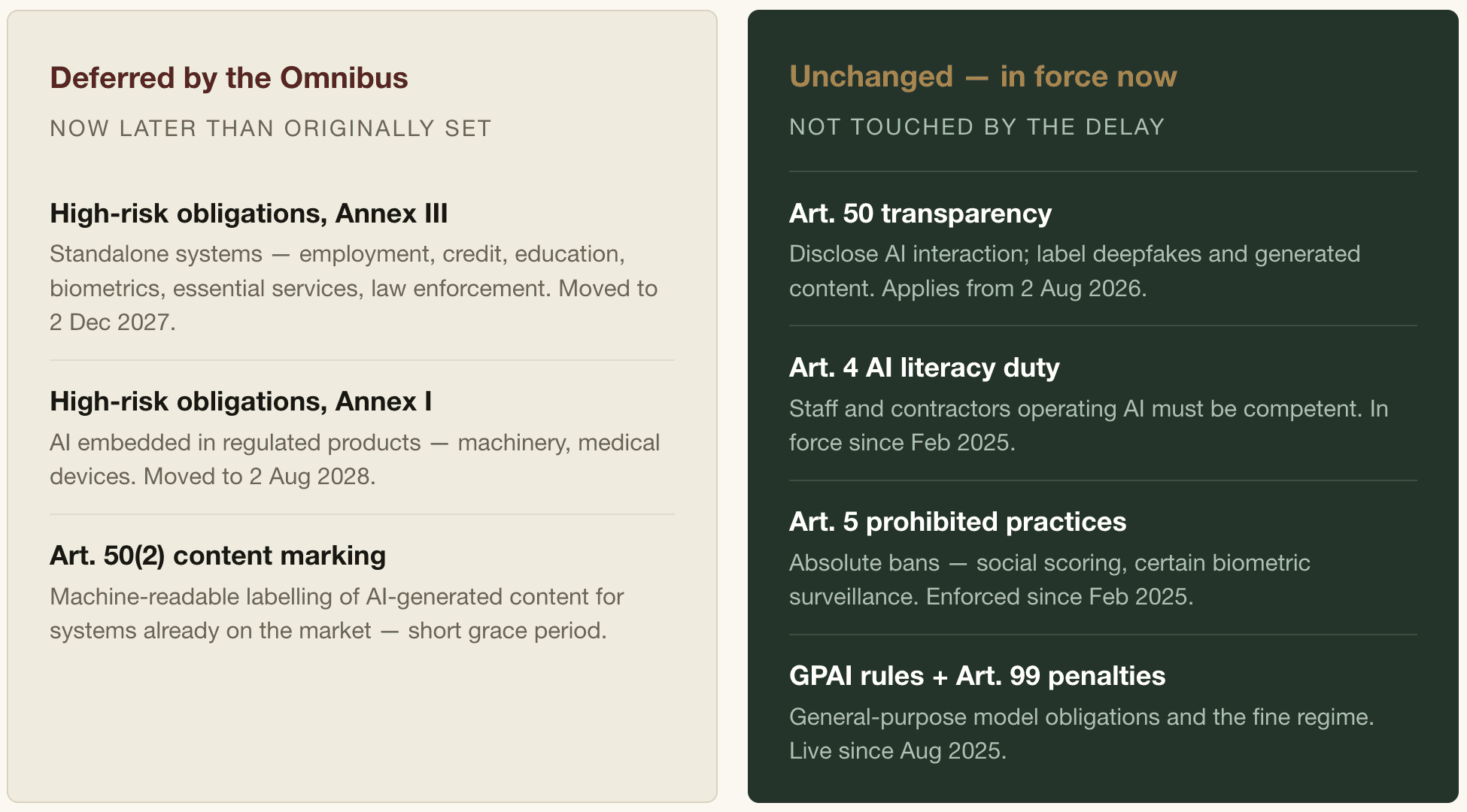
Read the right-hand column carefully, because it is the one most enterprises are ignoring. If you run a customer-facing chatbot, you owe a disclosure. If your teams use AI without documented competence, you carry an unmet literacy duty that regulators have signalled can aggravate other findings. And the penalty regime that backs all of it has been enforceable since August 2025.
What EU AI ACT Non-Compliance Actually Costs?
The reason none of this is optional is Article 99, and it is worth stating the numbers plainly because they exceed the GDPR maximum most boards already know. The penalty regime is a three-tier structure, and for a company each fine is the higher of a fixed sum or a percentage of global annual turnover. For SMEs and startups, the calculation inverts to the lower of the two; a deliberate proportionality mechanism.
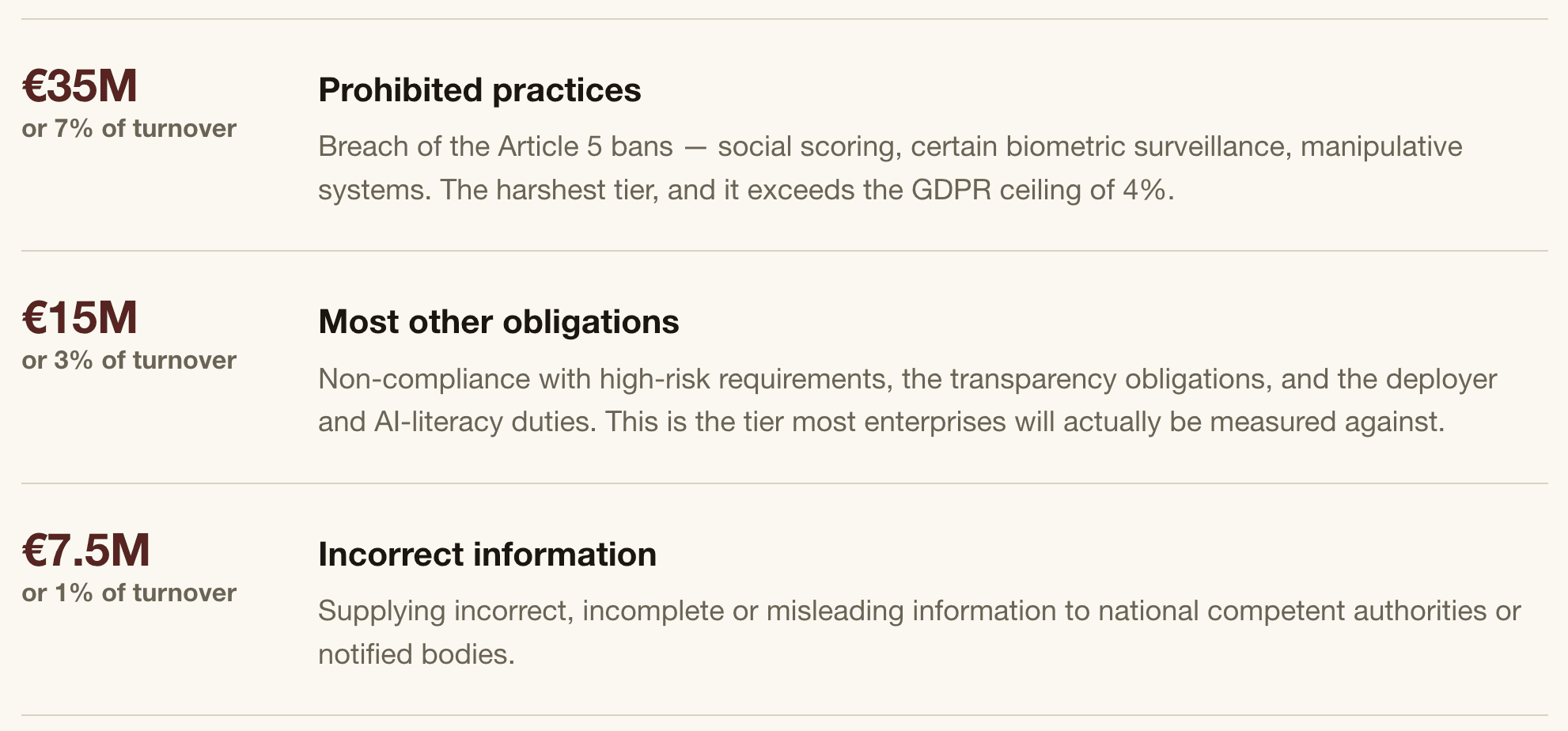
Enforcement is not centralised in one EU body. Each Member State designates national competent authorities to supervise compliance within its borders, while the Commission's AI Office coordinates cross-border cases and handles general-purpose AI providers directly. Enforcement is triggered by complaints, serious-incident reports, proactive market surveillance, sector regulators, and whistleblower protections. And the Act's reach is extra-territorial in the GDPR mould: if your AI system is used in the EU, or its output is relied upon there, you are in scope wherever you are headquartered.
Why Agents Raise The Governance Stakes?
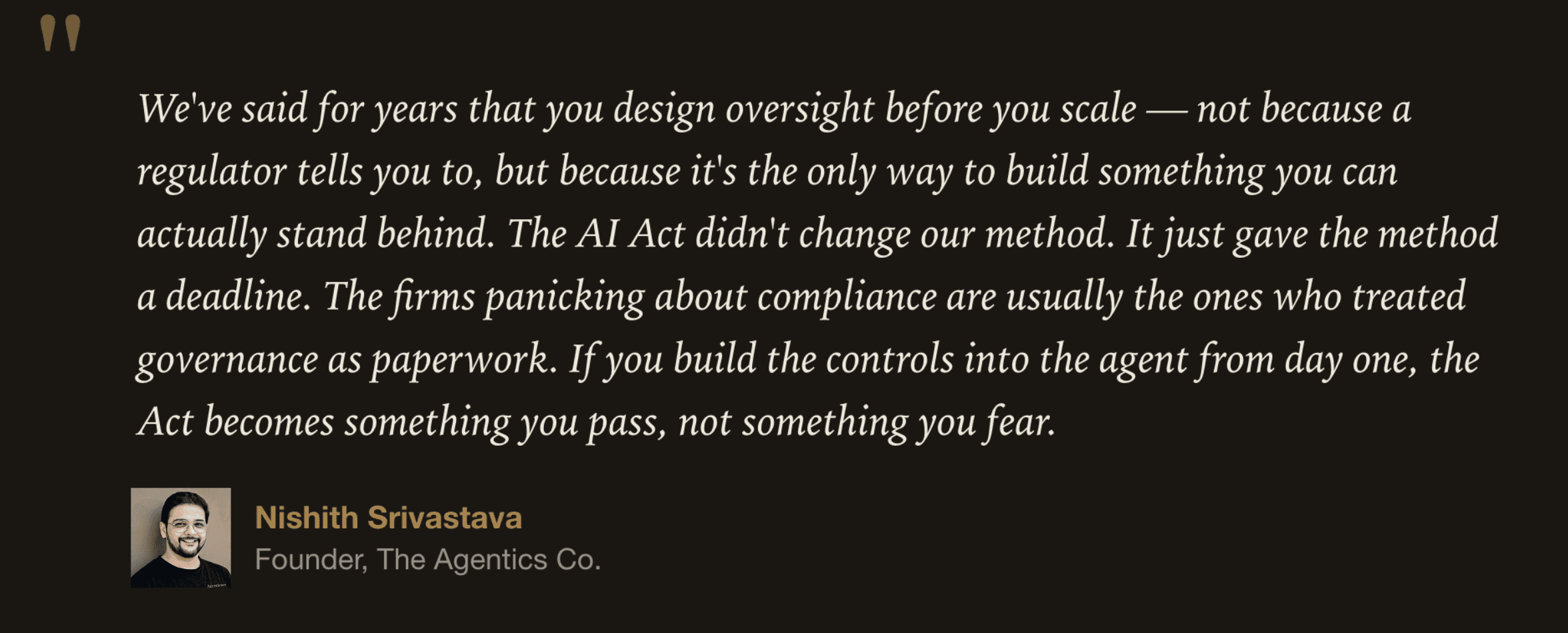
There is a specific reason this matters more for the readers of our work than for the average software buyer: AI agents change where the compliance boundary sits. A single model producing an output is one thing. An agent that plans, calls tools, invokes APIs and hands off to other agents is a chain of consequential actions and the Act sees it that way. Recitals 99 and 100 address multi-agent architectures explicitly: in a chain of agents, the compliance boundary extends to every agent that performs a high-risk function. Where agents invoke internal services, third-party platforms or external tools, that action layer falls squarely within the Act's cybersecurity and logging obligations.
The practical consequence is that governance cannot live at the level of the model. It has to be designed at the level of the agent workflow, which is precisely the discipline that separates agent pilots that reach production from the 86% that stall. Governed agents and production-ready agents turn out to be the same animal.
The Handbook: Eight Pillars of Durable AI Governance
Everything above is context. This is the part that stays useful after the news cycle moves on. Whatever the deadline, an enterprise that can evidence these eight pillars is defensible and, not coincidentally, is running AI it can trust. Each maps to the relevant articles of the Act, but the value is operational, not just legal.

1 | Foundation · Art. 6, Annex III: Inventory and classify every AI system
You cannot govern what you cannot see. Build and maintain a live register of every AI system in use i.e. built, bought or embedded and assign each a risk tier using the Article 6 classification guidance. This is the first move, and the one most organisations skip.
2 | Continuous · Art. 9: Run a living risk-management system
Risk management is not a one-time assessment filed before launch. It runs continuously across the system's lifecycle, revisited as the model, data and use context change. For agents, that means re-evaluating whenever the workflow, tools or autonomy level shift.
3 | Data · Art. 10: Govern the data, including at inference
Training, validation and test data must be relevant, representative and governed and the obligation extends to inference-time inputs. This is where Article 10 intersects with your existing GDPR lawful-basis work; treat them as one programme, not two.
4 | Evidence · Art. 11, 12, 18: Document and log to survive an audit
Complete technical documentation (Annex IV) prepared before deployment and kept current, plus tamper-evident, automatically generated logs retained for the required period. If it isn't written down and time-stamped, for enforcement purposes it didn't happen.
5 | Control · Art. 14: Build human oversight that actually functions
Not a checkbox that says "human in the loop," but real, calibrated oversight: defined checkpoints, meaningful override capability, and escalation paths sized to the risk of the task. This is the pillar that most often exists on paper and fails in practice.
6 | Resilience · Art. 15: Engineer accuracy, robustness and security
High-risk systems must be resilient against error and adversarial attack across the whole action layer — not just at the model output. For agents that call tools and APIs, the attack surface is the entire workflow, and it must be defended as such.
7 | Transparency · Art. 50: Disclose AI, and label what it generates
Live from August 2026: tell people when they are interacting with an AI system, and mark AI-generated content. This is the obligation with the nearest teeth and the lowest cost to meet; there is no reason to be exposed on it.
8 | People · Art. 4: Evidence AI literacy across your teams
Everyone operating AI on the organisation's behalf (staff and contractors) must be competent to do so, and you must be able to evidence it with dated training records. It is the broadest obligation in the Act and, uniquely, already fully in force.
Score Yourself: The AI Governance Maturity Checklist
Use this as a one-page self-assessment. An enterprise that can answer "yes, and I can prove it" to all eight is not just Act-ready whenever the deadlines land; it is running AI it can defend to a board, a customer and a regulator with the same set of documents.

Most enterprises we assess score three or four out of eight and almost always the gaps are in oversight, logging and literacy rather than in the technology itself. That is good news. Those three are the cheapest to close, and closing them moves you further across the proportionality assessment than any amount of model tuning. The delay to December 2027 is the window to do exactly that, deliberately, while your competitors mistake it for a holiday.

About this research
This handbook synthesises the primary regulatory text of Regulation (EU) 2024/1689 and the Digital Omnibus on AI with the leading 2026 legal and compliance analyses, alongside The Agentics Co.'s governance delivery work across regulated sectors in Europe, the Middle East and Africa. The eight-pillar framework and the Governance Maturity checklist are The Agentics Co.'s own analytical tools, developed through client engagement and offered here for the wider enterprise community.
The Agentics Co. is an Amsterdam-headquartered enterprise AI transformation firm specialising in agentic AI and multi-agent systems, fully GDPR-compliant, operating across Europe, the Middle East, Africa, APAC and LATAM. Its Validation-First Framework designs oversight, escalation and governance into every deployment before it scales. Learn more at theagentics.co.
Citation: The Agentics Co. (2026). The Enterprise AI Governance Handbook: The EU AI Act Deadline Moved — What Actually Comes Due, and How to Govern Agents That Last. Retrieved from https://theagentics.co/insights/ai-governance-the-eu-ai-act-2026---a-field-guide.
This handbook is analysis and general information, not legal advice, and does not create a professional relationship. AI Act implementation dates and guidance are evolving; the position stated is current as of 1 August 2026. Verify all dates and obligations against the EU AI Office and qualified counsel before acting.

SELECTED SOURCES & FURTHER READING
Regulation (EU) 2024/1689 (the EU AI Act) — primary text, Articles 4, 5, 6, 9–15, 50, 99; Annexes III & IV.
Digital Omnibus on AI — Council final approval, 29 June 2026; provisional agreement, 7 May 2026.
DLA Piper (2026) — The Digital AI Omnibus: Proposed Deferral of High-Risk AI Obligations.
Article 99 penalty structure — €35M/7%, €15M/3%, €7.5M/1% tiers.
The Agentics Co. — The Pilot-to-Production Playbook and The Enterprise Agentic AI Landscape 2026, theagentics.co/insights.
Related Post

Everything AI
Sep 3, 2026

Enterprise AI
Aug 19, 2026