
The €7 Million Mistake Most Enterprises Are Making Right Now
Despite significant investments in AI, over 80% of enterprises fail to achieve intended business value. The article explores the reasons behind this failure and highlights the successful approaches of enterprises that are effectively implementing AI.

Posted by
Enterprise AI
Posted at
AI Transformation
Posted on

Here is what the boardroom conversation looks like in most mid-to-large enterprises in 2026.
The AI budget was approved, sometimes two or three years ago.
An internal team was hired.
A few task-specific agents were built.
Some departments got copilots.
There were demos.
There were steering committee presentations.
There were LinkedIn posts about the company being on an “AI transformation journey.”
And then, somewhere between the pilot and the P&L, something went very wrong.
A 2026 survey found that 79% of organisations face challenges in adopting AI, a double-digit increase from 2025, with 54% of C-suite executives admitting that adopting AI is tearing their company apart. Yet these same organisations are not pulling back. They are doubling down on the same flawed architecture that produced those results in the first place. This article is about why that architecture fails, and what the enterprises that are actually moving the needle are doing differently.
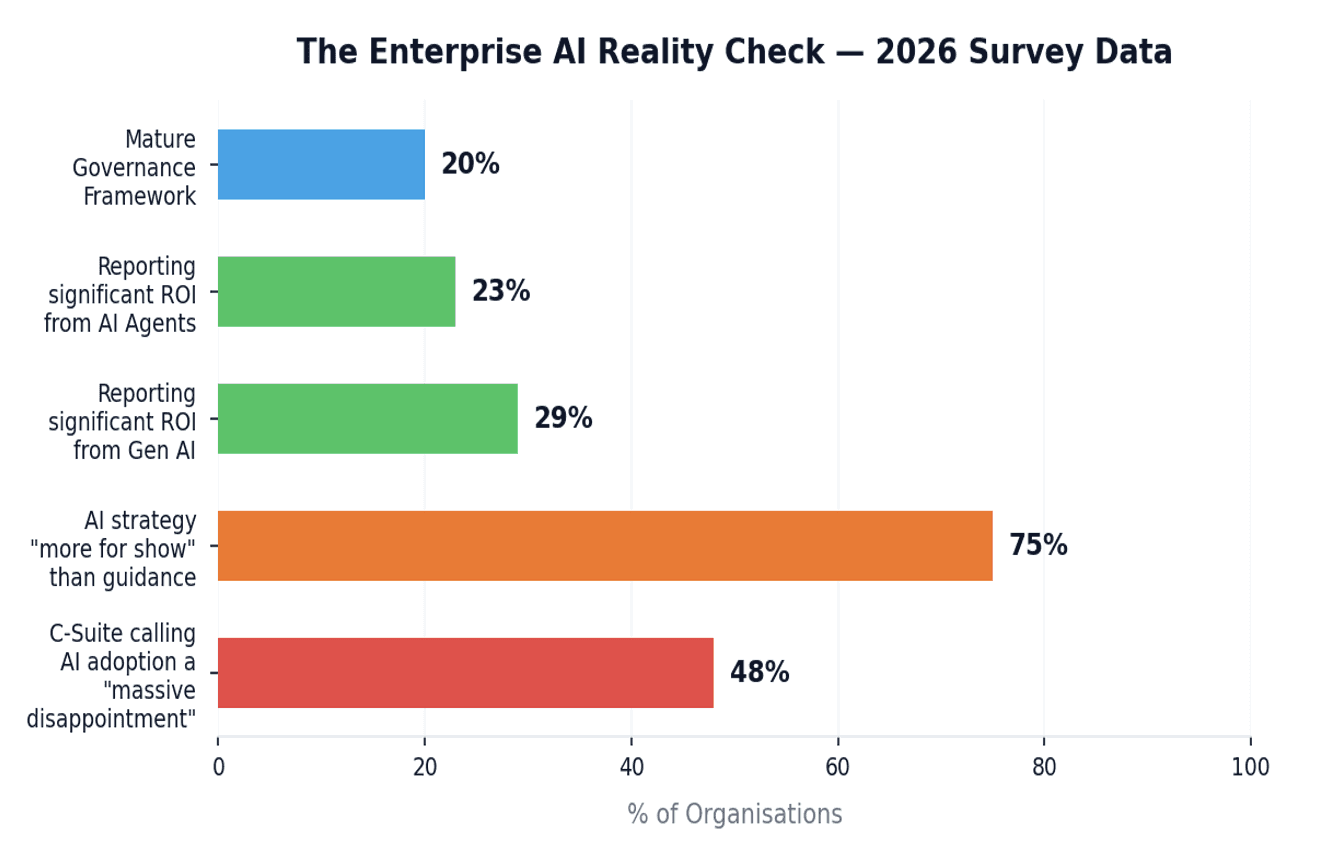
Fig 1: The Enterprise AI Reality Check 2026 Survey Data (Sources: PwC / McKinsey)
The Six Fault Lines in Enterprise AI
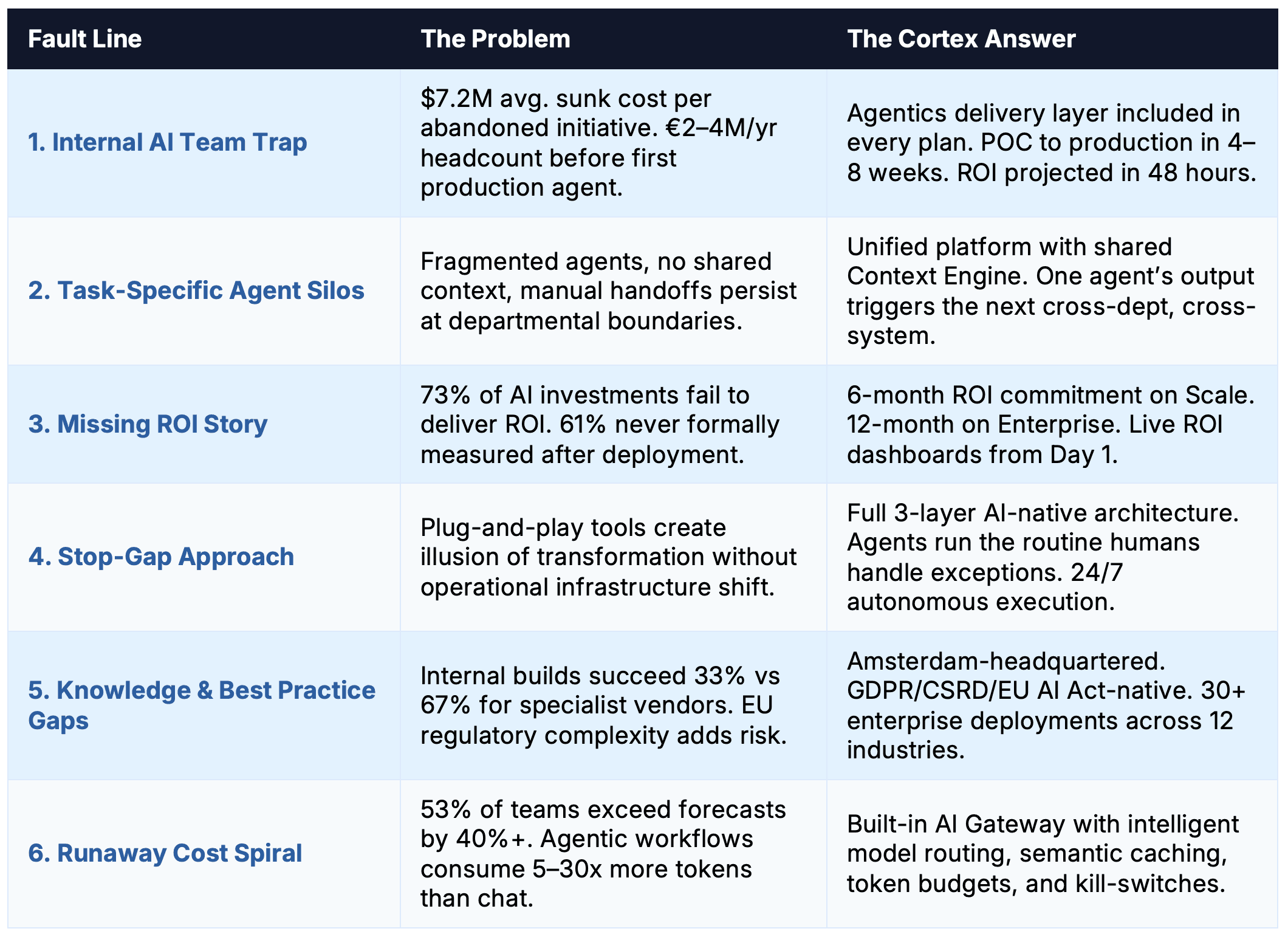
The following six patterns explain why the majority of enterprise AI programmes consume capital without delivering P&L outcomes. They are not isolated problems. They share a common root and a common solution.
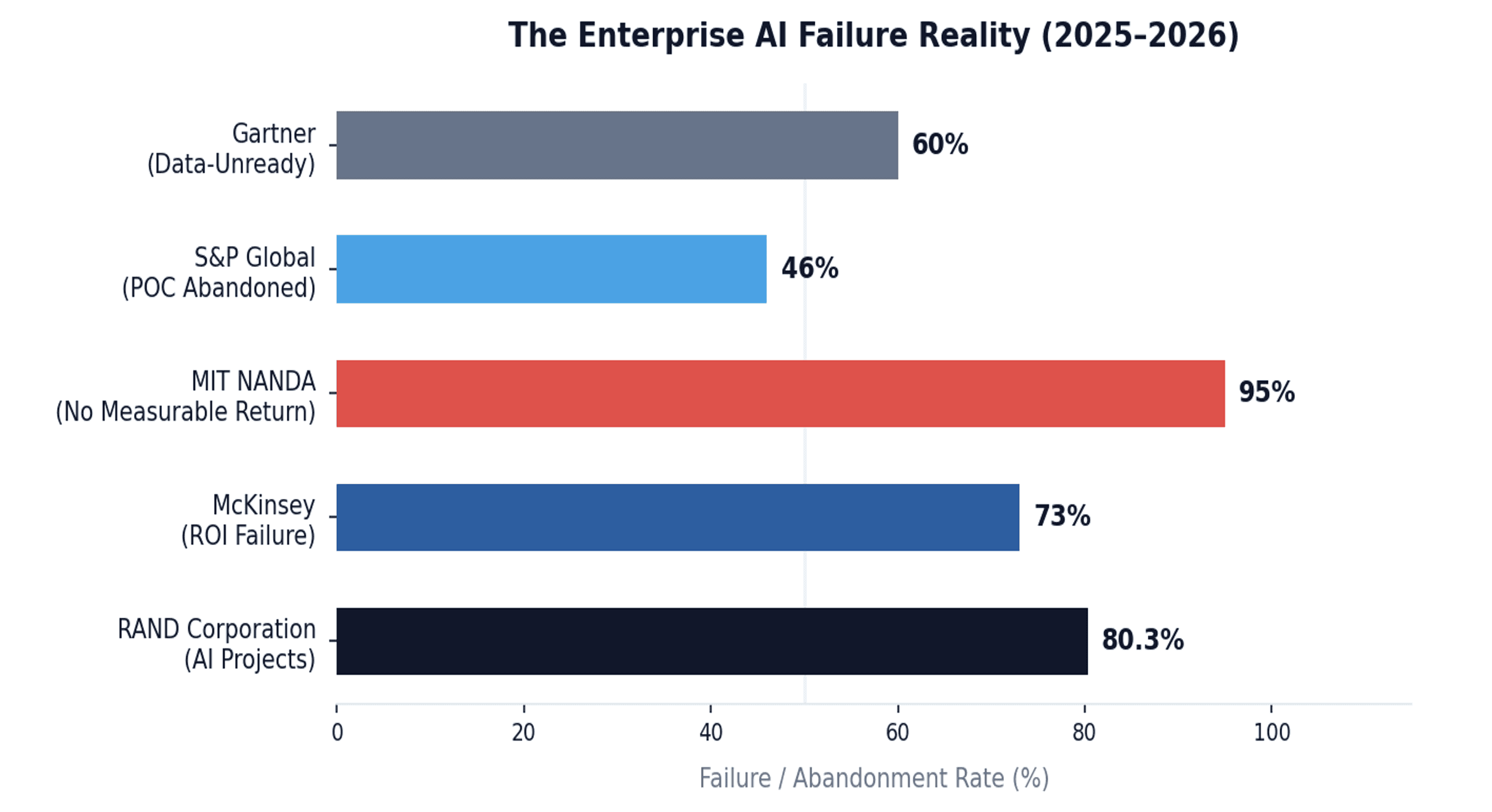
Fig 2: Enterprise AI Failure & Abandonment Rates by Research Source (2025–2026)
Fault Line 1: The Internal AI Team Trap
Building a Ferrari to Drive 20 Kilometres
When enterprises decide to “do AI properly,” the first instinct is to build internal capability. Hire a Head of AI. Recruit ML engineers, data scientists, LLMOps specialists, prompt engineers. Build a Centre of Excellence. Stand up the infrastructure. Establish a governance committee.
This instinct is understandable. It feels like ownership. It signals seriousness to the board. And in theory, an internal AI team should know the business better than any external vendor.
In practice, it is one of the most capital-intensive bets an enterprise can make with some of the worst odds of payoff in technology.

The economics of internal AI team building are brutal.
Senior ML engineers in Europe command €100–160K base salaries.
LLMOps specialists, a discipline that barely existed three years ago, are among the most contested talent in the market.
Data architects, AI product managers, prompt engineers, governance officers: by the time you have assembled a team capable of delivering enterprise-grade agentic AI at scale, you are running a €2–4M annual headcount line before a single agent touches production.
When the central AI team cannot keep pace with the demand flowing in from Finance, HR, Procurement, Compliance, and Sales simultaneously, departments stop waiting. They start building their own point solutions. What looked like a coordinated transformation program fragments into a sprawl of disconnected tools, vendor relationships, and local experiments, each carrying its own cost, its own risk, and its own governance debt.
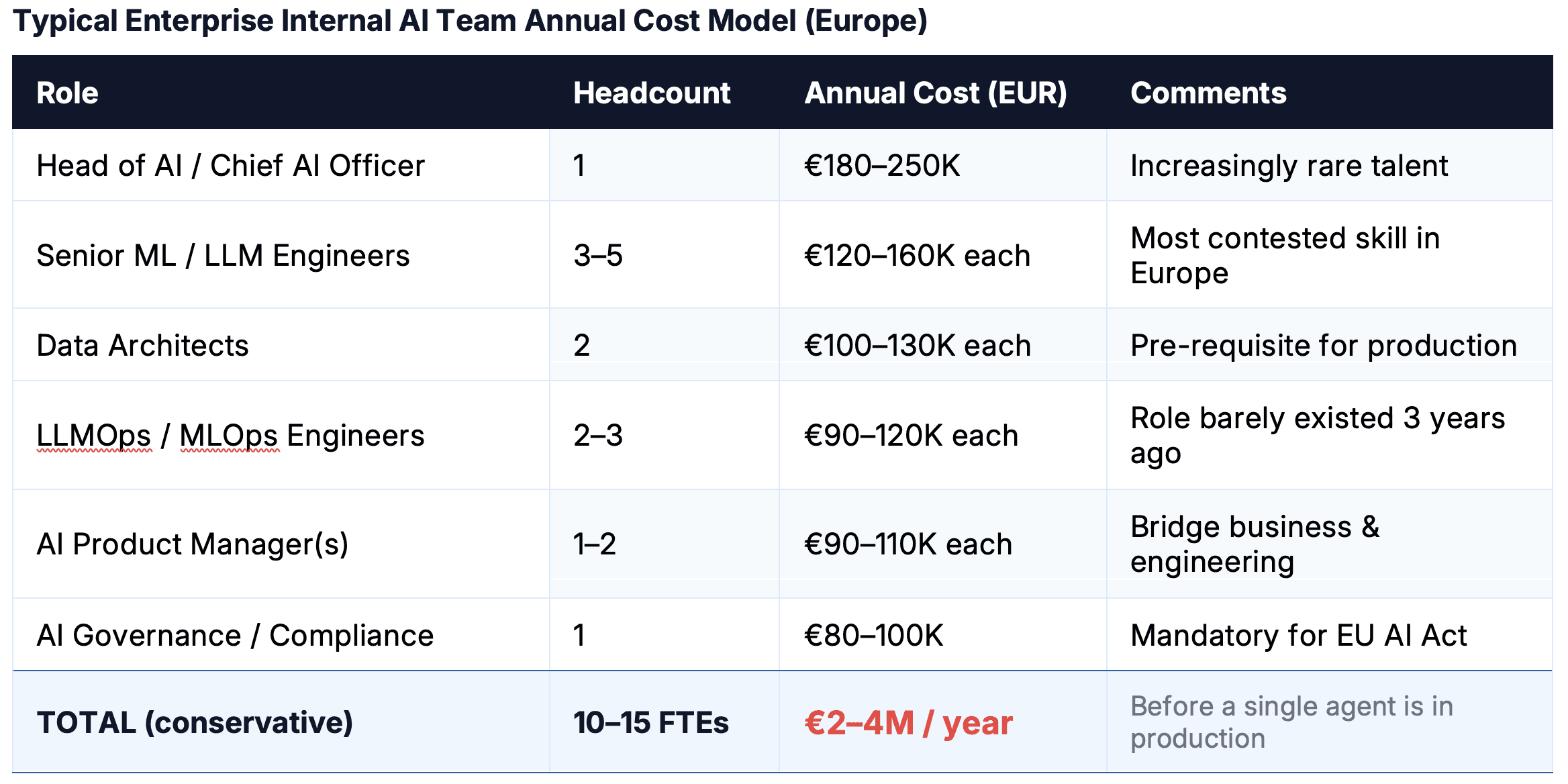
Note: Excludes infrastructure, tooling licences, SI fees, and ongoing training costs.
Fault Line 2: Task-Specific Agents | The Silo Problem in a New Wrapper
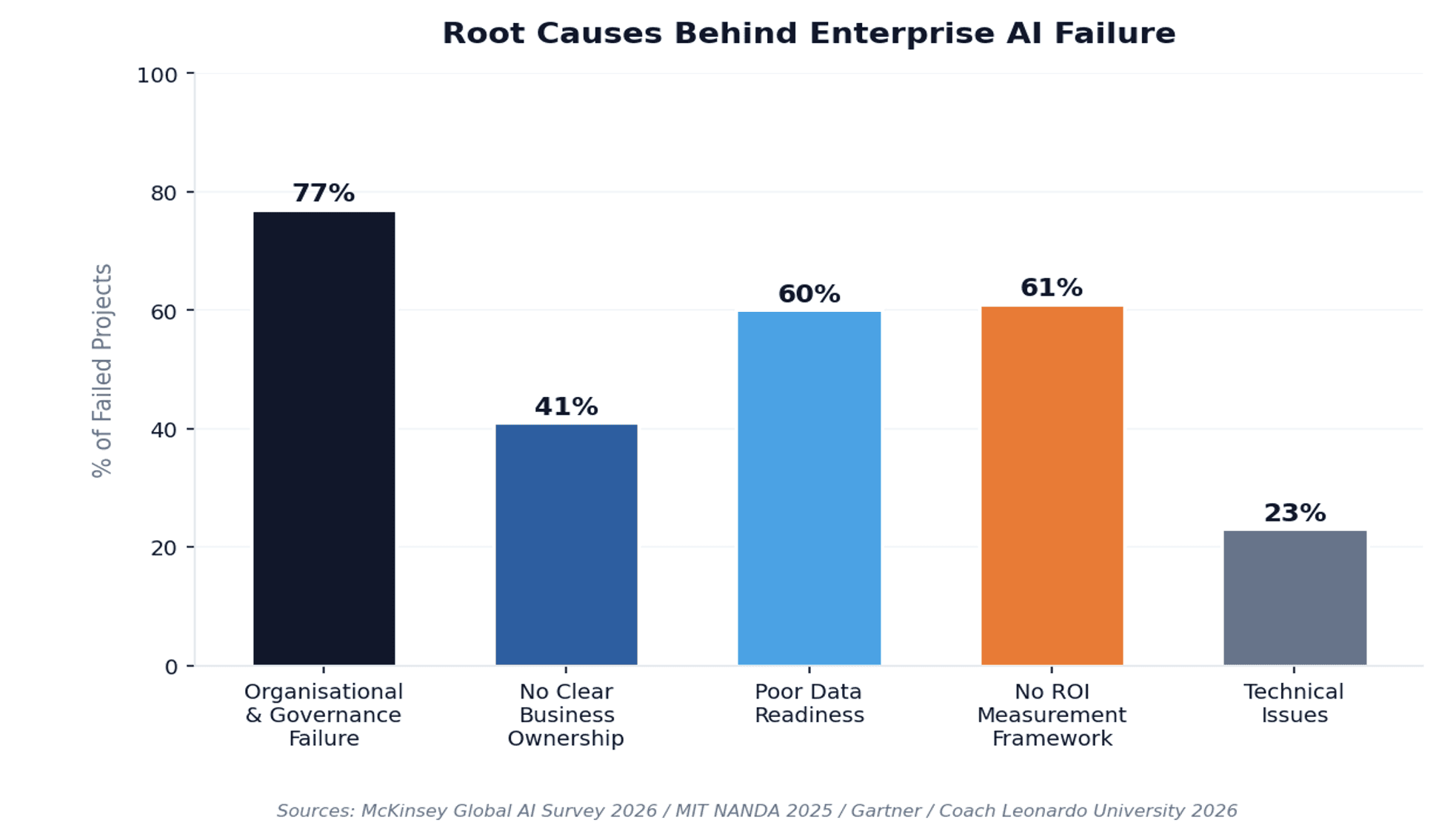
Fig 3: Root Causes Behind Enterprise AI Failure % of Failed Projects
Once the internal team is in place, the natural next step is to identify the highest-value use cases and build agents for them. An invoice-matching agent for Finance. A contract review agent for Legal. A ticket-triage agent for Customer Support. A pipeline-scoring agent for Sales.
Each of these is a legitimate and valuable deployment. Each demonstrates what agentic AI can do. Each generates a credible ROI story for a single function. And each one quietly reproduces the exact same fragmentation problem that made enterprise data architecture so expensive to manage in the first place.
The most common failure mode, appearing in 41% of underperforming projects, was “AI without a home” projects technically delivered but never operationally adopted because no clear owner existed across the enterprise.

Fault Line 3: The Missing ROI Story
When the Numbers Never Show Up in the P&L
This is the fault line most enterprises discover last usually when the CFO starts asking questions.

The uncomfortable truth is that individual task-level efficiency gains are real but insufficient. Saving an analyst 3 hours a week on invoice reconciliation is measurable at the individual level. It does not move the P&L.
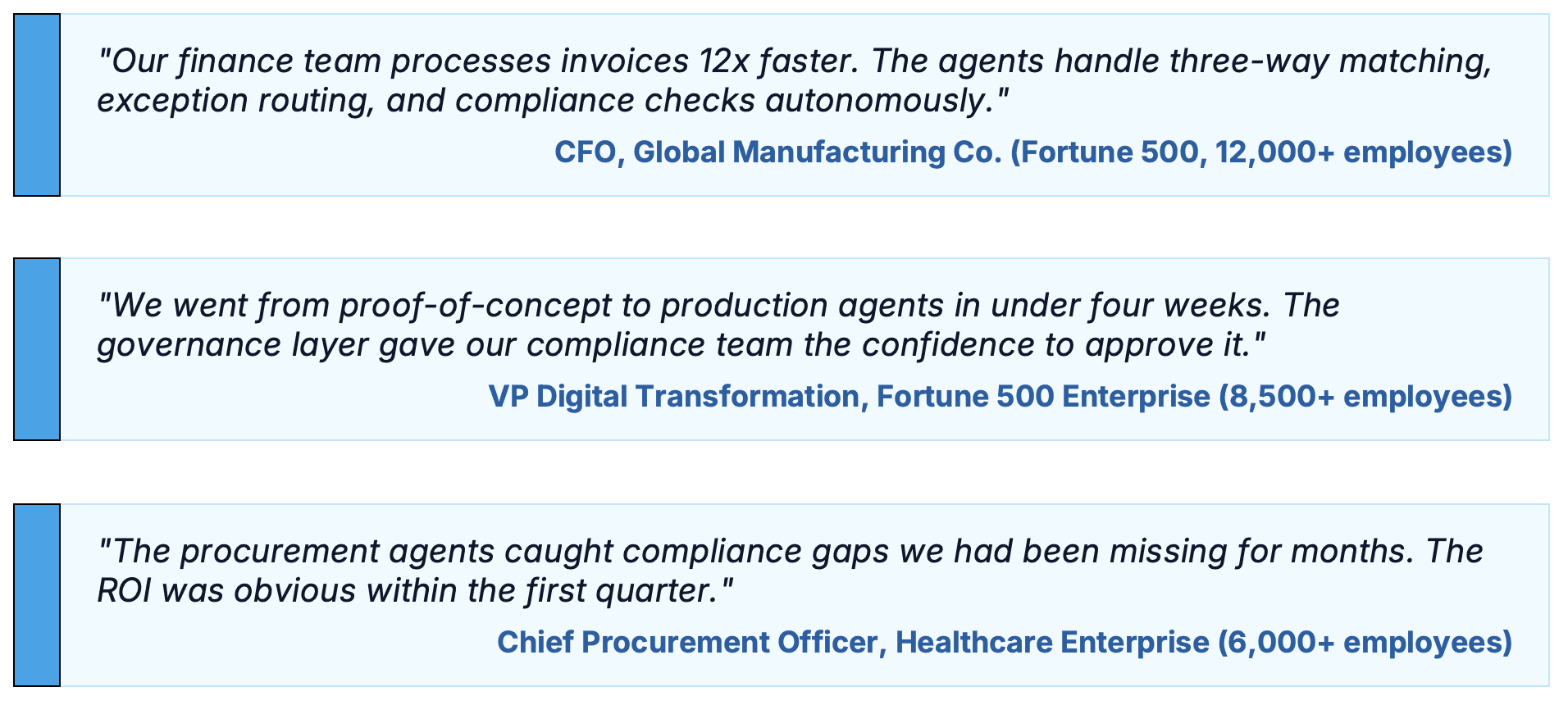
What moves the P&L is when Finance processes invoices 12x faster across the entire function, late-payment penalties are eliminated, and a headcount reallocation becomes defensible to the board. Enterprises building task-by-task never get there.
They accumulate agent complexity without accumulating enterprise value.
Fault Line 4: This Is Not AI-Native Transformation
It Is a Stop-Gap. A Plug-and-Play That Plugs Nothing.
There is a category difference between deploying AI tools into an existing enterprise and becoming an AI-native enterprise. Most organisations are doing the former and calling it the latter.
An AI-native enterprise is one where AI is not a tool layer sitting on top of existing workflows it is the operational infrastructure.
Agents do not assist human processes. They run the routine processes, with humans handling the exceptions.
Data flows continuously through a live semantic model.
Governance is not a compliance checkbox; it is the architecture every agent runs on.

Fault Line 5: Knowledge Gaps and the Best-Practice Deficit
Enterprise AI at production scale is not an experiment. It is an engineering and operational discipline one that most internal teams are building from scratch, in real time, against a moving target of model capabilities, regulatory requirements, and enterprise data complexity.
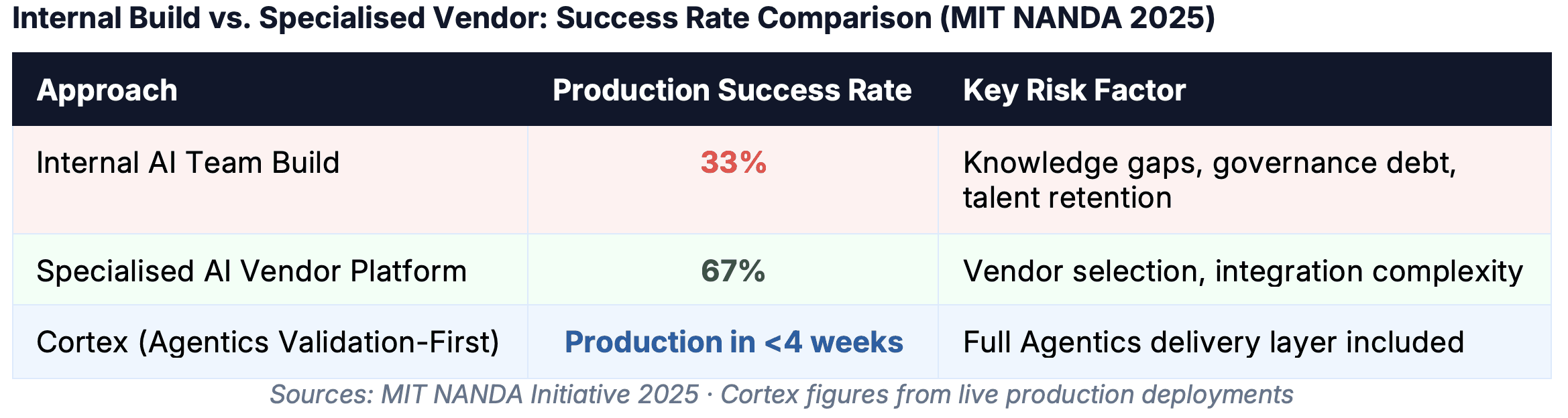
For European enterprises, the knowledge gap is compounded by a regulatory environment that US-built AI platforms and US-trained teams frequently misunderstand. GDPR is not a checkbox. CSRD is not a reporting template. The EU AI Act introduces risk-classification requirements that directly affect how AI agents must be designed, audited, and governed.
Fault Line 6: The Runaway Cost Spiral
When Monthly Bills Become the Story
This is the fault line that no one talks about in the board deck, but that almost everyone encounters in the billing cycle. LLM API spending doubled from $3.5 billion to $8.4 billion between late 2024 and mid-2025. Yet most teams have no systematic strategy to control those costs.
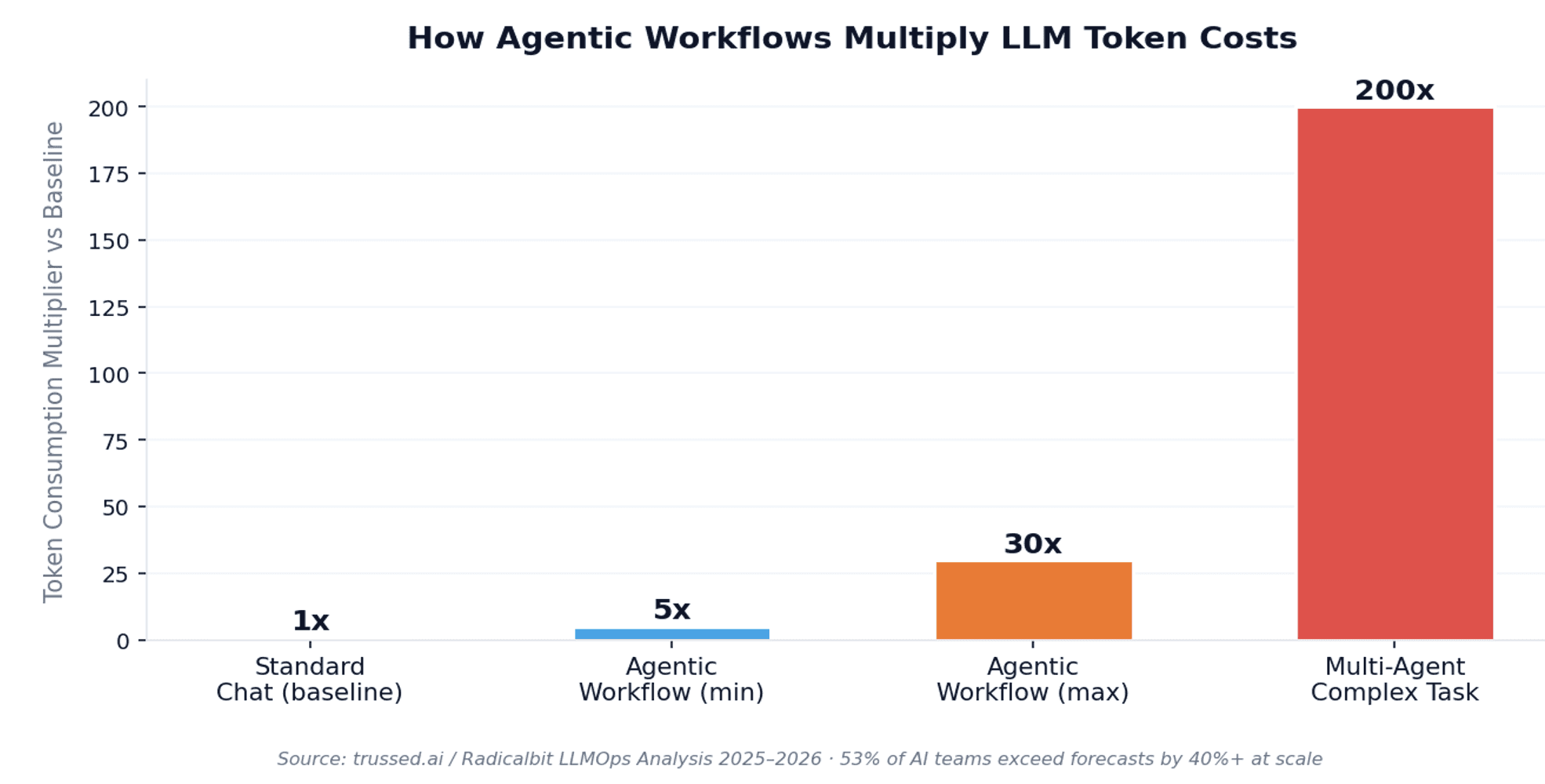
Fig 4: How Agentic Workflows Multiply LLM Token Costs vs Single Chat Interaction Baseline


Without a centralised AI Gateway, enterprise LLM costs have no natural ceiling. They grow with agent adoption exactly the scenario the business case assumed would generate ROI. The same scale that was supposed to deliver the return drives the cost overrun.
77% of surveyed executives reported financial losses from AI-related incidents. The CFO who approved the AI investment is now reviewing a monthly bill that no one in the room can fully explain and that no one built a cost governance framework to control.
The Architecture That Enterprises Actually Need
The six fault lines above are not independent problems. They share a common root cause: enterprise AI has been approached as a collection of tools and experiments rather than as operational infrastructure.
The enterprises generating real, measurable, P&L-level returns from AI in 2026 are not the ones with the largest AI team headcount, the most vendor relationships, or the most impressive demo portfolio.
They are the ones that made a different architectural decision earlier: to deploy AI as a governed execution layer across the enterprise with a shared data context, unified governance, intelligent cost management, and a delivery model committed to measurable outcomes.
That is what Cortex delivers.
Cortex by The Agentics: The Operating System for AI-Native Enterprises
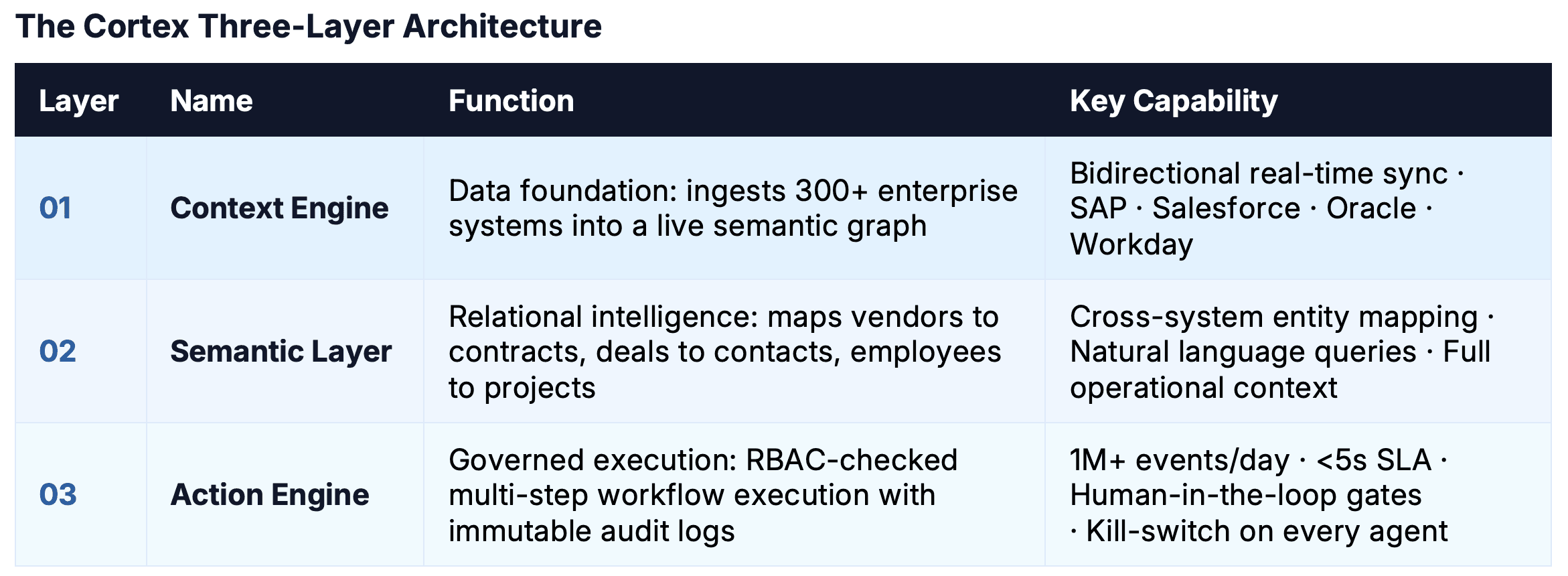
Cortex is not a task-specific agent. It is not a copilot. It is not a point solution for one department. It is the enterprise AI agent platform the operating system that turns fragmented enterprise systems into a coordinated, autonomous workforce.
Built on a three-layer architecture (Context Engine → Semantic Layer → Action Engine), Cortex deploys governed AI agents across Finance, Procurement, Sales, HR, Compliance, and Operations with full audit trails, role-based permission enforcement, and SOC 2 / GDPR / HIPAA / ISO 27001 compliance baked into the architecture.
How Cortex Eliminates Each Fault Line
Production Outcomes: The Numbers That Matter
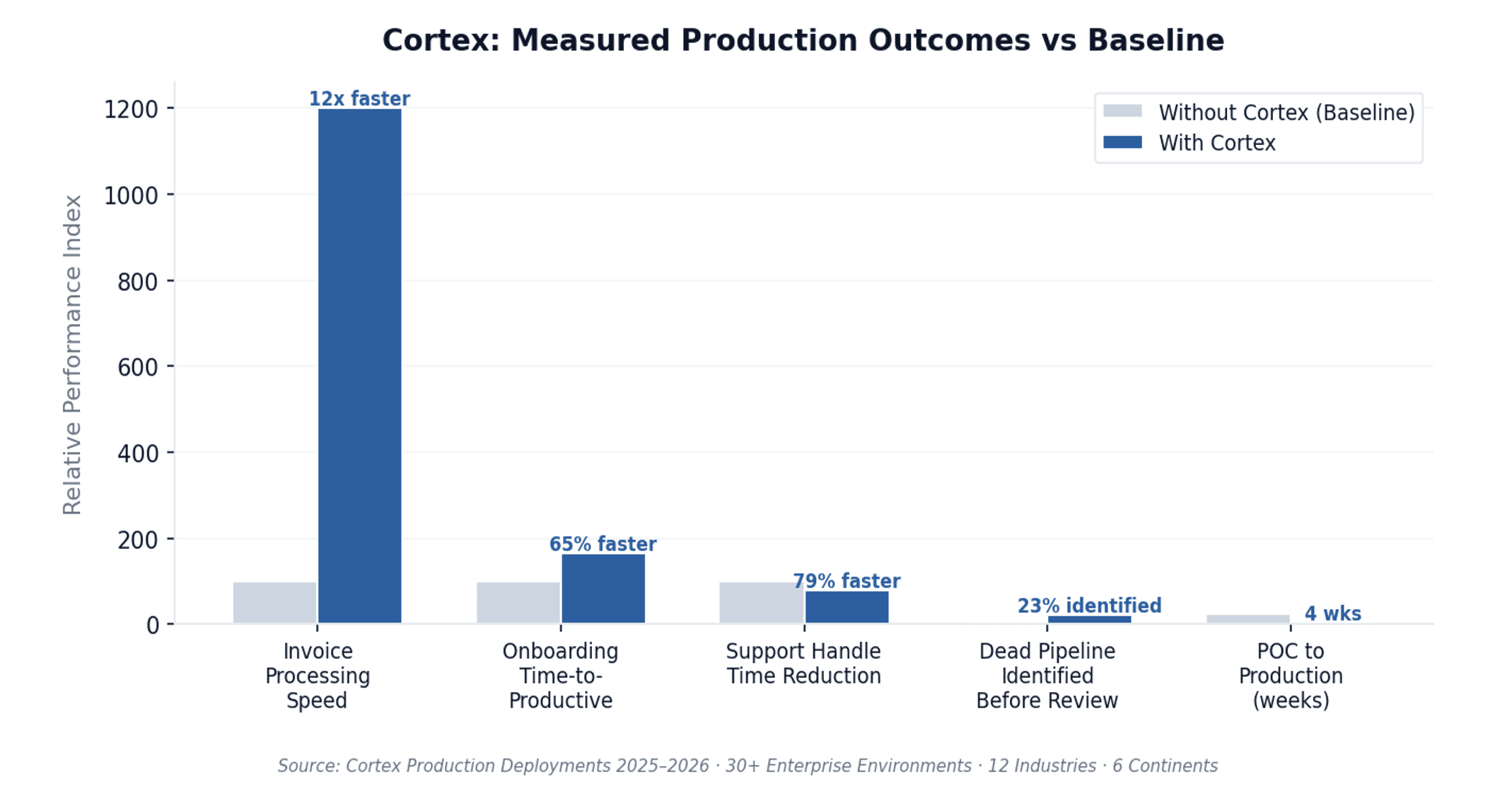
Fig 5: Cortex Measured Production Outcomes vs Baseline (30+ Enterprise Deployments · 2025–2026)
The Decision in Front of You
The data is unambiguous. In 2025, global enterprises invested $684 billion in AI initiatives, and over 80% failed to deliver intended business value.
The enterprises that fell into that 80% were not poorly managed or under-resourced. They were making what felt like the right architectural decisions building internal teams, deploying task-specific agents, working with established SI partners without the operational infrastructure that converts AI investment into P&L outcomes.
2026 is the year the bill comes due. Boards are no longer accepting pilots as progress. CFOs are reviewing AI spend lines that cannot be connected to measurable business outcomes. CIOs are being asked to demonstrate the enterprise value of programmes that have been running for two years.
The answer is not more agents. More agents without a governed execution infrastructure just means more cost, more complexity, and more fragmentation.
The answer is the right architecture once. Deployed correctly. With a committed outcome attached to it.
BOOK A 30-MINUTE DISCOVERY CALL
Cortex is not a platform you evaluate. It is a capability you deploy.
Bring your most painful workflow. No preparation needed.
Within 48 hours: custom PoC plan, ROI projections, integration requirements, compliance scope, week-by-week deployment roadmap.
hello@theagentics.co · theagentics.co/cortex-enterprise-ai-platform
Keywords: enterprise AI transformation · internal AI team · agentic AI platform · enterprise AI ROI · governed AI agents · Cortex Agentics · LLM cost control · EU AI GDPR compliance · enterprise AI agent platform Europe · EU AI Act
Published: June 2026
https://TheAgentics.co/Insights
Confidential © 2026 The Agentics Co.
Related Post

Agentic Commerce
Oct 6, 2026


Everything AI
Sep 3, 2026