
Your Agents Are Ready. Your Organization Isn't.
AI is everywhere. The Agentic Organization isn't. Yet. Everyone's deploying agents. Almost nobody has redesigned the workflow, the oversight model, or the leadership habits those agents actually need to earn trust at scale.

Posted by
The Agentics
Posted at
Enterprise AI
Posted on
95% of organizations deploying generative AI saw zero measurable P&L impact
— MIT Project NANDA, 2025.
We keep meeting leaders who've run five, ten, sometimes twenty AI pilots and still can't point to the P&L line where it shows up.
That's not a technology problem. It's an organization problem. And it's the one nobody wants to own, because the hard work isn't buying the tool, it's rebuilding the workflow, the team, and the oversight model around it.
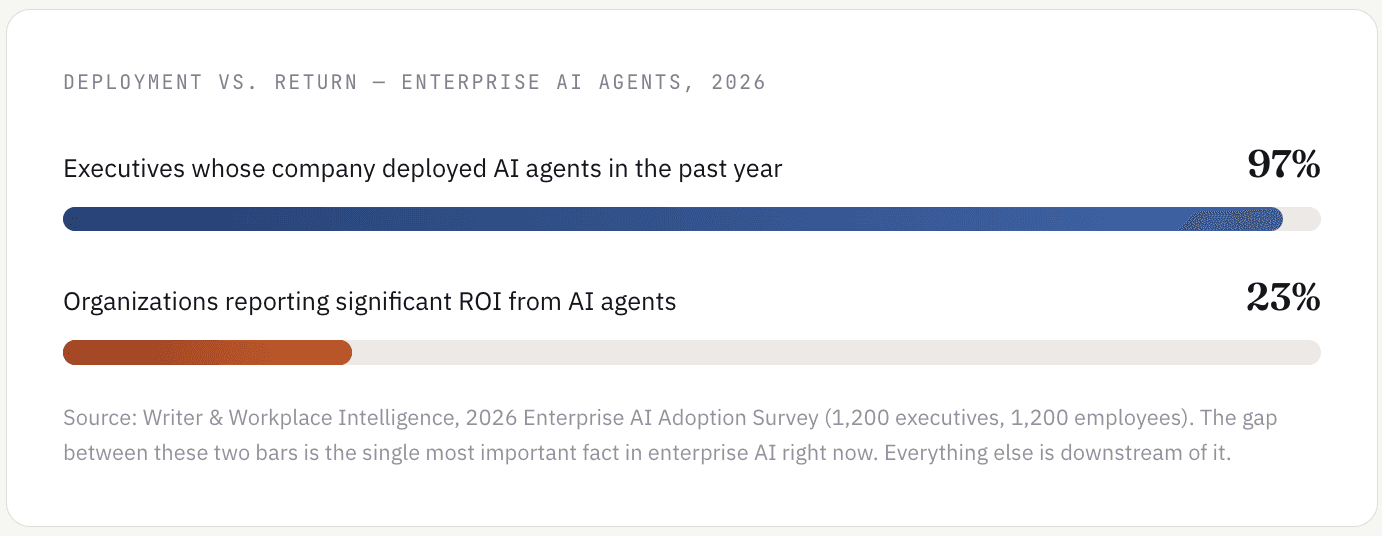
So what's actually broken?
Not the models. The operating model.
Most companies are still running agentic AI through org charts, approval chains, and job descriptions built for a world where software only assisted...never decided. You can't bolt a decision-making agent onto a workflow designed for a tool that just helps.
“Generative AI failure modes are visible and fairly easy to catch with a human reviewing the output. Agentic AI is a different animal, it plans, acts, and can fail on its own, several steps before anyone notices — Craig Le Clair, Forrester Analyst (Paraphrased)
We'd go one step further, based on what we've seen across our own engagements, payroll lending platforms, visa-processing voice systems, underwriting automation: the bottleneck is almost never the agent's capability. It's the absence of a validation layer that lets leadership trust the agent's output enough to act on it at scale.
"In the Loop" is a Checkpoint. "On the Loop" is a Redesign.
The industry has settled on two terms for this, and the distinction is worth sitting with, because it reframes what leaders should actually be building toward:
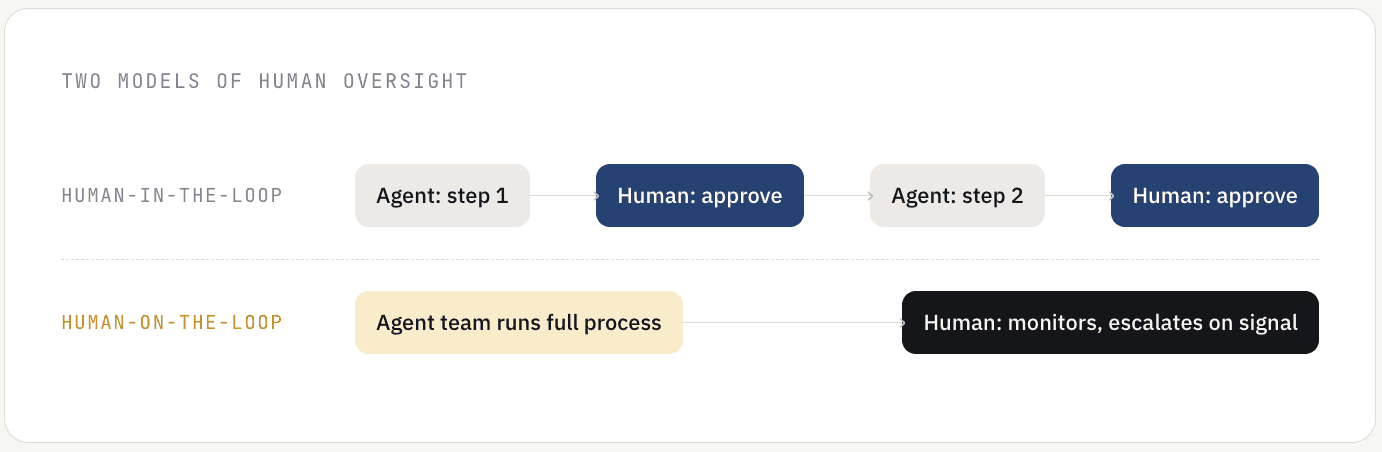
Here's the uncomfortable part: even the "in the loop" model, done badly, isn't the safety net people assume. A 2025 review of algorithmic governance practices found that human reviewers sitting formally "in the loop" caught the right call only about half the time; not because they were careless, but because presence without training, clear escalation triggers, or defensible criteria isn't the same thing as oversight.
The reshaping is Real and it's NOT 'The Story' most people are telling
The workforce conversation has gotten stuck on headcount. That's the wrong scoreboard. The real story is skills turnover, and it's moving faster than most org-design cycles can absorb.
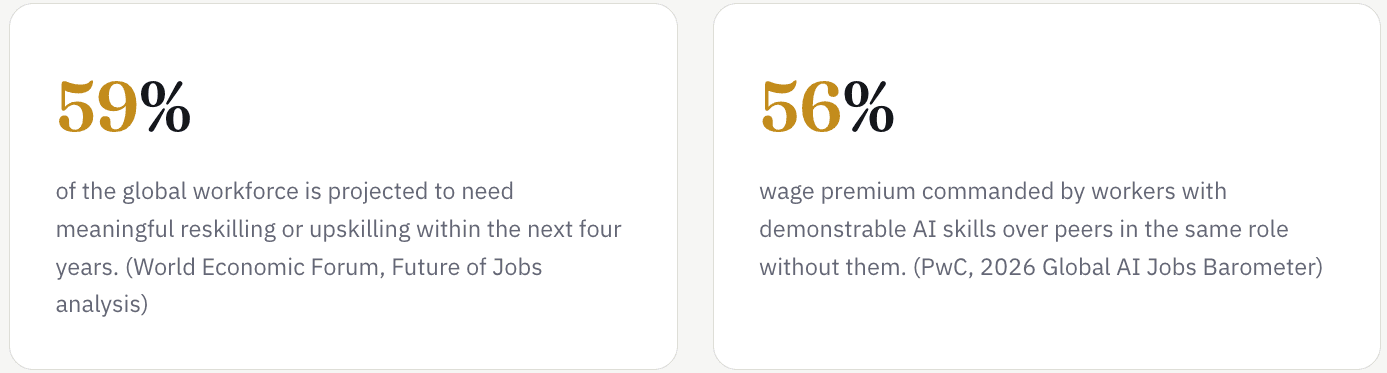
Net job creation is still expected to be positive, roughly 170 million new roles against 92 million displaced by 2030, a net gain, per the World Economic Forum. But "net positive" hides the real management problem: the people losing roles are rarely the same people qualified to fill the new ones. That gap is a re-skilling problem hiding inside a hiring statistic, and it lands on leadership, not HR alone.
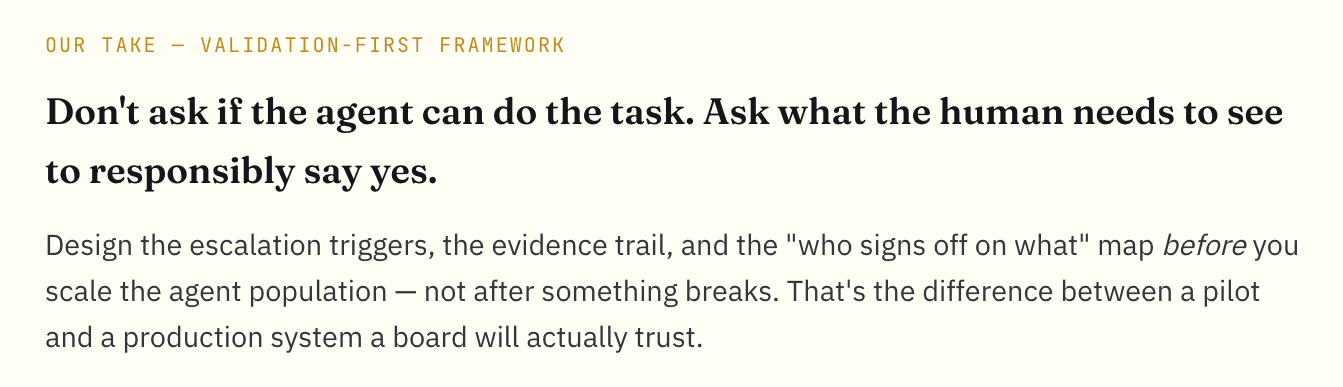
The highest-leverage move for a leader in 2026 isn't "which AI tool do I buy." It's "which of my team's judgment calls do I need to make explicit, teachable, and reviewable, so a human can supervise an agent doing that work at 10x scale?"
The Uncomfortable Part: Leaders have to CHANGE First
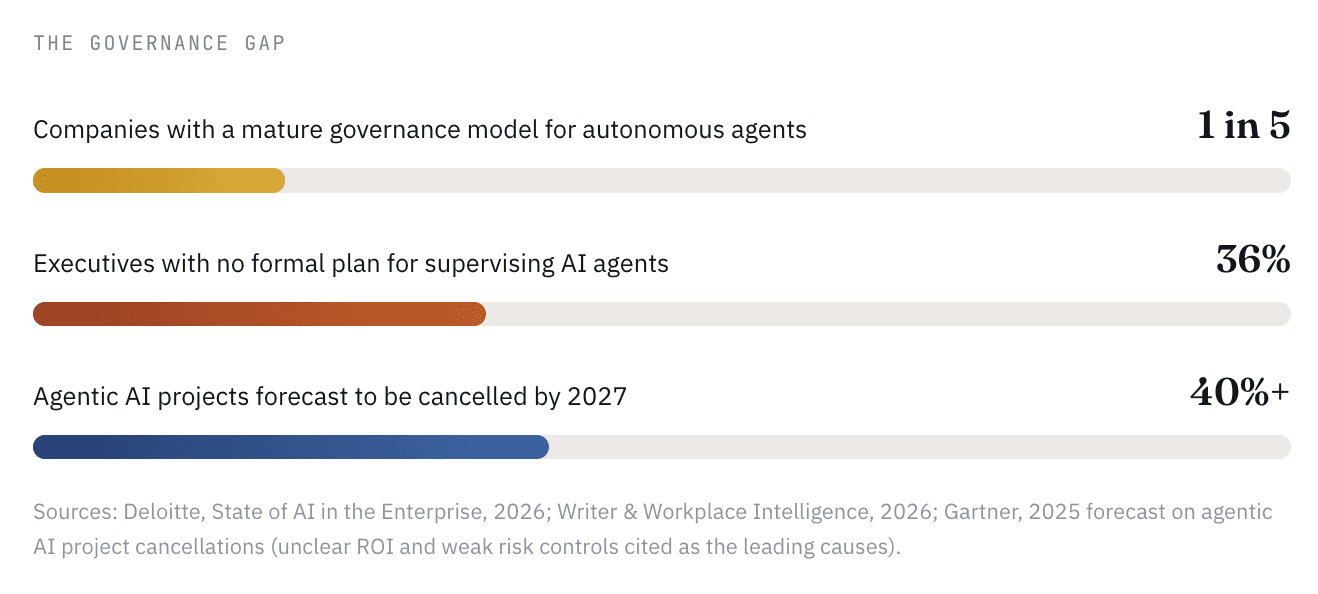
The clearest signal in the governance data isn't about technical maturity; it's about who owns the problem. Organizations where senior leadership actively shapes AI governance report significantly greater business value than those that delegate the work entirely to technical teams. Oversight that lives only in engineering never makes it into the boardroom conversation where the real trade-offs get decided.
We ask every client the same blunt question before we scope an engagement: Has your leadership team changed how it spends its own time because of AI or has it just added a chatbot to the existing routine? The answer tells me more about whether an agentic rollout will actually stick than any technical audit does.
Our Take
AI-everywhere and agentic-organization-nowhere isn't a paradox. It's a sequencing problem. Companies bought the capability before they redesigned the workflow, the governance, and the judgment layer that makes the capability trustworthy at scale.
The organizations that pull ahead in the next 24 months won't be the ones with the most agents deployed. They'll be the ones that made validation, oversight, and judgment (not deployment) the actual design center of their agentic architecture.
What's the real blocker in your organization right now → The Technology, or the Operating Model around it?
DATA SOURCES
MIT Project NANDA (2025)
Writer & Workplace Intelligence, 2026 Enterprise AI Adoption Survey
Deloitte, State of AI in the Enterprise (2026)
Gartner, agentic AI project forecasts (2025)
World Economic Forum, Future of Jobs analysis
PwC, 2026 Global AI Jobs Barometer
Forrester (Craig Le Clair)
#AgenticAI #EnterpriseAI #FutureOfWork #AIStrategy #ValidationFirst
Related Post


Everything AI
Sep 3, 2026

Enterprise AI
Aug 19, 2026