

There is a quiet category error running through almost every Digital Product Passport (DPP) conversation in boardrooms right now. Teams are asking "how do we generate the passport?" when the question that will actually matter in an audit is "will the data inside it hold up?"
The DPP is often framed as a labelling exercise → a QR code, a data carrier, a record to attach to a product. But underneath that interface sits something structural: a requirement that product information becomes traceable, verifiable, and continuously accessible across the entire lifecycle, from raw material to end-of-life. That is not a document. It is a live data obligation. And it lands on data estates that, for most enterprises, were never designed to carry it.
The Landscape 2026: The passport era has already begun
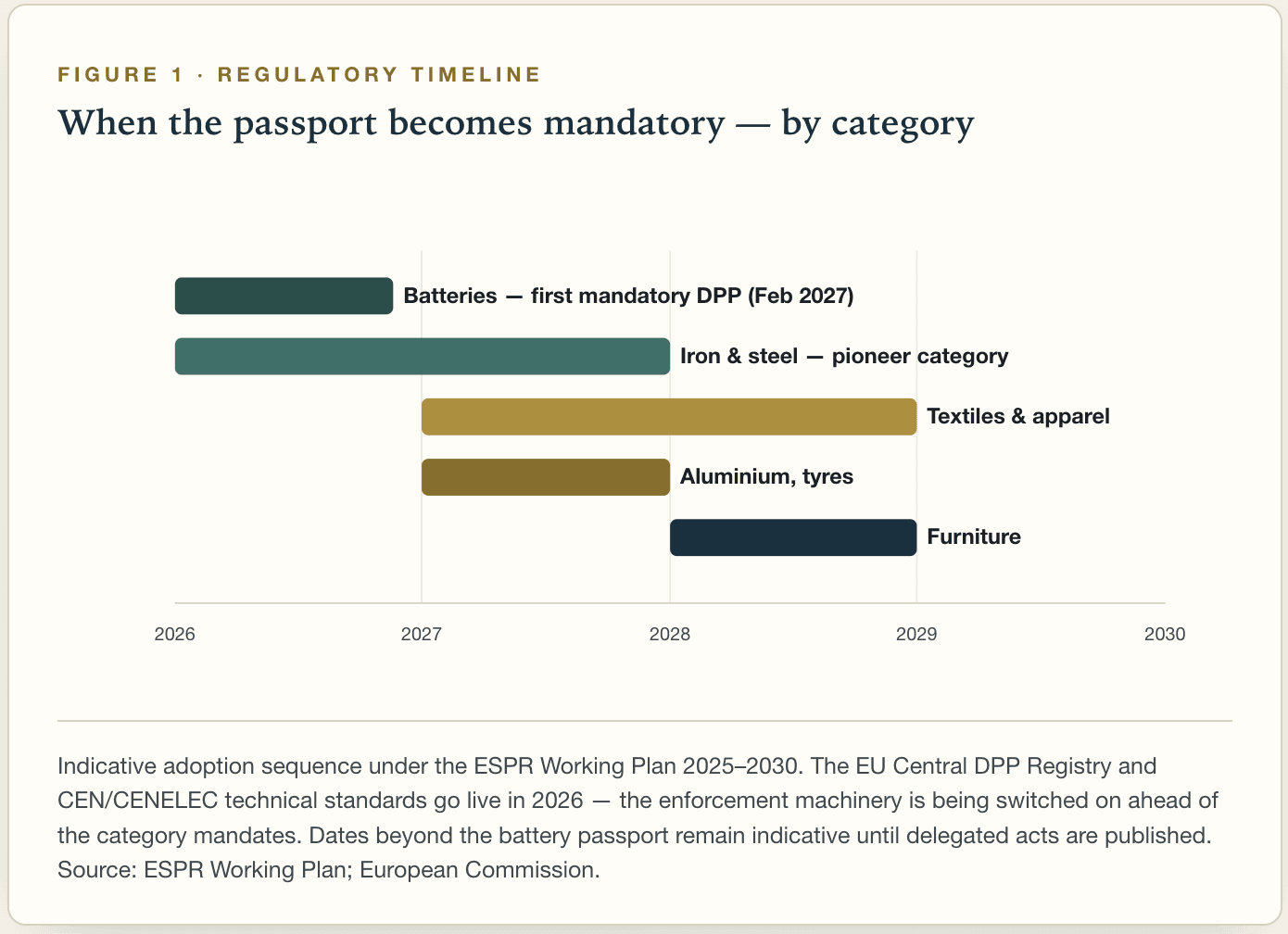
This is no longer a future-tense problem. Under the Ecodesign for Sustainable Products Regulation (ESPR), DPP requirements are phasing in by product category between 2026 and 2030, with batteries first to carry legally binding requirements, followed by iron and steel, textiles, aluminium, electronics, furniture and more. Once a delegated act is adopted for a category, businesses typically have just 18 months before enforcement begins, a window that, in practice, is far shorter than the time it takes to map a supply chain and align suppliers.

The Sharpener - CBAM: Why weak data just became a price?
If the DPP defines what must be disclosed, the Carbon Border Adjustment Mechanism (CBAM) attaches a price to getting it wrong. CBAM entered its definitive period on 1 January 2026. Importers of covered goods ie. cement, iron and steel, aluminium, fertilisers, electricity and hydrogen, must now surrender certificates against the embedded emissions of what they bring into the EU.
Here is the mechanism that should concentrate every operations leader's attention. To use actual emissions data, a supplier's figures must be verified by an accredited third party including an on-site audit in the first year and assessment against a strict 5% variance threshold. Where that verified data does not exist, importers must fall back on EU default values, set conservatively high and escalating with a punitive mark-up: +10% in 2026, +20% in 2027, and +30% from 2028 onward.
In other words: the absence of defensible data is not a neutral state. It is the most expensive state.
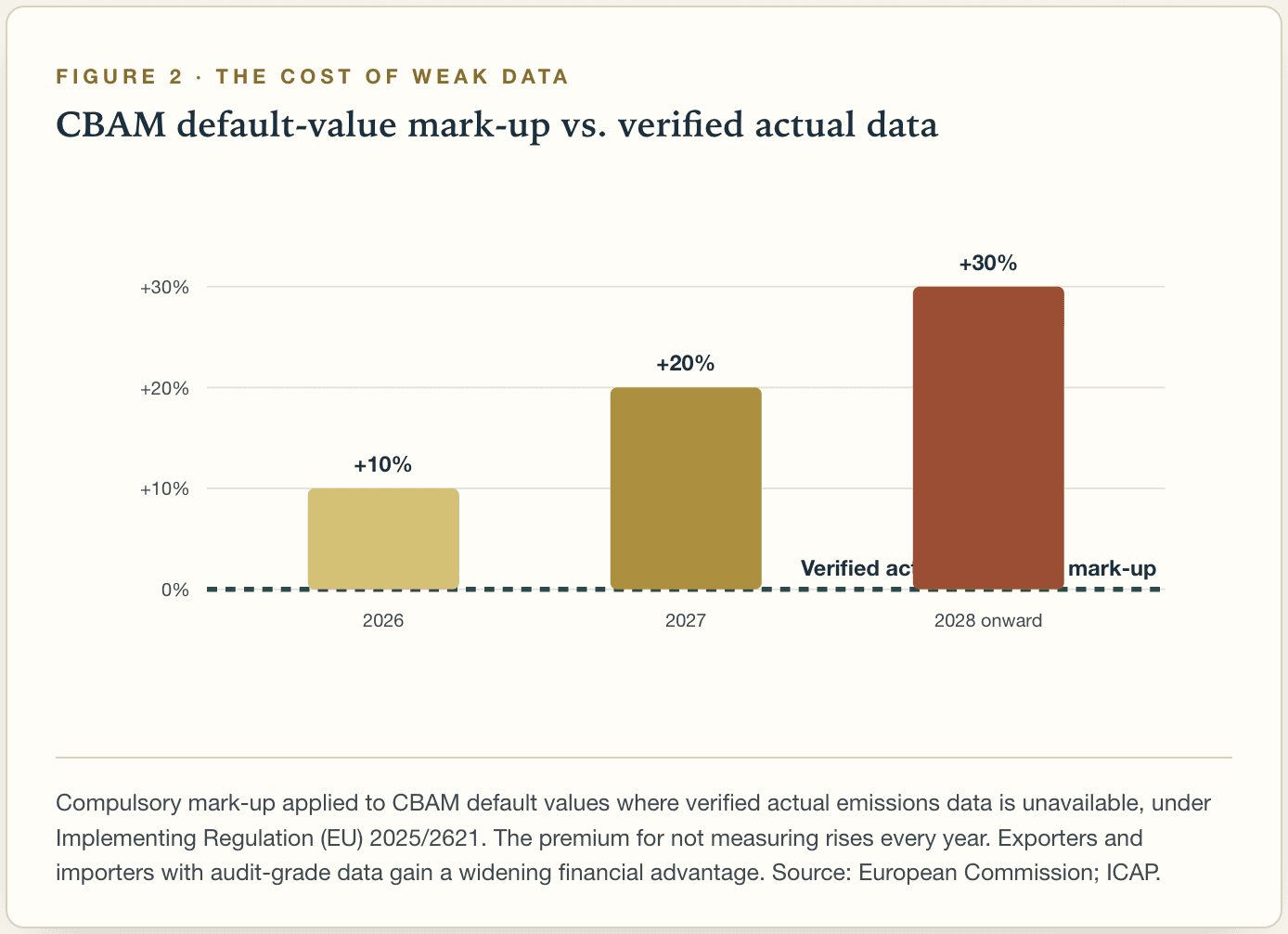
Figure 2 · The Cost of Weak Data
The Real Problem: A passport is only as trustworthy as the data behind it
Most DPP and emissions implementations today are fragile in the same predictable ways. Footprints are estimated rather than measured.
Material and emissions claims rest on supplier self-declarations that have never been independently verified.
Carbon figures are attached at high-level category averages instead of the component or batch level where regulators and auditors actually look.
That fragility is invisible right up until the moment it is tested. And the testing is now structural: the December 2025 CBAM package explicitly tightened reporting to reduce under-reporting in complex, multi-country supply chains, and the World Economic Forum has flagged that for many critical materials there is still limited visibility over where they originate and how they move. The data simply has not historically existed at the resolution the new regime demands.
This is, at root, the same problem enterprises face with AI adoption generally and it is worth naming the parallel. Organisations keep layering powerful capabilities on top of fragmented, disconnected systems, hoping the technology alone will create value.
Quality data sits in inspection systems; supply-chain data lives in spreadsheets; compliance records are stored somewhere else entirely. A passport generated on top of that patchwork inherits every crack in the foundation.
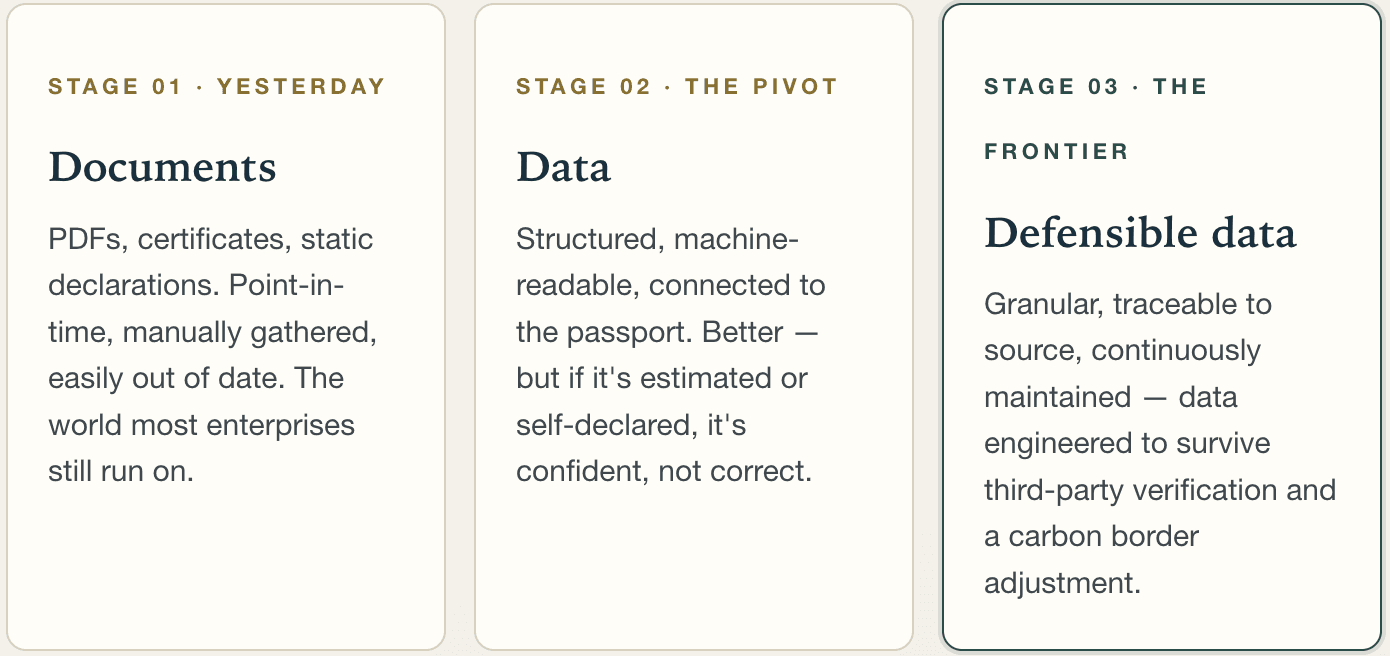
From documents, to data, to defensible data. Each step raises the bar and the regulatory regime has now moved to the third.
The Frontier: 3 stages of maturity
It helps to see the progression as three distinct levels of maturity. Most organisations are still operating at the first, scrambling toward the second, and have not yet recognised that compliance and competitive advantage, now live at the third.
What This Requires: From digital product passports to material passports
Defensible data is not something you buy as a static dataset. It has to be built at a resolution most implementations never reach.
A digital product passport describes the product; but the trust and the regulatory exposure lives one layer deeper, in the materials and components that make it up. This is where the distinction between a digital product passport and a material passport becomes decisive.
A material passport pushes traceability down to the component and batch level: granular records of embodied carbon, material origin and genealogy, recyclability, and end-of-life pathways, attached to the material itself rather than averaged across a product category. That granularity is precisely what separates a figure an auditor accepts from a figure that triggers a default value.
It is the difference between "we have a passport" and "our data can survive both regulatory scrutiny and a carbon border adjustment."
This is the layer we work at. EcoRatings.ai, our AI-ESG platform, is built to take organisations from product-level passports to material-level traceability by combining component-level embodied-carbon intelligence with full Life Cycle Assessment (LCA) and decarbonisation capabilities.
Rather than estimated footprints and supplier self-declarations, EcoRatings assembles material and emissions intelligence that is granular, traceable to source, and engineered to hold up under the verification regime CBAM and ESPR now demand.
The shift the market keeps celebrating "from documents to data" is real and necessary. But it is only the halfway point. Structured data that cannot withstand an audit is simply a better-formatted liability.
The frontier that actually determines exposure and market access is the move from data to defensible data, and that frontier runs through the material layer.
_______________
EcoRatings.ai, an AI-ESG platform delivering material-level traceability, embodied-carbon intelligence, Life Cycle Assessment, and decarbonisation. We help enterprises move from fragmented documents to defensible, audit-grade sustainability data.
Sources & further reading: European Commission, ESPR Working Plan 2025–2030 & Regulation (EU) 2024/1781 · CBAM definitive period and Implementing Regulations (EU) 2025/2621, 2025/2547 · International Carbon Action Partnership (ICAP) · World Economic Forum, materials traceability (2026) · industry analysis from Inriver, Circularise, OneClick LCA and Quality Magazine. Indicative dates beyond the battery passport remain subject to adoption of the relevant delegated acts. This article is for informational purposes and does not constitute legal or regulatory advice.