

Your ERP is a world-class system of record. It is not a system of action. A record can tell you an invoice exists; it cannot decide whether to pay it, and it will never pay it for you. That bridge between knowing and doing is still manual in most enterprises, even mature SAP S/4HANA estates.
The fastest, lowest-risk way to close that gap is not to replace the ERP. It is to run a governed agentic layer in parallel to it: autonomous agents that read and write back through standard connectors, reason over live enterprise data, execute within permission, and escalate exceptions to your team. You adopt it one module at a time, starting where manual effort hurts most and prove ROI in a scoped 4–8 week pilot before scaling.
This guide walks through the model, the governance spine, and a module-by-module playbook across Finance, Procurement, Supply Chain, Sales, HR, Master Data and ESG.
The Problem: The Gap your ERP was NEVER BUILT to Close
Enterprise Resource Planning software solved a real problem: a single, reliable source of truth for structured transactions. What it never solved is the cross-functional work that happens between transactions — the reconciling, matching, forecasting and orchestration that still runs on people and spreadsheets.
Consider a familiar sequence. SAP posts an invoice. The invoice fails a 3-way match because the price sits outside tolerance. From there, the record simply waits. A human in Finance eventually notices, pulls the purchase order and goods receipt, checks the contract for a negotiated rebate, decides whether the variance is acceptable, and either clears it or routes it to a buyer. The ERP held every fact needed to resolve the exception but it could not reason across those facts or act on them. → That is the gap.
Three generations of tooling have tried to bridge it and fallen short:
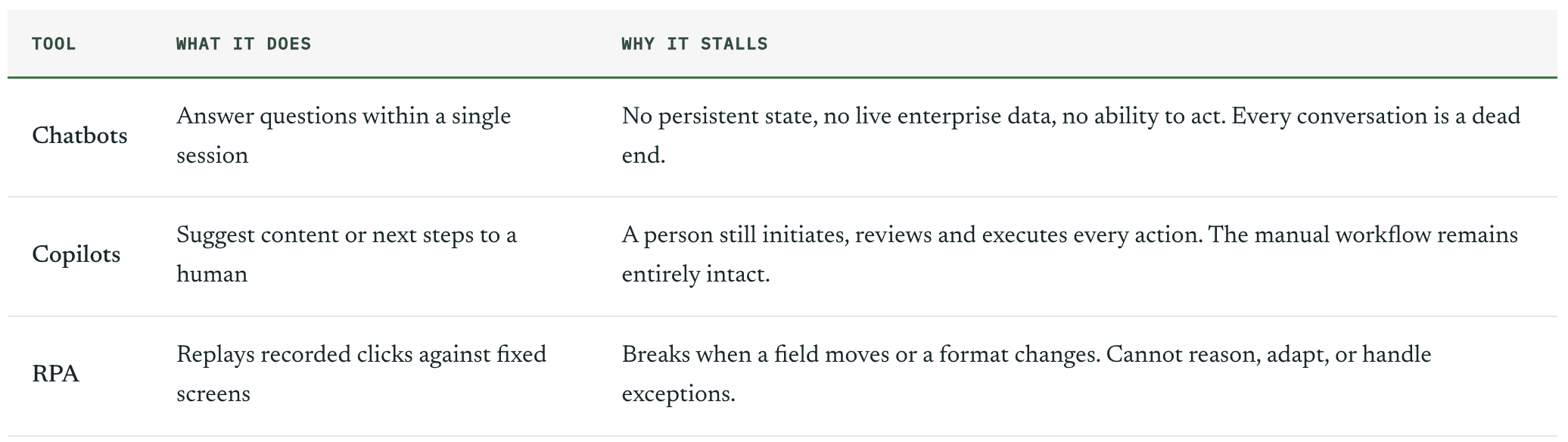
The cost of leaving the gap open is measurable, and it compounds quietly across the estate:

The MIT figure deserves a pause. The reason 95% of pilots stall is not model quality → It is the learning and integration gap: generic tools that do not retain context, do not adapt to a workflow, and never cross from suggesting into governed doing. The lesson from the 5% that succeed is consistent: they pick one high-value pain point, integrate deeply with the systems of record, and partner for delivery rather than buying a demo.

WHY NOW → 2026 is the Inflection Point AND the Window is Narrow
Agentic AI has crossed from novelty into board-level priority. The market data, the analyst forecasts, and the ERP vendors' own roadmaps now point in the same direction: autonomous, governed execution layered onto existing systems of record.
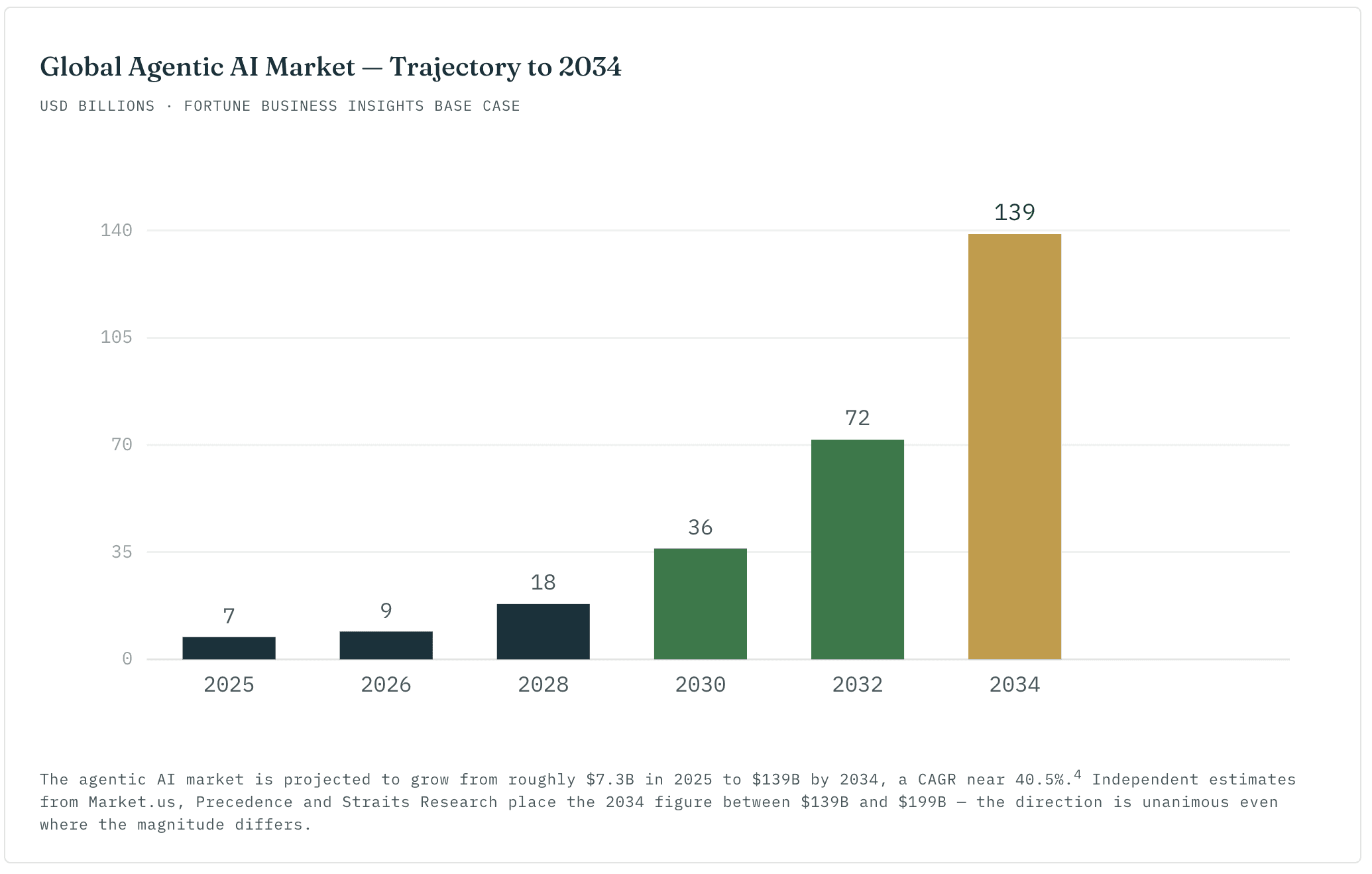
Three signals matter more than any single market number:
Gartner: by 2028, one-third (33%) of enterprise software applications will include agentic AI, up from less than 1% in 2024 and at least 15% of day-to-day work decisions will be made autonomously.5
Supply chain leads the verticals: agentic AI in supply chain and logistics is forecast to grow from $9.2B (2025) to $46B by 2035, with large enterprises already holding ~68.6% of spend and multi-agent architectures taking the majority share.6
The ERP vendors are moving too: SAP now ships 30+ specialized Joule agents and 2,400+ skills embedded across S/4HANA, Ariba and SuccessFactors.7 The direction of travel is settled; the open question is architecture and governance, not whether.
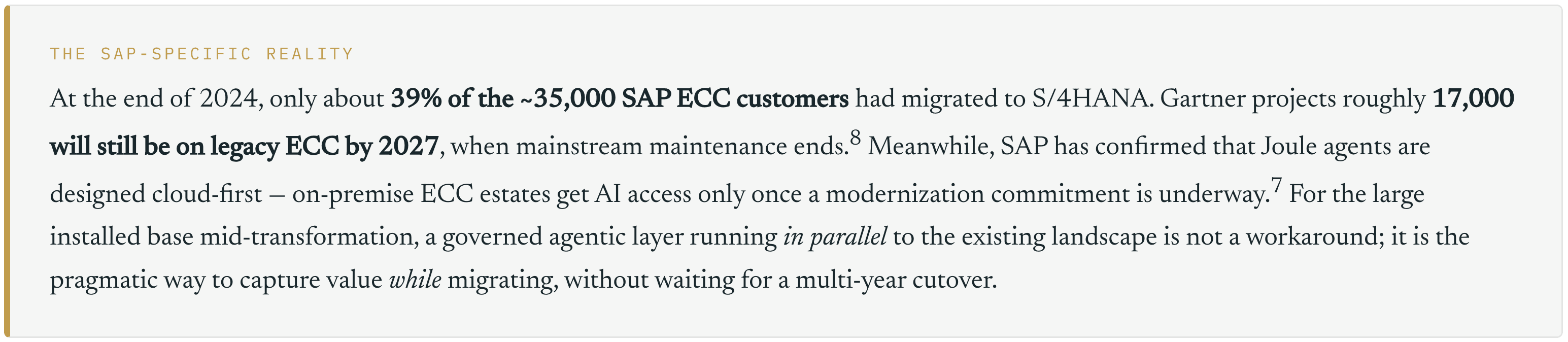
Gartner adds a sober counterweight worth stating plainly: it expects over 40% of agentic AI projects to be cancelled by the end of 2027, citing unclear business value and inadequate risk controls, and warns of widespread “agent washing.” That is not an argument against adoption. It is an argument for the exact discipline this guide describes → Scoped ROI, Deep integration, and Governance built in from day one.

THE ARCHITECTURE: 3-layer Model → Understand, then Act
Most agent platforms fail in production because they act on data they don't understand. The durable pattern separates understanding from action, and places governance precisely at the action layer, where risk actually lives.
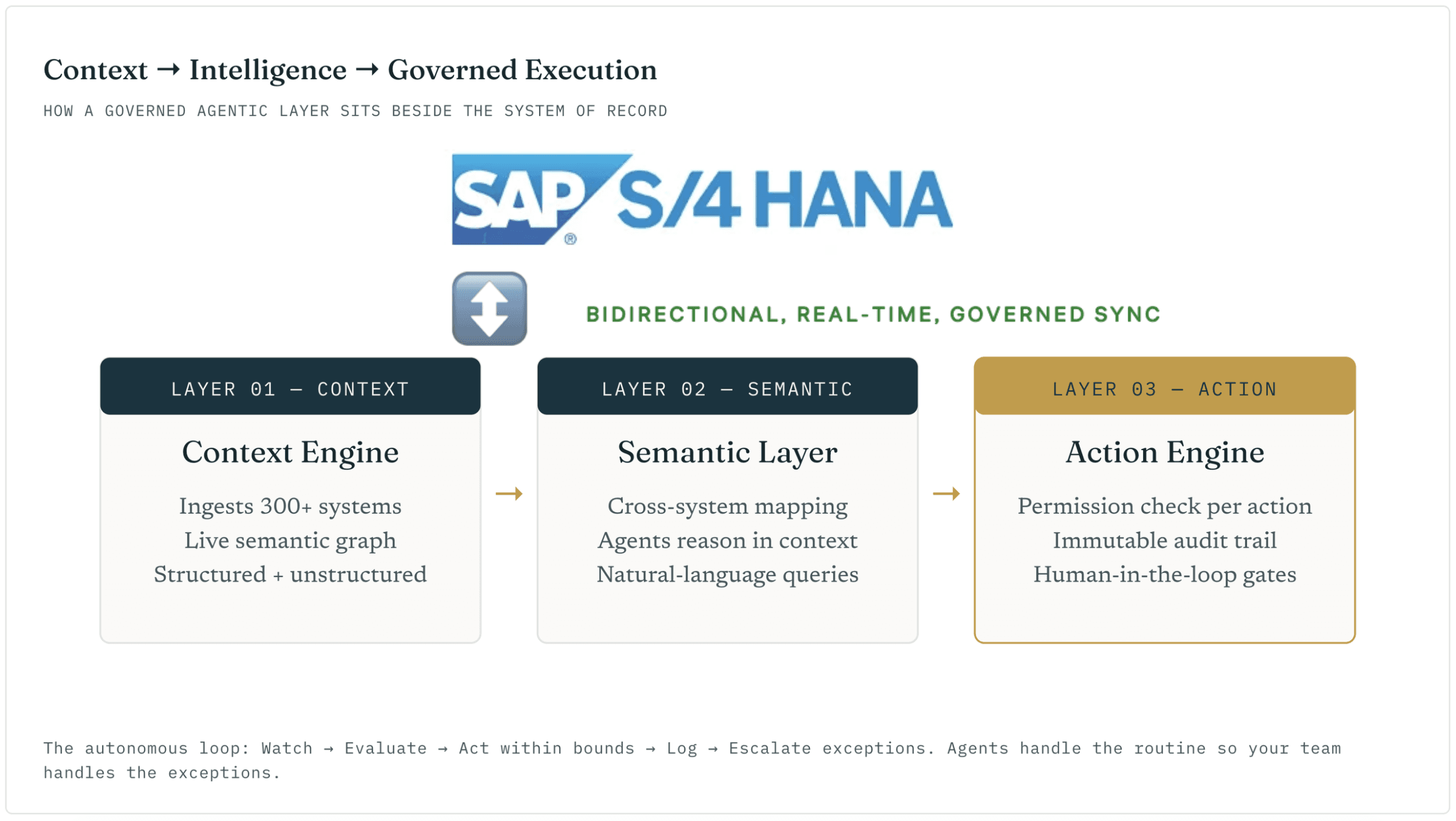
Layer 1 — The Context Engine
Agents are only as good as what they can see. The context engine ingests data continuously from the ERP and the systems around it (CRM, HRIS, ticketing, document repositories, supplier portals, market feeds) through pre-built connectors and standard SAP interfaces (IDoc, RFC, BAPI, OData). It maintains a live, continuously updated picture rather than a stale snapshot or a document fragment. This is the difference between an agent that reasons over your actual contract terms and one that hallucinates from training data.
Layer 2 — The Semantic Layer
Raw data is not understanding. The semantic layer maps relationships across that data i.e. vendors to contracts, deals to contacts, tickets to products, POs to goods receipts to invoices, so an agent reasons with the full operational picture. When the 3-way-match exception fires, the agent doesn't just see a number out of tolerance; it sees this vendor, under this contract, with this negotiated rebate clause, and this payment history.
Layer 3 — The Action Engine (where Governance lives)
This is where an agent stops advising and starts doing and therefore where every control belongs. The action engine executes multi-step workflows with a permission check on every action, writes an immutable audit entry for each step, routes high-risk actions through human approval gates, and can be halted instantly. Rules govern where you need certainty (tolerances, approval matrices); reasoning governs where you need judgment (ambiguous exceptions). The routing path itself is the explanation.
The Non-Negotiable
THE NON NEGOTIABLE: Governance at the Action Layer, not the Model
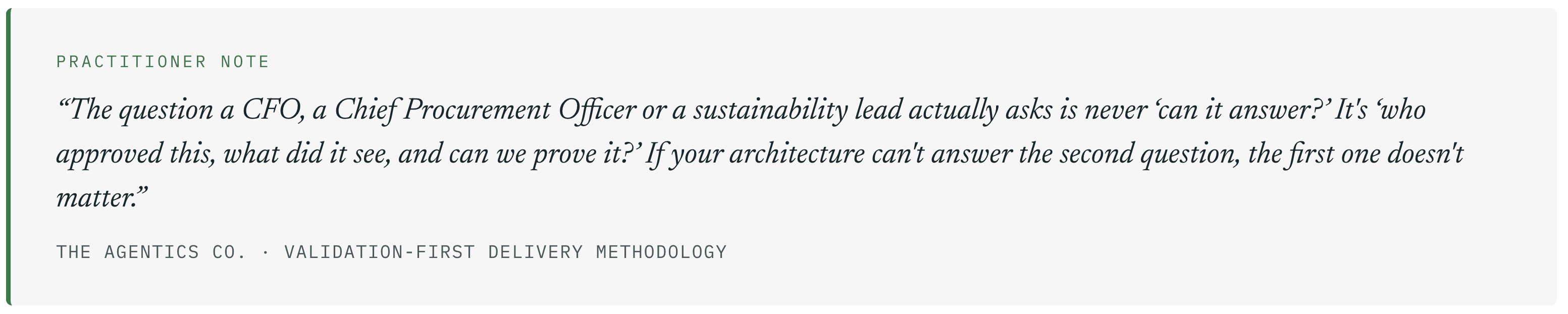
For any business touching money, master data or regulated reporting, governance is not a feature you add later. It is the precondition for deploying at all. Four control families make an agentic layer safe enough for production in a regulated enterprise.
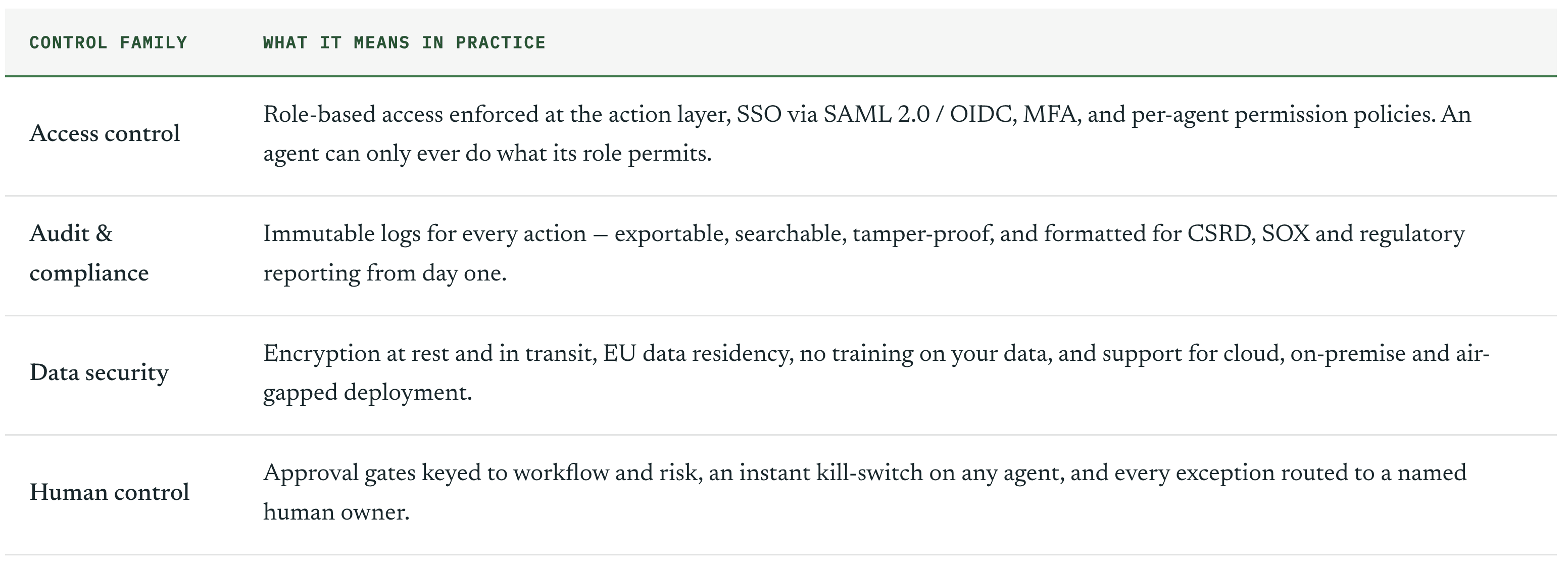
These map cleanly onto the emerging regulatory frame. An EU-headquartered enterprise reporting under CSRD and operating under the EU AI Act needs its automation designed for those regimes from the outset → Not a platform built elsewhere and retrofitted. Certifications that matter here: SOC 2 Type II, ISO 27001, GDPR- and HIPAA-readiness, and explicit EU AI Act alignment.
Module-by-Module Playbook: Where the Layer Pays Off
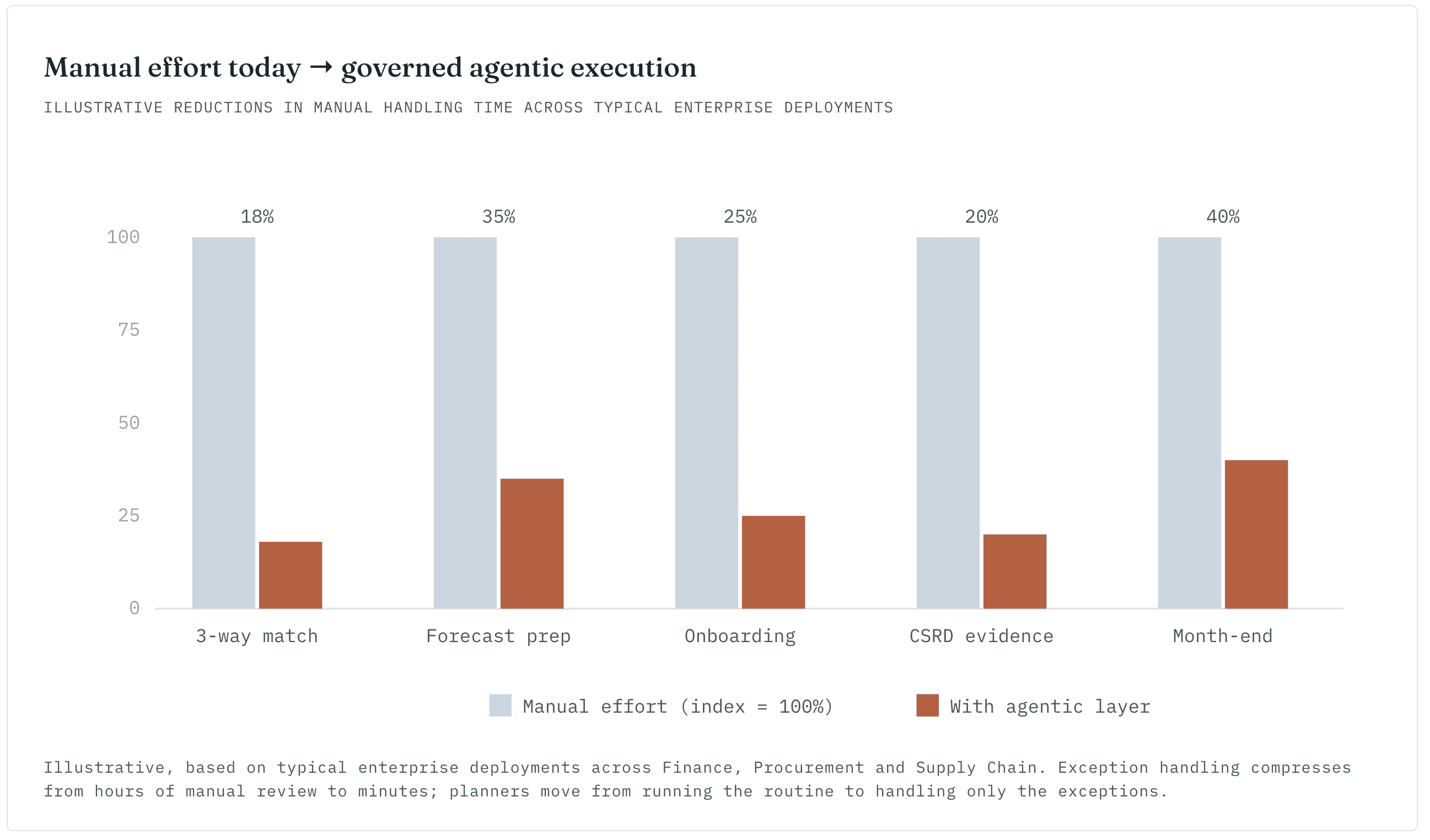
Adoption is not a big-bang platform decision. It is a sequence of scoped, governed layers → Each dropped beside one ERP module, each proving ROI before the next. Below, seven modules with the workflows, the SAP surface area, the metrics and the governance posture for each.

Finance is the most common and usually the best place to start, because the pain is quantifiable to the cent and the workflow is well-bounded. The flagship use case is 3-way invoice matching and exception handling: an agent watches for invoices that fail the PO/goods-receipt/invoice match, pulls the full context from the semantic graph, reasons about whether the variance is legitimate, and either auto-clears within policy or routes to a buyer with the evidence already attached.
Core Agentic Workflows
Touchless invoice capture, coding and 3-way matching, with exceptions triaged rather than dumped in a queue
Approval routing against the correct authority matrix, with the audit entry written as the action happens
Payment-run preparation, duplicate detection and early-payment-discount capture
Month-end and period-close controls: reconciliations, accruals evidence, and variance narratives drafted for review

SAP Surface Area
→ Systems: SAP FI/CO, SAP MM, and any AP automation or e-invoicing feed
→ Interfaces: OData / BAPI for posting; document AI for unstructured invoice PDFs
→ Governance: Human approval gate on any variance beyond tolerance; every clear/route logged immutably


Procurement is where multi-agent orchestration earns its name. Rather than one monolithic model, a team of specialised agents divides the work across supplier evaluation, contract-compliance checking, spend classification, PO automation, and coordinates through the shared semantic layer. This mirrors where the market itself is heading: multi-agent systems already hold the majority architecture share in supply-chain and procurement deployments.
Core Agentic Workflows
Autonomous three-way matching and exception routing, running as a continuous background process
Spend classification and tail-spend analysis against live category data
Contract-compliance checks: flagging off-contract buying and price deviations before they post
Supplier risk monitoring with predictive alerts, drawing on external data feeds alongside SAP records

SAP surface area
→ Systems: SAP MM, SAP Ariba or Coupa, supplier portals (EDI), external risk data
→ Pattern: Multi-agent team with a coordinator agent orchestrating specialists
→ Governance: Auto-route within policy; human gate on new-supplier onboarding and contract exceptions


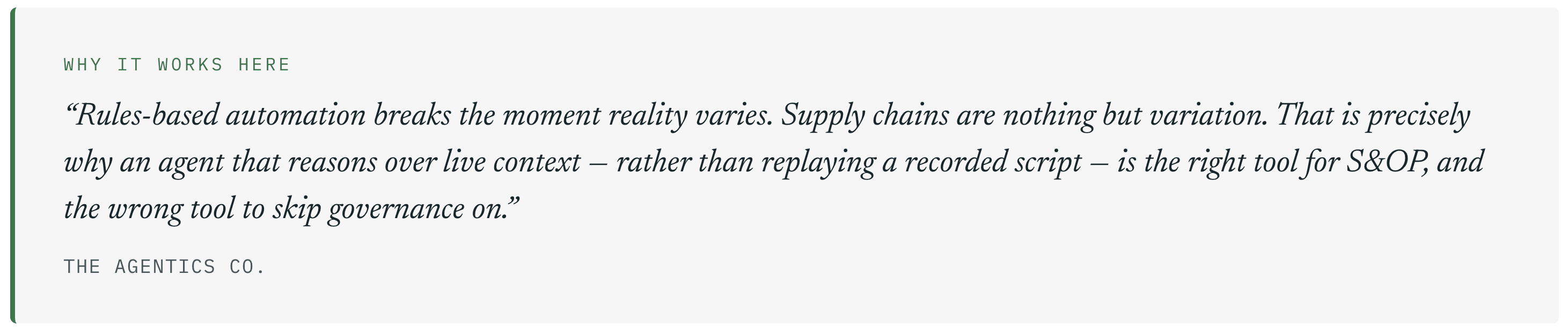
Supply chain is the single largest agentic-AI vertical, and for good reason: the work is inherently cross-functional, exception-heavy, and time-sensitive, exactly what static workflow engines handle badly. Autonomous agents monitor demand signals across regions, adjust forecasts in real time, and trigger production-planning adjustments by interfacing directly with SAP S/4HANA PP and MM.

Core Agentic Workflows
Demand forecasting & S&OP: Agents reconcile signals across systems (the reconciliation that planners still do in spreadsheets each cycle) and surface a single adjusted forecast with its reasoning attached
Supply chain orchestration: End-to-end visibility connecting inbound logistics, inventory, production scheduling and outbound distribution, with exception alerts routed to your team
Inventory optimization: Continuous rebalancing against live demand, lead-time and commodity signals
Disruption response: Event-driven agents that detect a delay or shortage and propose a re-plan before a human notices
SAP Surface Area
→ Systems: SAP PP, SAP IBP, SAP LE, SAP WM — plus carrier/logistics APIs and weather/commodity feeds
→ Mode: Event-driven and schedule-based background agents
→ Governance: Agents act within planning bounds; re-plans above a threshold escalate to the planner

Sales agents add the most value where the CRM and the ERP need to agree — pricing, availability, credit, order status. Grounded in live CRM and SAP SD data, agents handle pipeline scoring, deal intelligence, account enrichment and automated follow-ups without the hallucination risk of models working from stale snapshots.
Core Agentic Workflows
Pipeline scoring and deal intelligence grounded in live order, delivery and payment history
Account enrichment and next-best-action, reconciled against actual account health in SAP
Quote and order support that respects real-time pricing, credit limits and available-to-promise
Automated, context-aware follow-ups — drafted for a rep, or sent within guardrails

SAP Surface Area
→ Systems: SAP SD, Salesforce or HubSpot, marketing and product data
→ Governance: Outbound messages either drafted-for-human or sent within explicit content and rate guardrails

HR and internal operations are full of cross-system handoffs that agents are well-suited to close: onboarding that touches HRIS, IT, facilities and payroll; ticket triage that spans multiple tools; access provisioning that has to stay compliant. The goal is employee issues resolved before anyone opens a ticket.
Core Agentic Workflows
Onboarding orchestration across SuccessFactors, IT provisioning and facilities
Ticket triage and resolution for common employee requests, with escalation for the rest
Cross-system access provisioning that respects role-based policy and leaves an audit trail
Policy and benefits Q&A grounded in current, approved HR documents

SAP Surface Area
→ Systems: SAP SuccessFactors, ITSM (ServiceNow / Jira), identity and access management
→ Governance: Access provisioning gated to role policy; sensitive changes routed for human approval

Master data is the least glamorous module and quietly the most important. Every agent in every other module amplifies whatever data it is given — and poor master data produces poor agent decisions. As SAP's own guidance puts it, data quality is a prerequisite for agent deployment, not a by-product of it. Material and vendor master hygiene is therefore both a use case in its own right and the foundation the others stand on.
Core Agentic Workflows
Material and vendor master hygiene: duplicate detection, enrichment, and standardisation
Continuous validation of new master-data records against policy at point of creation
Cross-system reconciliation where the same entity lives in SAP, CRM and supplier portals
Enrichment from trusted external sources, with provenance recorded
SAP Surface Area
→ Systems: SAP MDG, plus every system that holds a copy of the same entity
→ Governance: Enrichment and merges proposed by the agent, confirmed by a data steward for high-impact records

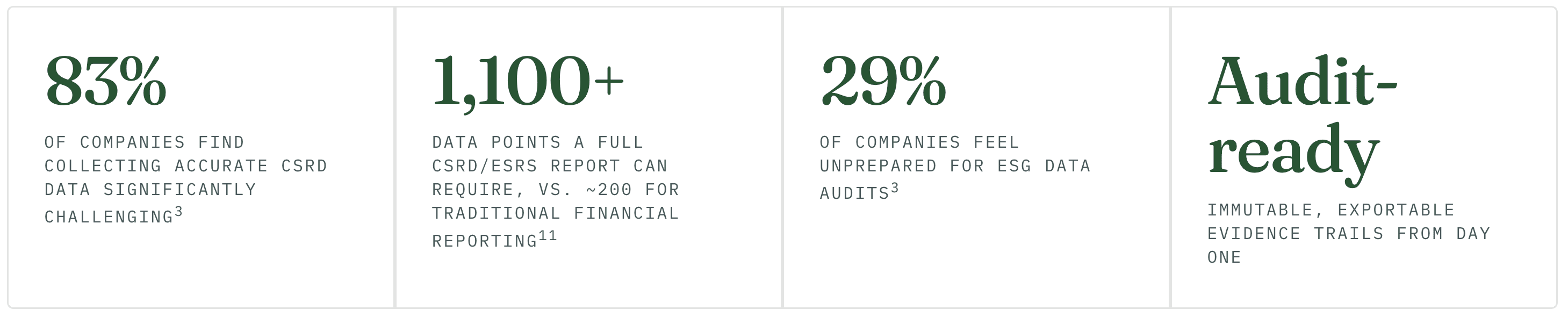
ESG reporting is where the manual burden is heaviest and the audit stakes are highest → A natural fit for governed agents, and a distinct advantage for EU-native platforms designed for these regimes from day one. CSRD reporting under the ESRS requires disclosure across a scope of data points far larger than traditional financial reporting, and the data is scattered across systems, subsidiaries and suppliers.
Core Agentic Workflows
CSRD / ESRS evidence collection and aggregation across SAP and external systems, with source provenance on every data point
Life-cycle-assessment (LCA) data collection from suppliers, replacing manual chase-and-collect cycles
Automated supplier risk monitoring with predictive alerts
Audit-ready reporting: regulatory gap detection, and evidence assembled to survive limited assurance
SAP Surface Area
→ Systems: SAP plus external regulatory, supplier and LCA data sources
→ Governance: Every reported figure traceable to source; human sign-off on the assured disclosure
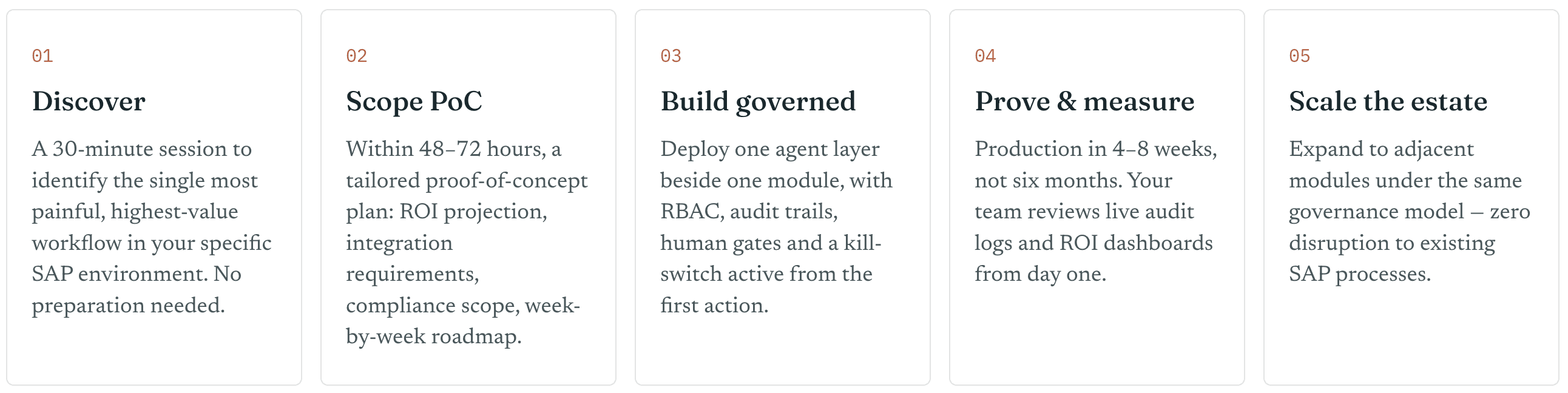
Agentic AI x ERP: The Adoption Roadmap; The Pilot is the Proof
The enterprises that succeed with agentic AI (the 5% in the MIT data) do the same three things: they scope tightly, integrate deeply, and prove value before they scale. Here is that discipline as a sequence.
What good scoping looks like?
Pick one workflow where the pain is measurable to the cent. 3-way match, demand-forecast reconciliation, or CSRD evidence collection are proven starting points.
Integrate with the system of record, not around it. The 95% that fail typically bolt a generic tool onto the side. The 5% that win write back into SAP through standard interfaces and reason over live data.
Instrument governance before you instrument the agent. Decide the approval gates, the audit format and the kill-switch owner first. This is what lets compliance say yes.
Define ROI as a P&L number, not a demo metric. Late-payment penalties avoided, cycle-time reduced, touchless rate lifted.
Only then, scale. Each new module inherits the same governance spine, so expansion is additive, not a fresh risk assessment each time.

Frequently Asked Questions
What is agentic AI on top of an ERP?
It is a governed layer of autonomous software agents that reads from and writes back to your ERP — such as SAP S/4HANA — through standard connectors. Unlike a copilot that only suggests, an agent reasons over live enterprise data and executes multi-step workflows within permission boundaries, escalating exceptions to humans. It runs in parallel to the system of record, so no rip-and-replace is required.
Do I need to replace my ERP to adopt agentic AI?
No. The recommended pattern is to layer an agentic tier beside the ERP, connected bidirectionally through standard interfaces (IDoc, RFC, BAPI, OData) and pre-built connectors. Start with one high-value module, prove ROI in a scoped pilot, then expand across the estate with zero disruption to existing ERP processes. This is especially relevant for the large SAP installed base still mid-migration from ECC to S/4HANA.
Which ERP module should I start with?
Start where manual effort and financial leakage are highest and the workflow is well-bounded, for most enterprises, Finance & Procurement, specifically 3-way invoice matching and exception handling, because the ROI is immediate, measurable and auditable. Supply Chain (demand forecasting, S&OP) and ESG/CSRD evidence collection are common fast-follows.
How is agentic AI governed in a regulated enterprise?
Governance sits at the action layer, not the model. The core controls are role-based access control enforced per action, immutable and exportable audit trails, human-in-the-loop approval gates on high-risk actions, and an instant kill-switch on every agent. This lets a business touching money, master data and regulated ESG reporting answer not just what the agent did, but who approved it, what it saw, and whether it can be proven.
How long does deployment of Agentic AI layer in an ERP take?
A scoped proof of value on a single workflow typically runs 4 to 8 weeks from discovery to production, versus the multi-month timelines of a full ERP transformation. ROI projections are available within days of discovery, and live audit dashboards are available from day one of the build.
How does this relate to SAP's own Joule agents?
They are complementary. SAP's Joule agents run cloud-first and cover standard, in-suite processes well. A parallel agentic layer adds value where you need to (a) reason across SAP and non-SAP systems, (b) run on-premise, hybrid or air-gapped estates, (c) deploy organisation-specific workflows that native agents don't cover, or (d) capture value while a migration is still underway. Many enterprises run both.
Isn't there a high risk these projects fail?
There is — if they're run badly. Gartner projects 40%+ of agentic projects will be cancelled by 2027, and MIT found 95% of GenAI pilots delivered no P&L impact. In every case the cause was breadth over depth, weak integration, or missing governance. The scoped, governed, integration-first approach in this guide is designed specifically to avoid those failure modes.

References, sources & further reading
Ardent Partners, State of ePayables 2025, via Parseur and Stealth Agents AP-automation benchmarks (2025–2026): average manual invoice cost $10.89 vs. best-in-class $2.78; cycle time 10.9 vs. 3.1 days; ~25% all-buyer straight-through rate.
MIT Media Lab, Project NANDA, The GenAI Divide: State of AI in Business 2025 (July 2025): 95% of enterprise GenAI pilots delivered no measurable P&L impact; only 5% created significant value.
GRC 20/20 Research and Council Fire analysis of EU CSRD readiness (2025–2026): 83% of companies find collecting accurate CSRD data significantly challenging; 29% feel unprepared for ESG data audits.
Fortune Business Insights, Agentic AI Market (2026): global market projected from ~$7.29B (2025) to $139.19B by 2034 at 40.5% CAGR. Corroborating estimates: Market.us, Precedence Research, Straits Research.
Gartner press releases (2025): 33% of enterprise software applications to include agentic AI by 2028 (from <1% in 2024); at least 15% of daily work decisions made autonomously by 2028.
Evolvance Market Research, Agentic AI in Supply Chain & Logistics Market (2026): $9.2B (2025) to $46.15B by 2035 at 17.5% CAGR; large enterprises 68.65% share; multi-agent systems 56.87% share.
SAP News Center, SAP Business AI Release Highlights Q1 2026; SAPinsider, SAP Sapphire 2026: 30+ Joule agents and 2,400+ Joule skills; cloud-first agent design with hybrid on-premise access tied to modernization.
Gartner via CIO.com (June 2025): ~39% of ~35,000 SAP ECC customers migrated to S/4HANA by end-2024; ~17,000 projected to remain on ECC by 2027 (mainstream maintenance ends 31 December 2027).
Gartner press release (June 2025): over 40% of agentic AI projects projected to be cancelled by end of 2027 due to unclear value and inadequate risk controls; caution on “agent washing.”
Invoice-automation ROI analyses (Artsyl, Datrose, 2025–2026): 60–90% reduction in per-invoice processing cost with AI-driven capture and matching.
GRC 20/20 Research (2025): CSRD/ESRS reporting can require 1,100+ data points vs. ~200 for traditional financial reporting.
Market-size figures vary by research provider and methodology; ranges are cited where sources differ. Metrics labelled “illustrative” reflect typical enterprise deployment patterns rather than guarantees, and outcomes depend on data quality, scope and governance maturity. This guide is informational and does not constitute legal, financial or regulatory advice; regulatory scope under CSRD and the EU AI Act continues to evolve following the 2025–2026 Omnibus simplification package.
© 2026 The Agentics Co.
The Agentics Co. ∞ · Enterprise Agentic AI
Hello@theagentics.co · Amsterdam, NL