Enterprise AI questions rarely arrive one at a time. An architecture decision creates a governance obligation. A governance obligation changes what you can deploy. What you deploy determines whether you can prove a return and whether you can prove a return determines if the programme survives its second budget cycle.
Most AI content treats these as separate subjects. In delivery they are one problem viewed from different chairs. The Blueprint is our attempt to publish them the way they actually connect: five tracks that each stand alone, cross-linked wherever the questions genuinely meet.
Everything here is free to read and citable with attribution. Agentics built these frameworks, developed through client work rather than desk research, and we publish them in full because a framework nobody can examine isn’t much of a framework.

START WITH THE QUESTION YOU’RE FACING
Not a linear roadmap. Pick the problem that’s actually in front of you.
1) “We’re choosing how to structure our agents.”
Patterns, when each works, and when adding agents makes things worse.
Click here >> Architecture, Part One
2) “Our pilot works but won’t scale.”
The six failure modes that stall pilots, and the constraints that fix each one.
Click Here >> Pilot-to-Production
3) “It’s live and the bill just arrived.”
The token multiplier, observability, and controls for production fleets.
Click Here >> Architecture, Part Two
4) “Compliance is blocking us.”
What the EU AI Act actually requires now, after the Digital Omnibus delay.
Click Here >> EU AI Act Field Guide
5) “We can’t prove any of this pays.”
Framing value, measuring it honestly, and compounding it across a portfolio.
Click Here >> Value Realisation Engine
6) “We’re just starting. What’s the landscape?”
Where enterprise agentic AI actually stands, without the vendor gloss.
Click Here >> Agentic AI Landscape 2026
01 Architecture & Engineering
Designing multi-agent systems that survive contact with real workloads → patterns, infrastructure, protocols and production operations.
Start here if you’re deciding how to structure agents, or if something you’ve already built is behaving badly at scale. The architecture series is the spine: Part One covers design, Part Two covers what happens after go-live.
The Multi-Agent Architecture Series
Part One · Whitepaper
How to Design: patterns, infrastructure and the governance gap. Why single agents break at scale, the five coordination patterns, agent-speed infrastructure, self-replication, and a nine-question architecture diagnostic. Read Part One
Part Two · Whitepaper
Deployment at Scale: volume, cost and incidents. The token multiplier, why most failures are structural rather than prompt-level, the observability baseline, five production controls and a deployment maturity ladder. Read Part Two
Further reading: The Enterprise MCP Guide 2026 · Self-Replicating AI Agents · From Agentic AI to Multi-Agent Systems · Multi-Agent Orchestration — Playbook for Dummies
02 Governance, Risk & Regulation
Making agents defensible: EU AI Act obligations, oversight design, agent identity, and the controls that let you scale rather than stall.
Governance designed in early is a scaling accelerator. Governance bolted on at review is the most common reason value-positive pilots never reach production.
Field Guide · Most current
AI Governance & the EU AI Act 2026. What the Digital Omnibus deferral changed, what still applies now, the penalty tiers, and an eight-pillar governance framework with a maturity checklist. Read the field guide
Further reading: Enterprise AI Adoption: The AI Governance Playbook · Your Agents Are Ready. Your Organization Isn’t. · Chief AI Officer to Chief AI Decision-Maker
03 Value Realisation & ROI
Getting from pilot to proven return: framing value before you build, measuring it honestly, and compounding it across a portfolio.
Adoption is solved; realisation isn’t. This track exists because roughly four in five enterprises report no measurable profit impact from AI despite widespread adoption, a gap that is structural rather than technological.
Framework · Flagship
The Enterprise AI Value Realisation Engine. Five gated stages i.e. Frame, Validate, Govern, Scale, Compound, running on three continuous spines: a Value Ledger, a Governance Layer and Validation Gates. Explore the framework
Further reading: The Enterprise AI Pilot-to-Production Playbook 2026 · The €7 Million Mistake Most Enterprises Are Making · The Enterprise Agentic AI Landscape 2026
04 Agentic Commerce & ERP
Where agents meet the transaction layer: Autonomous commerce, Pricing intelligence, Customer operations, and Agentic Intelligence alongside the ERP.
Commerce and ERP are where agentic systems touch money directly, which makes them the highest-stakes deployment surface in most enterprises and the one where governance and architecture decisions show up fastest on the P&L.
Explore the track: Agentic AI × ERP: Layer Intelligence Beside Your ERP · An Agentic AI Layer Inside the ERP for US Bundling Compliance · Building an Agentic AI-Powered eCommerce Ecosystem · Unlocking Agentic Commerce with Multi-Agent Systems · Competitor Price Intelligence & Dynamic Pricing · Agentic Multichannel Autonomous Customer Service
05 Industry Applications
What agentic systems look like in regulated and operationally complex sectors: Finance, supply chain, insurance, healthcare and ESG.
Patterns generalise; constraints don’t. These pieces show how the same architecture and governance principles land differently once a sector’s regulators, data and margins are in the room.
Explore the sectors: Agentic AI and the Finance Enterprise · Autonomous Supply Chain, Shipping & Logistics · Transforming Marine Insurance Through Multi-Agent Ecosystems · AI-Powered Clinical Intelligence for Medical Oncology · Ai-ESG: Empowering ESG with GenAI · Your Digital Product Passport Is Only as Trustworthy as the Data Behind It · Solving Unstructured Data with a Multi-Agent System
The Agentics - Enterprise AI Frameworks
Six proprietary frameworks, developed through client delivery and published in full. All are free to use and citable with attribution.
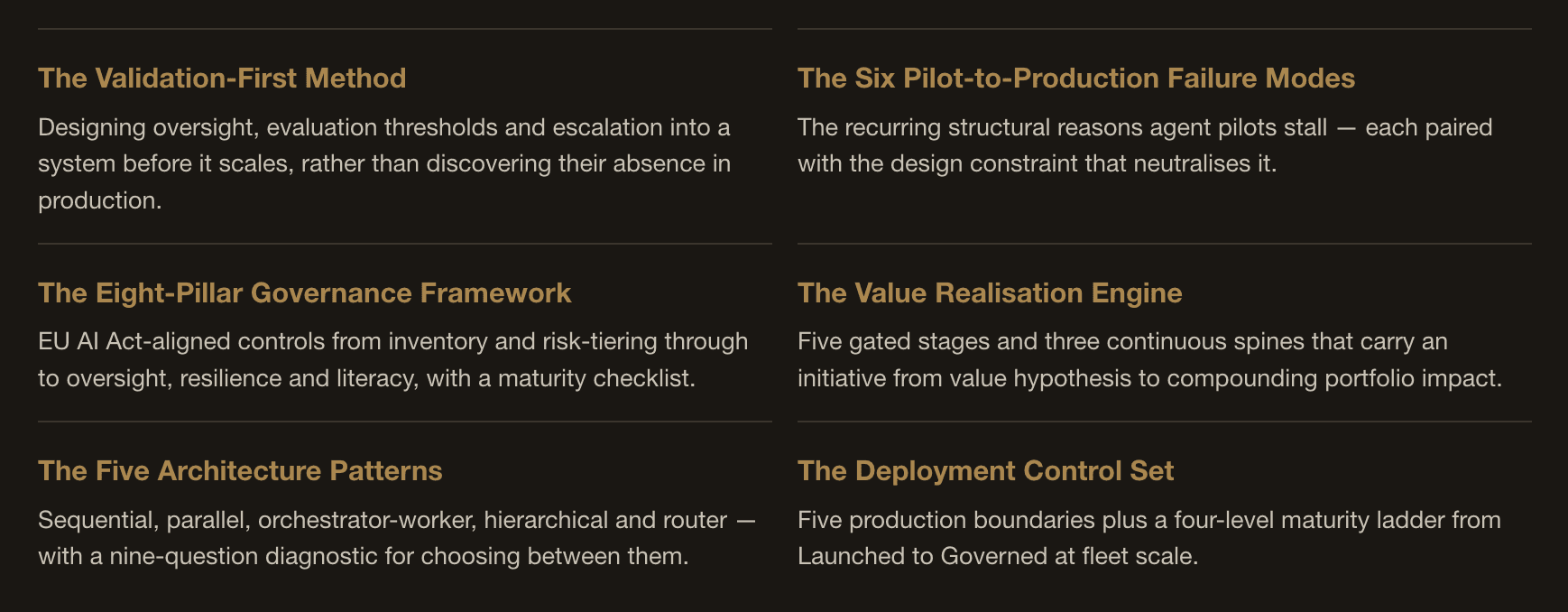
The Validation-First Method: designing oversight, evaluation thresholds and escalation into a system before it scales.
The Six Pilot-to-Production Failure Modes: recurring structural reasons agent pilots stall, each paired with the design constraint that neutralises it.
The Eight-Pillar Governance Framework: EU AI Act-aligned controls from inventory and risk-tiering through oversight, resilience and literacy.
The Value Realisation Engine: five gated stages and three continuous spines that carry an initiative from value hypothesis to compounding portfolio impact.
The Five Architecture Patterns: sequential, parallel, orchestrator-worker, hierarchical and router, with a nine-question diagnostic for choosing between them.
The Deployment Control Set: five production boundaries plus a four-level maturity ladder from Launched to Governed at fleet scale.
Put the Blueprint to Work
Enterprise AI Readiness Assessment
A structured review of where your organisation stands on data, governance, architecture and operating model before you commit budget. >> Explore the assessment